

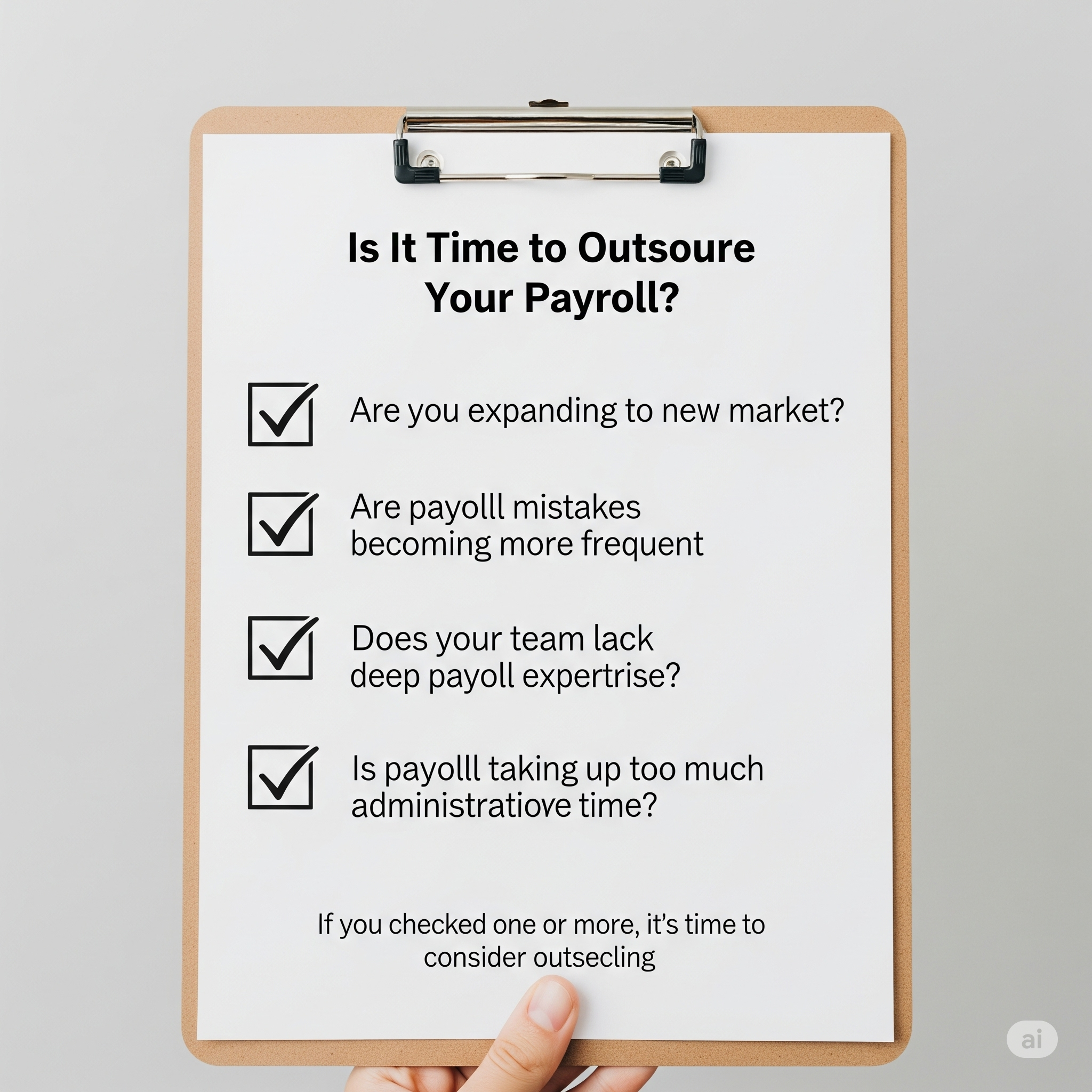

The strongest reasons to outsource payroll in 2026 are compliance load and penalty exposure. IRS failure-to-deposit penalties run from 2% to 15% of a late deposit, Form W-2 has new boxes for overtime and tips under the One Big Beautiful Bill Act, and a specialist team tracks these changes every pay cycle so your staff does not have to.
There is one limit every employer should understand before signing. Outsourcing moves the work, and the IRS still holds the employer responsible for the deposits and returns. This guide covers the nine reasons to outsource payroll that hold up against current IRS rules, then explains what you keep, how to supervise a provider, and when an in-house setup still makes sense.
Payroll used to be a fairly stable routine of gross-to-net calculations, deposits and quarterly returns. Three changes have raised the workload for the 2026 tax year.
First, the Social Security wage base moved again. IRS Publication 15 states that "The social security wage base limit is $184,500." Every payroll system has to stop the 6.2% Social Security withholding at that point for each employee, then keep withholding Medicare on all wages.
Second, the One Big Beautiful Bill Act (OBBBA) created new deductions for qualified overtime and qualified tips. Employees claim those deductions on their own returns, but employers have to report the figures. The 2026 Form W-2 instructions say "New box 12, code TT, will be used to report the total amount of qualified overtime compensation" and "New box 14b will be used to report the Treasury Tipped Occupation Code(s)."
Third, the penalty schedule for late deposits has not softened, and interest runs on top of it. The combination makes payroll a specialist task for most small and mid-size employers.
Late employment tax deposits are one of the most expensive payroll errors. The IRS failure-to-deposit penalty is tiered by how late the money arrives:
| Days late | Penalty rate | Penalty on a $20,000 deposit |
|---|---|---|
| 1 to 5 calendar days | 2% | $400 |
| 6 to 15 calendar days | 5% | $1,000 |
| More than 15 calendar days | 10% | $2,000 |
| More than 10 days after the first IRS notice, or on the day an immediate-payment notice arrives | 15% | $3,000 |
The tiers do not stack. In the IRS's words, "The penalty amounts don't add up," so a deposit 20 days late carries a 10% penalty in total. The IRS also says "We charge interest on penalties." A provider that runs deposits on a fixed calendar, with a second person checking each one, removes most of this risk.
Form 941 is due four times a year. Publication 15 lists the quarterly due dates as "April 30, July 31, October 31, and January 31." Add state withholding returns, state unemployment returns, Form 940 and the January W-2 deadline, and a small business can face dozens of filing dates a year. Our payroll compliance checklist for 2026 lays them out by month and quarter. An outsourced team works from that kind of calendar for every client, so a missed date is far less likely.
The OBBBA reporting rules are detailed. For overtime, the W-2 instructions define qualified overtime as pay required under section 7 of the Fair Labor Standards Act that exceeds the regular rate, and they give this example: "only the 'half' portion of 'time-and-a-half' compensation would be reported using code TT." An employee paid $30 an hour who works 10 overtime hours earns $450 of overtime pay, and only $150 of that goes in code TT.
For tips, code TP reports "the total amount of cash tips reported to the employer," and box 14b needs an occupation code. The instructions add: "If any tips were received in a nonqualifying occupation, then '000' must be input as one of the occupation code(s)." These amounts still carry income tax withholding and Social Security and Medicare tax. A payroll team that sets up the earnings codes correctly at the start of the year avoids a scramble in January.
High earners hit the $184,500 Social Security cap partway through the year, and the system must stop withholding the 6.2% at exactly that point. An employee earning $200,000 has $11,439 of employee Social Security tax for 2026, matched by $11,439 from the employer, while Medicare continues on the full $200,000. Errors here produce over-withholding that has to be refunded or under-withholding that the employer owes.
State rules add another layer once you hire remote staff. Withholding, unemployment insurance and local taxes differ by state, which our guide to multi-state payroll for small businesses covers in detail.
Most payroll errors come from small manual steps: a missed pay rate change, a benefit deduction set up wrong, or a worker paid as a contractor who should be on W-2. Our list of common payroll mistakes small businesses make shows how often these repeat. An outsourced process uses checklists, reconciliations between the payroll register and the general ledger, and a reviewer who did not prepare the run. Those controls catch errors before employees see them.
Withheld income tax and the employee share of Social Security and Medicare are trust fund taxes. If they go unpaid, the IRS can assess the Trust Fund Recovery Penalty against individuals. The IRS says the penalty "is equal to the unpaid balance of the trust fund tax," and willfulness only requires that a person knew or should have known about the unpaid tax and "intentionally disregarded the law or was plainly indifferent to its requirements." Our article on when unpaid payroll taxes become personal explains how assessments work. Reliable deposits are the best defense, which is one of the more practical reasons to outsource payroll.
Running payroll in-house means collecting hours, approving changes, calculating, depositing, filing and answering employee questions. For a small business, that often lands on an owner or office manager. Handing the cycle to a dedicated team frees that time for billing, collections and month-end close. To see how the numbers compare with a salaried hire, our guide to outsourced payroll cost per employee sets out typical pricing models.
When one person runs payroll and leaves, the knowledge of pay rates, benefit elections and deposit schedules often leaves too. An outsourced team documents each client's setup and keeps more than one person trained on it. That way payroll keeps running when someone is on leave or resigns.
Adding employees, a second state or a new pay type such as tipped wages changes the payroll setup. A provider that already handles those cases can add them without the employer building the process from scratch. CPA firms that serve many payroll clients can compare options in our guide, How to Choose a Payroll Provider for Your Firm's Clients in 2026.
Outsourcing changes who does the work, and the IRS still looks to the employer for the result. Publication 15 says: "Generally, as an employer, you're responsible to ensure that tax returns are filed and deposits and payments are made," and adds, "You remain responsible if the third party fails to perform any required action."
The IRS page on outsourcing payroll duties is direct about this: "The employer is ultimately responsible for the deposit and payment of federal tax liabilities." The same IRS list of people who can be held responsible for trust fund taxes includes "Payroll Service Providers (PSP) or responsible parties within a PSP," which means a provider's failure can lead to assessments against both the provider and the business owner.
Certified professional employer organizations (CPEOs) are the main exception. Publication 15 says "A CPEO is generally treated for employment tax purposes as the employer" of the individuals it pays under the contract, though it notes the customer may also be treated as an employer of certain covered employees. A standard payroll service or reporting agent does not carry that treatment. Our comparison of PEO vs in-house payroll explains the co-employment model in more depth.
The IRS gives three practical warnings for employers who outsource:
Beyond those steps, review the quarterly Form 941 before it is filed, reconcile annual W-2 totals to the four 941s, and ask how the provider handles OBBBA codes TT and TP. Our 30-point checklist for evaluating an outsourcing provider covers contract terms, data access and service levels.
Outsourcing is a poor fit for some employers. A business with two or three salaried employees in one state and no tips or overtime may find a simple payroll app enough, provided someone checks every deposit. A company with a full payroll department and strong internal controls may also gain little. The reasons to outsource payroll grow stronger as headcount, states, pay types and turnover increase, and as the owner's own time becomes more valuable.
For CPA firms, the question is often whether to run client payroll internally or with an outsourced back office. Our article on outsourcing payroll and 1099 services for accounting firms looks at that decision from the firm's side.
What are the main reasons to outsource payroll? The main reasons are on-time tax deposits, accurate quarterly and annual filings, correct handling of the 2026 wage base and the new W-2 overtime and tip codes, fewer calculation errors and time saved for owners and staff. Continuity when payroll staff leave is another common reason.
Does outsourcing payroll transfer IRS liability to the provider? Generally no. Publication 15 states that the employer remains responsible if a third party fails to perform a required action. A certified professional employer organization is the main exception, because it is generally treated as the employer for wages it pays.
How much is the IRS penalty for a late payroll tax deposit? The failure-to-deposit penalty is 2% for 1 to 5 days late, 5% for 6 to 15 days, 10% for more than 15 days and 15% if the amount is still unpaid more than 10 days after the first IRS notice or on the day an immediate-payment notice arrives. Interest is charged on penalties as well.
What is the Social Security wage base for 2026? It is $184,500. Social Security tax of 6.2% stops at that amount for each employee, while Medicare tax applies to all wages.
What changes on Form W-2 for overtime and tips? The 2026 Form W-2 uses box 12 code TT for qualified overtime compensation, box 12 code TP for cash tips reported to the employer and box 14b for Treasury Tipped Occupation Codes. Only the premium portion of overtime is reported in code TT.
Madras Accountancy supports US businesses and CPA firms with payroll processing support for all pay frequencies, including after-the-fact payroll, along with 1099 preparation, reconciliations and related bookkeeping, working within the client's own systems and review process. To talk through your payroll setup, contact our team.
The section 4960 excise tax is 21% of nonprofit pay over $1M. From 2026 it covers all employees. See the medical carve-outs, Form 4720 and a worked example.

The paid family and medical leave tax credit is permanent from 2026. See the 12.5% to 25% rates, the premium option, the 6-month rule and how Form 8994 works.
Opportunity zones become permanent in 2027 under the One Big Beautiful Bill. See the new deferral, rural bonus, and the 2026 handoff.