

Small businesses have five realistic ways to get taxes done: a CPA firm (often supported by an offshore team such as Madras Accountancy), TurboTax's business products, H&R Block's Block Advisors, TaxSlayer, or Bench's bookkeeping-plus-tax plan. DIY software suits simple returns; partnerships, S corporations and multi-state businesses usually need a professional.
For a lot of small business owners, tax season feels like exam week at school, except the grades are measured in dollars. You know you should have started revising months ago. You didn't. And now it's time.
You have plenty of options. Sifting through them while juggling payroll and customers is its own kind of punishment, so here are five realistic paths, from DIY software to a CPA backed by an offshore team. Descriptions are based on each provider's own website as of November 2026; features and prices change, so check before you buy.
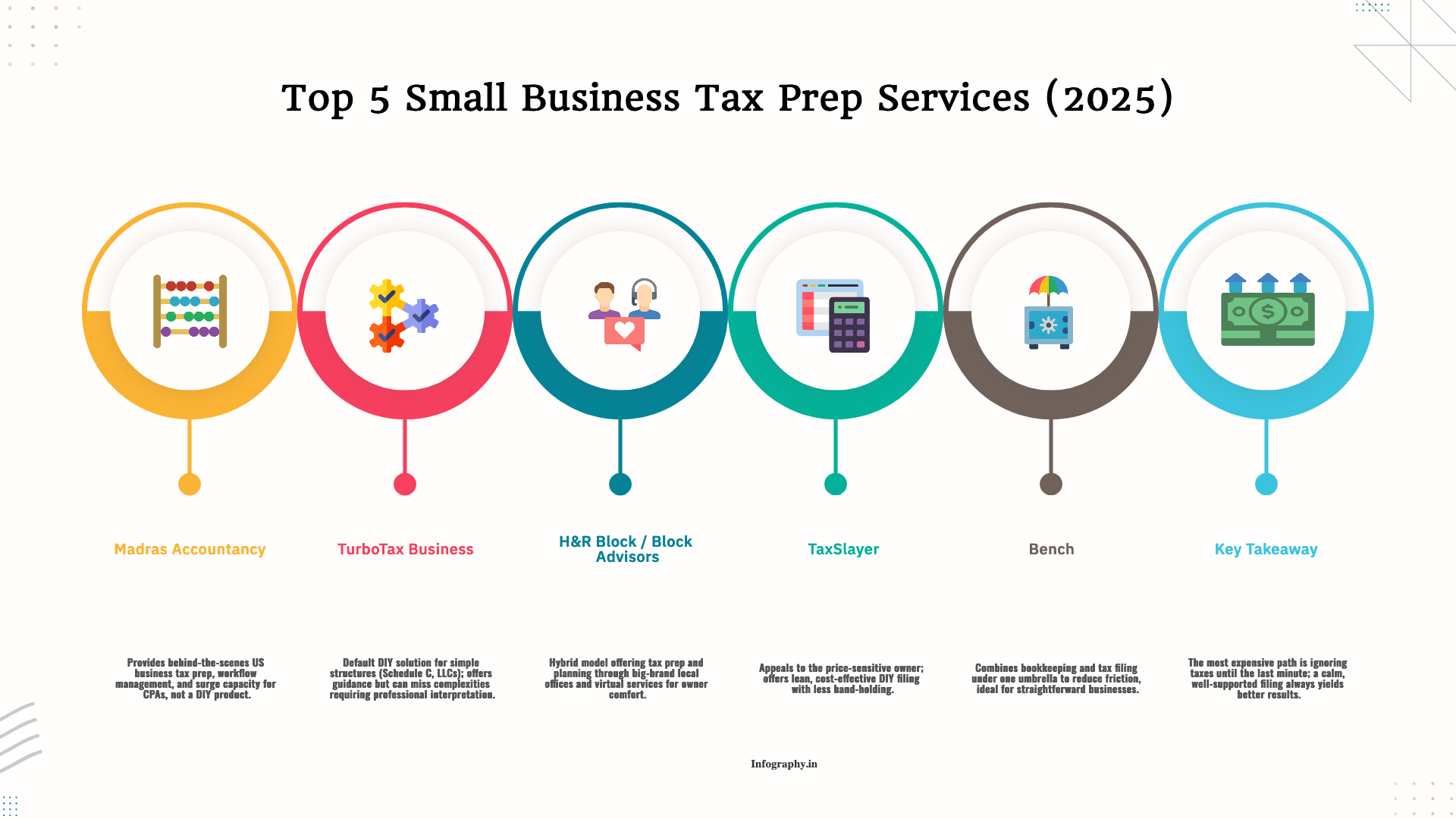
Madras Accountancy (the publisher of this guide) is not a TurboTax-style app. It is an offshore accounting and tax support provider that works mainly with US CPA firms. According to its website, services include tax preparation and planning support, accounting and bookkeeping, payroll and 1099 work, sales tax compliance and fractional CFO support.
For a small business, this usually means working with a local CPA who uses an offshore team for preparation and bookkeeping, while the CPA reviews, signs and advises. The benefit is professional review of your return. The trade-off is that this is not a self-file tool, and fees are higher than DIY software.
TurboTax offers several small business options. Expert Assist Business lets you prepare the return yourself with help from a tax expert, and Expert Full Service Business has an expert prepare it for you. Both cover sole proprietors, S corporations and partnerships. TurboTax states that its online expert products do not currently support C corporations (Form 1120); it points corporations to its desktop business software instead.
The appeal is a lower cost than a full-service CPA engagement and plenty of guidance. The risk with any DIY approach is that if your structure is complex, with multiple entities, multiple states or unusual transactions, it is easy to miss something.
H&R Block is a household name for individual tax, and its Block Advisors brand focuses on small businesses. According to its website, Block Advisors offers business tax preparation (including S corporation, C corporation and partnership returns), bookkeeping and payroll, with local offices as well as virtual services.
For owners who want a large brand and the option to meet someone in person, it can be a comfortable middle ground between DIY software and a CPA firm. Check whether the person preparing your return holds a CPA, EA or other credential if you may need representation before the IRS.
TaxSlayer tends to appeal to price-conscious, DIY-minded owners. Its Self-Employed edition is aimed at freelancers and contractors, with help on 1099 income and Schedule C deductions and access to a tax pro with self-employment experience. Its separate TaxSlayer Pro software is for professional preparers, not for filing your own return.
If you are comfortable with tax concepts and your business is a sole proprietorship, it can be a lean way to file. Partnership and corporate returns are a different matter, so confirm what the product supports before you start.
Bench offers a combined model. Its website lists a Bookkeeping + Tax plan that adds income tax filing and advisory to its full-service bookkeeping. The same provider that keeps your books coordinates the return.
That can reduce the annual ritual of emailing PDFs and hoping for the best. For straightforward businesses, having books and returns in one place removes friction. Highly complex or high-stakes situations may still need a specialist CPA.
There is no single best option, but there is likely a best fit for you:
For context on professional fees, the NATP 2025 Fee Study found an average fee of $236 for a Form 1040 with Schedules 1-3. Business returns cost more and vary widely, so ask for a written quote.
Whichever route you take, the most expensive option is usually ignoring tax until the last minute, rushing the prep and paying for mistakes later. A calm, well-supported filing beats a panicked one every time.
The section 4960 excise tax is 21% of nonprofit pay over $1M. From 2026 it covers all employees. See the medical carve-outs, Form 4720 and a worked example.
The paid family and medical leave tax credit is permanent from 2026. See the 12.5% to 25% rates, the premium option, the 6-month rule and how Form 8994 works.
Opportunity zones become permanent in 2027 under the One Big Beautiful Bill. See the new deferral, rural bonus, and the 2026 handoff.