

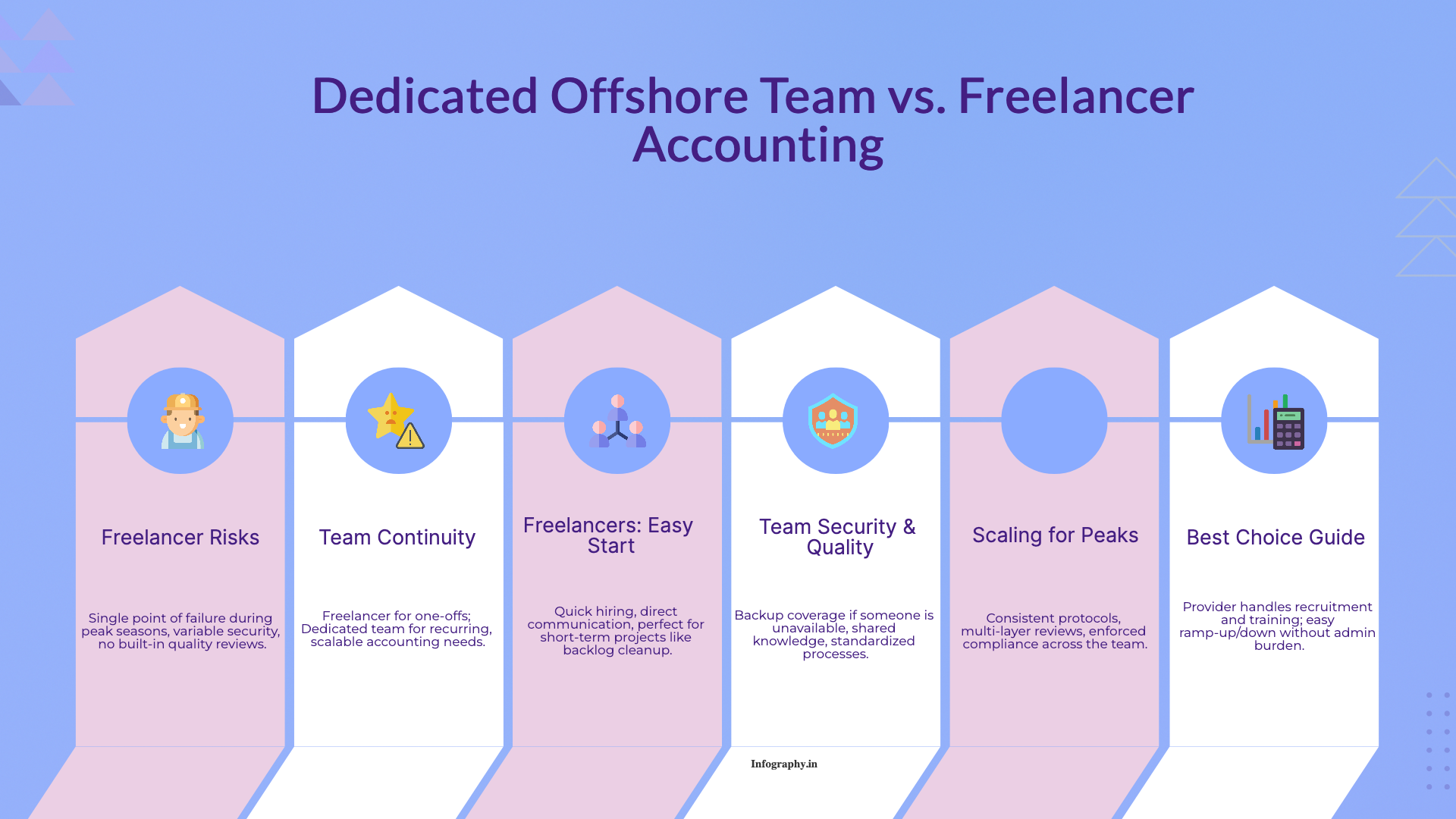

Every March, the same story repeats itself across CPA firms nationwide. That reliable freelancer who handled your tax prep suddenly goes silent. No response to emails. No updates on deadlines. Just radio silence during the busiest time of year. You scramble to find coverage, onboard someone new mid-season, and spend more time managing the crisis than reviewing returns.
This single point of failure is not a bug in the freelancer model. It is the model. One person means one set of skills, one schedule, one risk threshold. When that person is unavailable, your workflow stops. The question is not whether you will face this disruption, but when.
Hiring a freelancer feels straightforward. You post a job, review a few profiles, conduct an interview, and start working together within days. There is no long sales process, no contract negotiation with a vendor, no multi-week onboarding. You communicate directly with the person doing the work, which can feel refreshingly simple compared to corporate bureaucracy.
For small, defined projects, this model can work well. If you need someone to clean up a backlog of bookkeeping from a client acquisition, a skilled freelancer can knock it out in a few weeks. The scope is clear, the timeline is finite, and the risk of disruption is low because the project has a natural endpoint. If they disappear after the work is done, it does not matter.
The trouble starts when firms try to scale this model for recurring work. Tax season comes every year. Monthly close happens every month. These are not one-off projects. They require consistency, institutional knowledge, and predictable capacity. A freelancer who is perfect in July may be overbooked in February, leaving you hunting for backup when you can least afford the distraction.
Beyond availability, freelancers introduce operational risks that are easy to overlook in the honeymoon phase. Security protocols vary wildly. Some freelancers follow best practices for data handling and access controls. Others store client files on personal devices with minimal encryption. You are trusting your clients' sensitive financial data to someone whose security standards you cannot easily verify or enforce.
Quality control becomes another challenge. When you work with an individual, there is no built-in review process. The work goes from their hands to yours, with no intermediate quality check. If they misunderstand a tax code update or apply an outdated methodology, you only discover the error when you review their output. By then, you have already paid for work that needs to be redone.
Training and process adherence also fall entirely on you. If your firm has specific checklists, review procedures, or documentation standards, you need to train each freelancer individually. When that person moves on, the next freelancer starts from scratch. There is no institutional memory, no shared knowledge base, and no continuity of process.
A dedicated offshore team operates differently. Instead of contracting with an individual, you work with a provider that manages a group of professionals assigned to your firm. If one team member is sick or unavailable, another steps in without you needing to intervene. The provider handles backup coverage as part of their service model.
This structure creates continuity that freelancers cannot match. Team members share knowledge, follow standardized processes, and cross-train on your firm's specific workflows. When your contact for tax prep is out, someone else on the team can access the same documentation, use the same checklists, and pick up where they left off. You do not restart the onboarding process every time someone is unavailable.
Security controls become standardized across the entire team. The provider implements consistent access protocols, data handling procedures, and audit logging. You negotiate these terms once, at the contract level, rather than trying to enforce them individually with each person. Compliance becomes a managed service, not a patchwork of individual agreements.
Quality control improves because the provider builds review layers into their workflow. Junior staff complete the initial work, senior team members review it for accuracy, and the provider's internal quality team conducts spot checks before deliverables reach you. This multi-tier review catches errors earlier and reduces the rework you need to perform.
Tax season and busy season demand surge capacity. With freelancers, scaling means recruiting, interviewing, and onboarding new people in the middle of your busiest weeks. Each new freelancer needs to learn your processes, your software, and your expectations while you are least available to train them.
A managed team can scale more smoothly because the provider handles recruitment and training. When you need two additional people for busy season, the provider pulls from their bench of trained staff who already understand accounting workflows, even if they need a brief orientation to your firm's specific procedures. The heavy lifting of finding, vetting, and preparing these resources happens off your plate.
After busy season ends, scaling back down is just as clean. You do not need to awkwardly reduce hours or end contracts with individuals you have built relationships with. The provider adjusts team size based on your current needs, and those resources move to other client projects. The emotional and administrative burden of workforce scaling shifts to the vendor.
The decision between freelancers and a structured team depends on the nature of your needs. For a short-term project with clear deliverables, a freelancer offers speed and simplicity. You can start fast, finish fast, and move on. The risks of disruption are minimal because the engagement is time-bound.
For recurring work that spans months or years, a managed team provides the stability and scalability that individual contractors cannot. You gain backup coverage, consistent quality controls, and the ability to scale up or down without managing the logistics yourself. The trade-off is a more formal relationship with slightly longer initial setup, but that investment pays dividends when you need reliable capacity during crunch periods.
Before committing to either model, define the workflow you need supported. Map out the tasks, the volume, the seasonality, and the quality standards. If the work is recurring and mission-critical, lean toward a managed team. If the work is a one-time cleanup or experimental project, a freelancer may suffice.
Run a pilot period of at least four weeks. Measure not just output volume, but rework rates, communication responsiveness, and how well the resource adapts to your feedback. These indicators reveal whether the model will hold up under pressure.
Accounting work does not stop. Client needs do not pause for holidays, sick days, or unexpected life events. Your support model should not create new risks when it is supposed to reduce them. Choose the structure that keeps your workflow moving, your quality high, and your risk managed.

Section 4960's 21% excise tax now reaches far more nonprofit employees. See who is a covered employee in 2026 and what changed.

The Section 45S paid family leave credit is permanent for 2026 with new options. See who qualifies, the amounts, and how to claim it.

Opportunity zones become permanent in 2027 under the One Big Beautiful Bill. See the new deferral, rural bonus, and the 2026 handoff.