


Every CPA firm says it wants to do more advisory work. Partners envision conversations about growth strategy, tax planning, and cash flow management. They imagine building deeper client relationships through proactive guidance rather than reactive compliance work. Then Tuesday arrives, and the partner spends three hours reconciling accounts for a client who never responds to emails. Friday comes, and another partner is chasing missing documents for a tax return that was supposed to be finished last week.
The advisory vision never materializes because there is no space for it. The calendar is consumed by production work, by cleanup tasks that should have been delegated years ago, and by emergencies that arise because processes are not documented or followed. Advisory does not happen by accident. It requires deliberate effort to create capacity, protect that capacity, and direct it toward work that clients value and will pay for.
Advisory work needs two foundational elements that many firms do not have. First, clean and timely numbers. You cannot advise a client on cash flow management when their books are two months behind and the reconciliations are full of unidentified discrepancies. Clients lose confidence in your guidance when the numbers you are analyzing are unreliable or outdated.
Second, time on the calendar that is protected from production work and administrative distractions. If every hour the partner saves by delegating a task immediately fills with another task of equal or lower value, nothing changes. The partner is still too busy to sit down with a client and walk through their financial performance, identify opportunities, and recommend actions.
Most firms fail at advisory not because their partners lack the skills or the desire, but because they never create the structural conditions that make advisory possible. The production treadmill keeps running, the calendar stays full, and advisory remains a future goal rather than a current service.
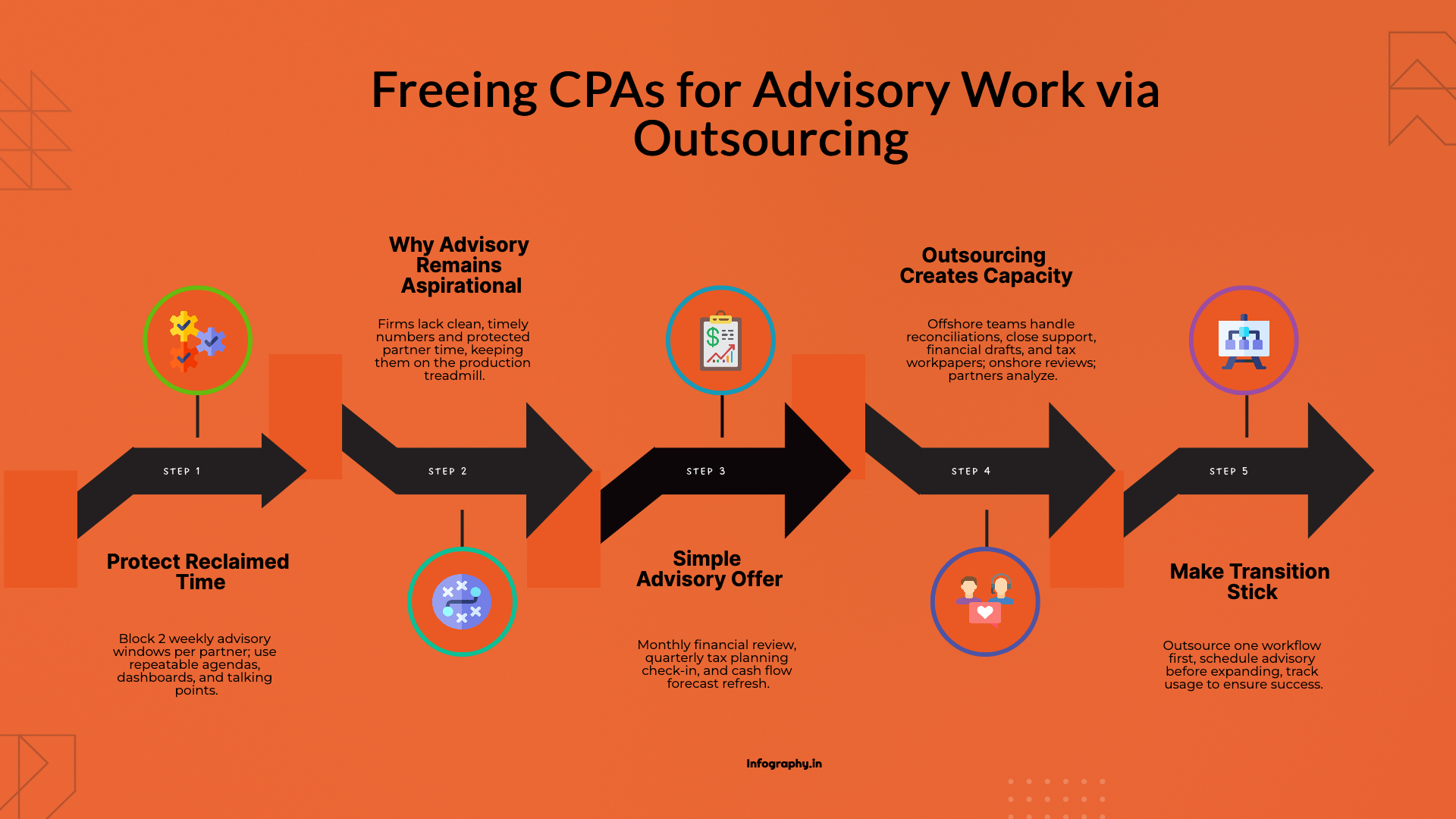
Outsourcing shifts the time-consuming preparation work off the partner's plate and onto a team that specializes in execution. The partner's role moves from doing the work to reviewing the work, which takes significantly less time and can be done in batches rather than continuously.
Reconciliations and transaction cleanup are prime candidates for outsourcing. These tasks require attention to detail and accounting knowledge, but they do not require partner-level judgment. An offshore team can handle the initial reconciliation, flag discrepancies, and document their findings. The onshore senior accountant reviews the work and addresses any complex issues. The partner is freed from the mechanics of the reconciliation and can focus on what the reconciled numbers reveal about the business.
Close support schedules and balance sheet tie-outs work the same way. The offshore team prepares the schedules, ties out the balances, and documents any reconciling items. The onshore team reviews for accuracy and completeness. The partner receives clean schedules and can focus on interpreting variances and identifying trends rather than building the schedules from scratch.
First draft financial statements and variance notes shift even more preparation work offshore. The team prepares the draft statements, calculates variances from prior periods and budget, and drafts notes explaining significant changes. The onshore team reviews the draft, refines the narrative, and tailors the commentary to the specific client. The partner receives a polished draft that requires minimal editing rather than a blank page that needs to be built from raw data.
Tax workpaper assembly and organizer preparation are repetitive, time-consuming tasks that consume hours during tax season. The offshore team assembles the workpapers, organizes the source documents, and prepares the organizer based on the prior year return. The onshore staff reviews for completeness and accuracy before the return is prepared. Partners are freed from administrative work and can focus on tax planning conversations with clients rather than document management.
Freeing up time does not automatically result in advisory work. If you do not proactively schedule advisory time, the calendar will fill with other commitments. Meetings, administrative tasks, and low-priority work expand to fill available time unless you deliberately protect it.
Block two advisory windows per week per partner. These are dedicated time slots on the calendar reserved for client advisory calls. No internal meetings, no production work, no administrative tasks. Treat these windows as client appointments, because that is what they are. If a partner consistently cancels or reschedules their advisory windows, the firm is not serious about advisory work.
Package advisory into a repeatable agenda so you are not starting from scratch with each client. A standard advisory conversation might cover cash position and forecast, profitability by product or service line, tax planning opportunities, and operational metrics like hiring or capacity utilization. Start with the same framework every time, then tailor the conversation based on what is most relevant to the specific client. This structure makes advisory scalable rather than a custom, one-off effort for each client.
Use the same dashboard and talking points each month. Consistency helps clients understand what to expect and allows them to prepare for the conversation. Over time, they start bringing their own questions and observations because they know the meeting is a safe space to discuss financial performance without judgment. The advisory relationship deepens not through one-time heroic efforts, but through regular, structured conversations that build trust.
Clients do not need complex consulting frameworks or buzzwords. They need help making decisions. A simple advisory offer that most small to mid-sized business clients can immediately understand and value includes three components.
A monthly financial review call where you walk through the financial statements, highlight key trends, and answer questions. This is not a compliance review where you simply confirm the numbers are correct. It is a business performance discussion where you help the client understand what the numbers mean and what actions they might consider.
A quarterly tax planning check-in where you project their year-end tax liability, identify opportunities to reduce that liability, and recommend timing for major decisions like equipment purchases or retirement contributions. This proactive planning prevents year-end surprises and positions you as a strategic partner rather than a reactive compliance provider.
A cash flow forecast refresh where you update the cash forecast based on recent performance and upcoming obligations. Cash flow problems are the number one reason small businesses fail, and most owners do not have a formal process for forecasting cash. Providing this as a standard advisory service addresses a critical client need and differentiates your firm from competitors who only provide historical financial statements.
Start by outsourcing one workflow that currently consumes significant senior or partner time. Reconciliations, close support, or tax workpaper assembly are good candidates. Track the hours saved over 30 days and measure the quality of the work being delivered. If rework rates are acceptable and the time savings are real, you have validated the model.
Before expanding the outsourcing scope, schedule the advisory time. Put the blocks on the calendar, communicate the new advisory offer to clients, and start booking calls. If you expand outsourcing without scheduling advisory time, the freed capacity will simply absorb more production work and you will be back where you started.
Track whether the advisory time is actually being used for advisory work. It is easy to let other commitments creep into those blocks. If advisory windows are consistently being used for non-advisory work, something is wrong with either the commitment to advisory or the firm's ability to protect partner time.
Outsourcing creates the potential for advisory work by freeing up capacity. But potential does not become reality without intentional effort to protect that capacity, structure the advisory offer, and deliver it consistently. Firms that treat advisory as something they will get to when they have time never get to it. Firms that build advisory into the calendar and protect it like any other client commitment make the transition successfully.

Section 4960's 21% excise tax now reaches far more nonprofit employees. See who is a covered employee in 2026 and what changed.

The Section 45S paid family leave credit is permanent for 2026 with new options. See who qualifies, the amounts, and how to claim it.

Opportunity zones become permanent in 2027 under the One Big Beautiful Bill. See the new deferral, rural bonus, and the 2026 handoff.