


Most outsourcing relationships fail not because the offshore team lacks skills, but because the firm never set them up for success. The provider gets blamed for quality issues, communication breakdowns, or missed deadlines, when the real problem is that the firm never documented its processes, cleaned up its workflows, or defined clear handoffs. The failure was baked in from day one.
Successful outsourcing is not about finding the perfect provider. It is about treating outsourcing as a real operating model that requires structure, documentation, and discipline. Firms that approach it as an emergency fix for short-staffing or a quick way to reduce costs without changing how they work are setting themselves up for disappointment.
The patterns that separate successful outsourcing from failed experiments are consistent and predictable. They show up across firms of different sizes, in different markets, with different providers. The do's and don'ts below are not theoretical advice. They are lessons drawn from firms that have lived through the implementation and come out the other side with a model that works.
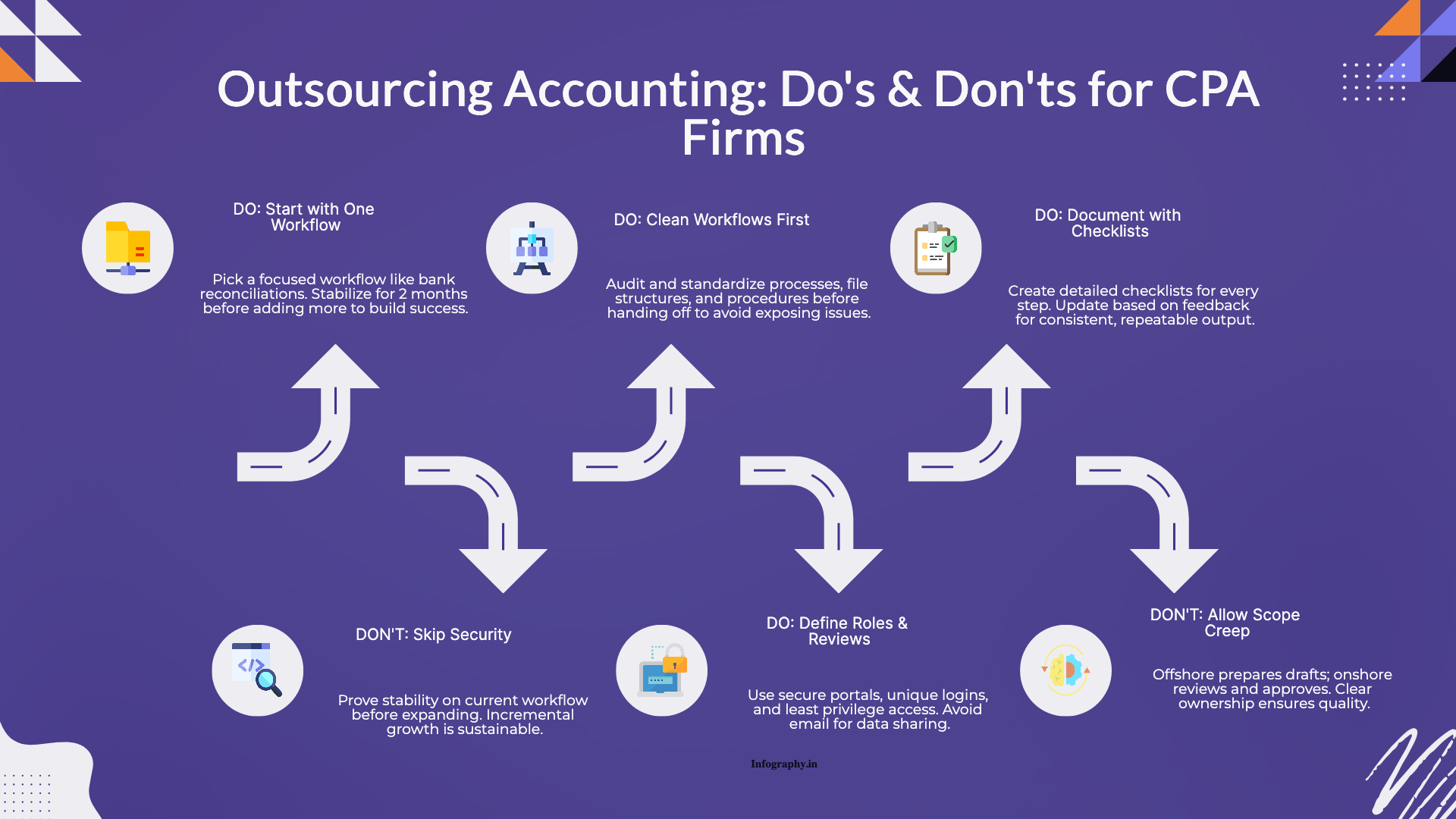
The temptation when starting with outsourcing is to offload multiple types of work at once. Bookkeeping, tax prep, payroll support, and audit assistance all need help, so why not tackle everything together? Because trying to implement multiple workflows simultaneously fragments attention, dilutes training efforts, and makes it impossible to diagnose what is working and what is not.
Pick one workflow with clear inputs and outputs. Bank reconciliations are a common starting point because the inputs are defined transactions and statements, the process is structured, and the output is a reconciled account with documented adjustments. Month-end close support works well for the same reasons. These workflows produce tangible results quickly, allowing you to measure quality and identify gaps in training or documentation.
Once the first workflow is stable, meaning the offshore team can complete it with minimal rework for two consecutive months, then consider adding a second workflow. Stacking workflows before the foundation is solid creates a cascade of issues that becomes harder to untangle the longer it continues.
Outsourcing does not fix broken processes. It exposes them. If your files are inconsistent, your chart of accounts is a collection of miscategorized transactions, and your naming conventions change from client to client, the offshore team will spend more time asking clarifying questions than doing productive work. The confusion multiplies rather than resolves.
Before handing off a workflow, audit it. Are the file structures consistent across clients? Are the procedures documented or do they live in the heads of senior staff who have been with the firm for years? If a new hire would struggle to complete the work without constant guidance, the offshore team will struggle too. Clean up the workflow first. Standardize the file structures, document the procedures, and eliminate the exceptions that exist only because no one had time to fix them.
This upfront work feels like a delay, but it is an investment. The time you spend standardizing processes gets repaid many times over when the offshore team can execute independently without needing constant direction.
Checklists are the foundation of consistent output. Without them, quality depends entirely on whoever is doing the work remembering every step. Checklists externalize the process, making it repeatable regardless of who is executing it.
When you start outsourcing, create a checklist for every workflow. List every step, every file to check, every report to generate. As work gets completed and reviewed, track the feedback. If the same review note appears on multiple files, that is a sign the checklist is incomplete. Update it. Over time, the checklist evolves into a comprehensive process guide that captures institutional knowledge and reduces the need for constant supervision.
Do not rely on weekly meetings to transfer process knowledge. If a process only exists in verbal explanations during calls, it does not really exist. The offshore team will struggle to remember details, misunderstand nuances, and make assumptions that lead to errors. Document it in writing, reference the documentation during training, and update it as the process changes.
Outsourcing works best when there is a clear division between preparation and review. The offshore team handles drafting, data entry, and initial reconciliation. The onshore team handles review, client communication, and final approval. Blurring these lines creates confusion about who is responsible for quality and what level of accuracy is expected at each stage.
Write down who does what. The offshore team prepares the bank reconciliation and documents any uncleared items. The onshore senior accountant reviews the reconciliation, investigates unusual items, and approves it before it goes to the client. The partner spot-checks a sample of reconciliations monthly to ensure quality standards are being maintained. When everyone knows their role, accountability is clear and quality standards are easier to enforce.
Security is not an afterthought. It is a foundational requirement that must be addressed before any client data is shared with the offshore team. Use secure file portals, not email attachments. Assign unique logins for each offshore team member, not shared credentials. Implement least privilege access, meaning each person only has access to the specific files and systems they need for their assigned work.
Avoid email-based data handling wherever possible. Email is inherently insecure, difficult to audit, and prone to human error. A secure portal with activity logging provides visibility into who accessed what files and when, creating an audit trail that email cannot match.
Multiple tracking systems create duplicated work, missed deadlines, and confusion about what has been completed and what is still pending. Use one tracker as the single source of truth. Every task gets logged in the tracker, assigned to a specific person, and updated as it moves through the workflow.
The tracker should show what work is in progress, what is waiting for review, and what is complete. Both the onshore and offshore teams should have access to the same tracker and update it in real time. When everyone is working from the same information, miscommunication decreases and accountability increases.
Scope creep feels harmless at first. The offshore team is doing well on bank reconciliations, so you ask them to start handling journal entries too. Then someone suggests they could also prepare the financial statement drafts. Before you know it, the team is juggling five different workflows, none of which are fully stabilized, and quality is declining across the board.
Stabilize the first workflow before adding more. Prove that the process is working, that rework rates are low, and that the offshore team can handle the volume consistently. Only then should you consider expanding scope. Incremental growth is slower, but it is sustainable. Rapid expansion creates chaos that is difficult to recover from.
Track the number of review notes per file and the number of files returned for missing documentation or errors. These metrics reveal whether the offshore team is learning and improving, or whether the same mistakes are recurring. If rework rates drop over a four-week period, the system is working. If they stay flat or increase, something is wrong with the training, the documentation, or the workflow itself.
Use rework data to identify patterns. Are errors clustered around a specific type of transaction or client? That suggests a gap in training or documentation that needs to be addressed. Are errors random and inconsistent? That suggests the offshore team member may not have the skills or attention to detail required for the role, and a personnel change may be needed.
The whole point of outsourcing is to free up your onshore team for higher-value work. But if the hours saved through outsourcing immediately fill with low-value administrative tasks and unnecessary meetings, you have not actually gained anything. Protect the freed capacity. Direct it toward client advisory work, training junior staff, or improving firm processes. If you let the calendar fill with noise, the efficiency gains from outsourcing evaporate.
Outsourcing works when firms treat it as a real operating model that requires structure, discipline, and ongoing management. It fails when firms expect it to magically solve problems without changing how they work. Start small, document everything, measure results, and scale thoughtfully. That is how you build a sustainable outsourcing model that delivers long-term value.

Section 4960's 21% excise tax now reaches far more nonprofit employees. See who is a covered employee in 2026 and what changed.

The Section 45S paid family leave credit is permanent for 2026 with new options. See who qualifies, the amounts, and how to claim it.

Opportunity zones become permanent in 2027 under the One Big Beautiful Bill. See the new deferral, rural bonus, and the 2026 handoff.