

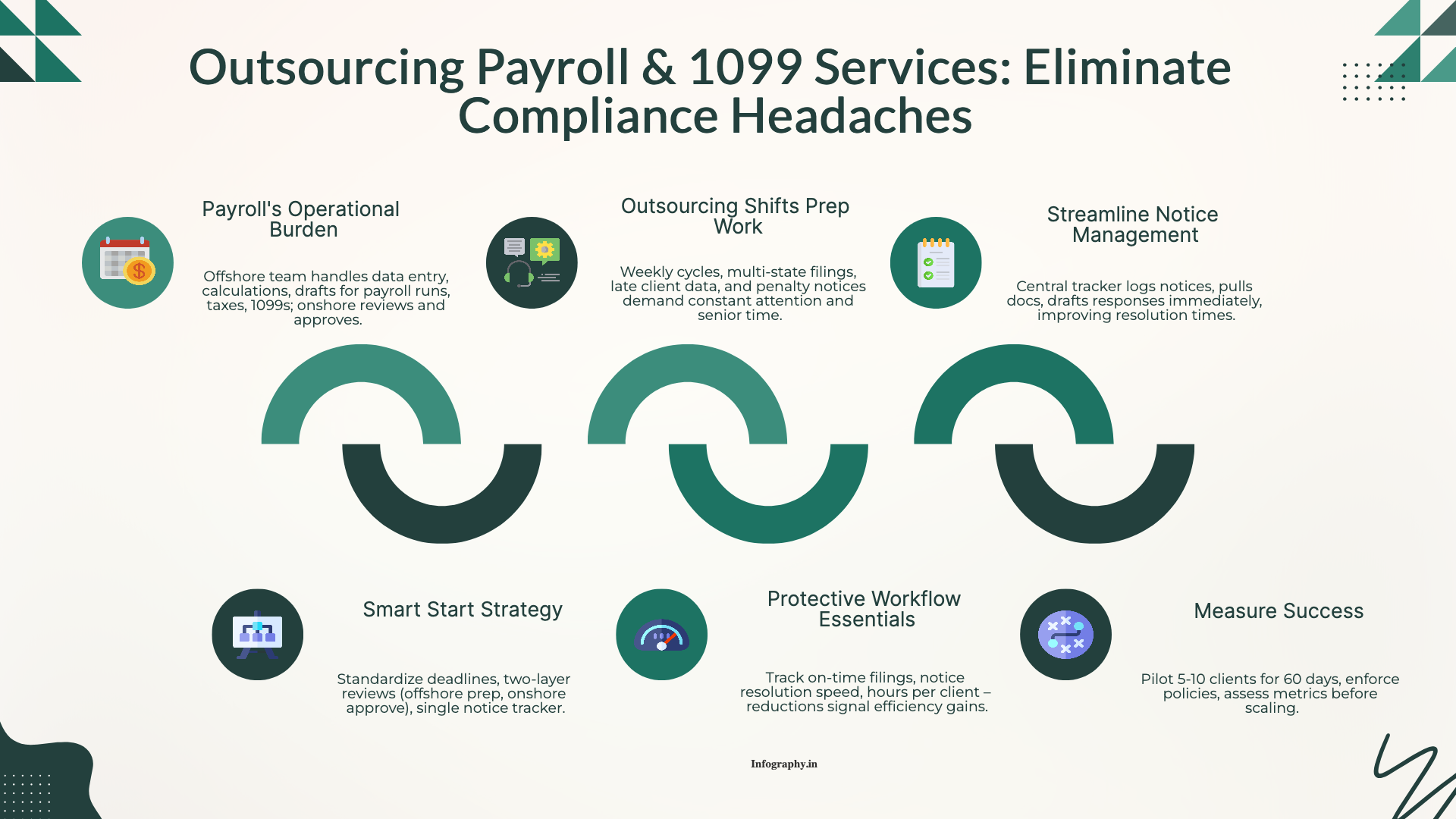

Payroll is the business function that punishes mistakes immediately. Miss a filing deadline by one day and the penalties hit your client's account within weeks. Miscalculate a tax withholding and the notice arrives months later, triggering corrections that consume hours of senior staff time. There is no grace period, no appeals process based on good intentions. The rules are rigid, the deadlines are absolute, and the consequences are financial.
Many CPA firms add payroll services because clients ask for help and the recurring revenue looks attractive. Then reality sets in. Every pay period brings another set of deadlines. Every state adds another layer of filing complexity. Every client approval that arrives late creates a scramble to process payroll before direct deposits fail. What looked like steady income becomes a source of constant operational stress.
Payroll is not like tax preparation, where the work clusters around a few peak months and then quiets down. Payroll runs weekly, biweekly, or semi-monthly, creating a perpetual cycle of data entry, calculations, review, and filing. Each cycle depends on timely input from clients who are busy running their own businesses and may not prioritize payroll approvals until the last possible moment.
State and local filing requirements add another dimension of complexity. A firm with clients in five states is not just managing five sets of rules. Each state has different wage bases, unemployment rates, and filing frequencies. Local jurisdictions layer on additional taxes with their own forms and deadlines. Keeping track of which filings are due when, for which clients, in which jurisdictions, requires meticulous tracking systems that break down the moment staff turnover disrupts institutional knowledge.
Then come the notices. A payroll tax notice is not necessarily an indicator of error. Sometimes agencies send routine inquiries about discrepancies between reported figures and their own records. Sometimes their records are wrong. But every notice demands a response, and responding requires pulling documentation, cross-referencing filings, drafting explanations, and following up to confirm resolution. This work rarely falls to junior staff. Partners and senior managers end up handling notice responses because the risk of ignoring or mishandling them is too high.
Outsourcing payroll support does not mean handing off client relationships or final decision-making authority. It means shifting the repetitive, time-intensive preparation work to a team that specializes in execution while your onshore staff retains oversight and client communication.
An offshore team can handle payroll run preparation, which includes collecting timesheets, entering hours, calculating gross wages, applying deductions, and generating draft payroll reports. They prepare the work package and flag any inconsistencies or missing information. Your onshore staff reviews the draft, addresses client questions, and approves the final run before funds move. The preparation happens off your plate, but control stays in your hands.
Payroll tax filing support works the same way. The offshore team prepares the filings based on completed payroll runs, cross-checks the math, and stages the submissions. Your onshore team reviews the prepared filings and gives final approval before they go to agencies. You eliminate the data entry and calculation work while maintaining quality control at the review stage.
For 1099 reporting, the offshore team tracks contractor payments throughout the year, maintains vendor records, and prepares draft 1099 forms at year-end. They handle the data aggregation and form preparation. Your team reviews the output, confirms accuracy, and handles distribution. The year-end crunch becomes manageable because the heavy lifting of data compilation is already done.
Notice tracking and documentation support is where outsourcing delivers unexpected value. Instead of notices sitting in email inboxes waiting for someone to have time to deal with them, the offshore team logs each notice in a centralized tracker, pulls the relevant documentation, drafts a response, and routes it to the appropriate reviewer. Response times improve because the initial work is handled immediately rather than queued behind other priorities.
Outsourcing payroll work requires clear processes that define where preparation ends and approval begins. Without defined handoffs, work gets duplicated, mistakes slip through, and accountability becomes murky.
Start by standardizing intake and approval deadlines. Clients need to know that payroll data must be submitted by a specific day and time each pay period. If data arrives late, you need a written policy that explains what happens. Does the payroll get delayed? Does the client pay a rush fee? Whatever the policy, it must be consistent and communicated upfront. The offshore team cannot fix chronic late submissions. That is a client management issue that requires onshore leadership.
The draft-offshore-approve-onshore model creates a natural quality control checkpoint. The offshore team prepares the work and documents their assumptions and calculations. The onshore team reviews the output with fresh eyes, catches errors, and asks clarifying questions before anything is finalized. This two-layer review reduces the risk that mistakes reach clients or agencies.
Notice tracking demands a single source of truth. Use one tracker where every notice is logged, assigned an owner, and tracked through resolution. The offshore team handles the initial logging and documentation pull. The onshore team reviews the draft response and decides whether to send it as-is or escalate to a partner. The tracker creates visibility so notices do not get lost in email threads or forgotten during busy periods.
Measuring the impact of payroll outsourcing requires tracking specific metrics that reveal whether the operational burden is actually decreasing.
Late filings and late payments are the clearest indicator. If outsourcing is working, the frequency of missed deadlines should drop. Track how many payroll runs are processed on time before outsourcing and compare that to performance after the offshore team is onboarded. If late submissions remain constant or increase, the workflow needs adjustment.
Notice volume and resolution time tell you whether compliance is improving. More notices may indicate filing errors that need to be addressed. Faster resolution times indicate that the notice tracking process is working. Track the average number of days from notice receipt to final resolution, and watch for trends that suggest the process is breaking down.
Hours spent per payroll client per month reveals whether the efficiency gains are real. If your onshore team is still spending the same amount of time on payroll despite outsourcing, something is wrong. Either the offshore team is not handling the scope you expected, or the review process is too cumbersome. Measure time investment before and after to confirm the model is delivering the promised relief.
Do not outsource your entire payroll book at once. Start with a pilot group of five to ten clients who represent a mix of complexity levels. Include a few simple clients with straightforward payroll and a couple of complex clients with multi-state filings or unusual deduction scenarios. Run the pilot for at least 60 days to get through multiple payroll cycles and encounter different types of issues.
Write the approval policy before the pilot starts, not after problems emerge. Clients need to know the deadlines, the consequences of late submissions, and the escalation path for exceptions. Share the policy in writing and reference it when late submissions occur. Consistency matters more than leniency.
Measure notice volume and turnaround throughout the pilot. If resolution times do not improve, or if notice volume increases, pause and diagnose the problem before scaling further. The goal is to reduce chaos, not redistribute it to a different team.
Payroll outsourcing works when it eliminates last-minute scrambling and creates predictable, controlled workflows. The offshore team handles preparation, your onshore team maintains oversight, and clients receive reliable service without penalties or surprises. If the model delivers that outcome, scale it. If it does not, fix the process before expanding.

Section 4960's 21% excise tax now reaches far more nonprofit employees. See who is a covered employee in 2026 and what changed.

The Section 45S paid family leave credit is permanent for 2026 with new options. See who qualifies, the amounts, and how to claim it.

Opportunity zones become permanent in 2027 under the One Big Beautiful Bill. See the new deferral, rural bonus, and the 2026 handoff.