

Accounts receivable services for small businesses cover the work between sending an invoice and posting the cash: billing, reminders and collections, matching payments to invoices, and setting the credit terms customers get in the first place. A provider can run all of it or only the parts your team keeps dropping, and the result shows up as a lower days sales outstanding (DSO) figure and more cash in the bank.
This guide explains what accounts receivable services for small businesses include, how to calculate DSO and the cash tied up in slow receivables, which federal collection rules apply when you chase your own customers, how receivables connect to the CECL allowance on your balance sheet, and how to decide whether to outsource. All dollar figures in the examples are illustrative.
AR work splits into four functions, which one person often juggles in a small company.
Invoicing and billing. The provider issues invoices from your accounting system on the day work is delivered or a milestone is hit, using your terms, purchase order numbers and remittance details. Billing errors give customers a reason to hold payment, so this step includes checking each invoice against the contract or order before it goes out.
Collections. Collections means a written reminder cadence before and after the due date, phone follow-up on larger balances, dispute logging and escalation to you when a customer stops responding. Every contact is logged in the customer file.
Cash application. Each payment received by ACH, card, check or lockbox is matched to the invoice it pays. Short payments, unidentified deposits and customer credits are researched and cleared. Cash application feeds the bank reconciliation, and when it slips in a busy month the aging report stops matching the bank. A clean monthly close checklist for AP, AR and reconciliations puts cash application on a fixed day each month.
Credit policy. Before a new customer gets terms, someone decides how much credit to extend and on what conditions. The provider drafts a written policy covering credit applications, limits, payment terms, early-payment discounts, late fees where your contracts allow them, and the point at which an account goes on credit hold.
On top of these four, most engagements deliver a weekly aging report (current, 1-30, 31-60, 61-90 and 90+ days) and a monthly summary of DSO, collections against forecast and disputed balances.
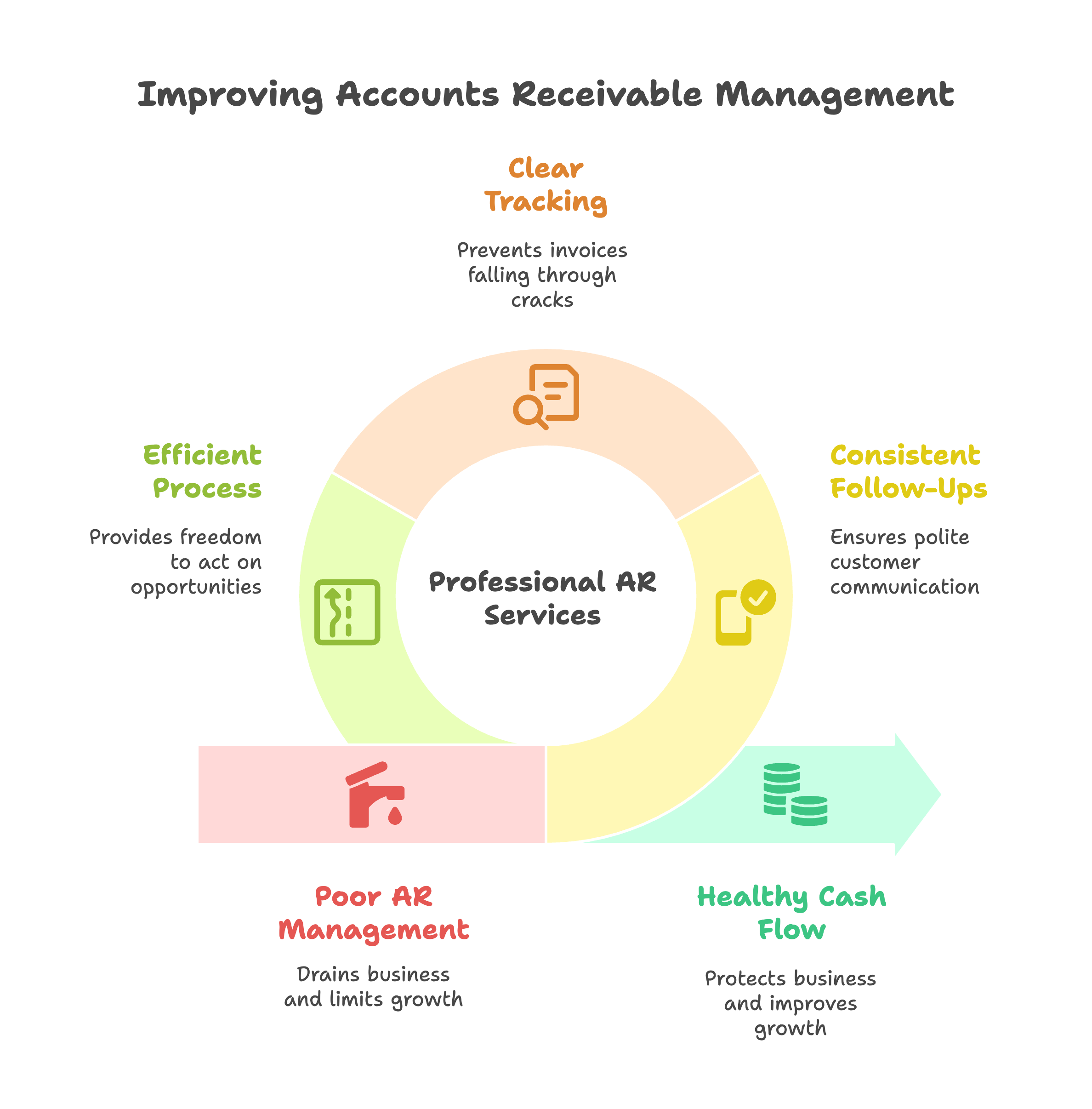
Bookkeeping records sales and receipts after the fact. AR services act on the open balances to get them paid. The two overlap at cash application and reconciliation, so many small businesses buy them together. Payables sit on the other side of the ledger, and the controls and scope there are covered in our guide to outsourcing accounts payable.
DSO tells you how many days of sales are sitting in receivables. OpenStax's Principles of Financial Accounting builds it from two ratios:
The turnover ratio shows how often receivables are collected in a period, and DSO converts that into days.
A small B2B services firm has these figures for its 2026 fiscal year:
Step by step:
The firm invoices on net 30 terms, so customers are paying about a month late on average. If a structured collections process brings DSO down to 45 days, receivables at the same sales level would be $6,575.34 × 45 = $295,890.41. That releases $400,000 − $295,890.41 = $104,109.59 of cash.
| Scenario | DSO | AR balance | Cash released vs today | Annual interest saved at 8% on a credit line |
|---|---|---|---|---|
| Today | 60.83 days | $400,000.00 | $0 | $0 |
| Moderate improvement | 50 days | $328,767.12 | $71,232.88 | $5,698.63 |
| Target | 45 days | $295,890.41 | $104,109.59 | $8,328.77 |
The 8% rate is illustrative, so substitute your own credit line rate. The released cash is a one-time gain that stays in the business for as long as DSO holds at the new level.
DSO is one of the metrics that links receivables to the cash conversion cycle. Our guide to working capital management strategies for growing businesses shows how DSO combines with inventory days and payable days, and the broader playbook on how to improve cash flow in a growing business covers pricing, deposits and tax timing alongside collections.
Track DSO monthly with the other essential KPIs for small business financial performance. As practitioner guidance, a DSO more than about 15 days above your standard terms usually points to a process gap worth fixing, such as late invoicing, disputes that nobody owns or a missing reminder step.
Which federal collection rules apply depends on who your customer is and who does the collecting.
The Fair Debt Collection Practices Act applies to consumer debt. The statutory definition of "debt" in 15 U.S.C. § 1692a is an obligation "of a consumer to pay money arising out of a transaction" where the goods or services are "primarily for personal, family, or household purposes." The FTC's debt collection FAQs state directly: "Business debts are not covered by the FDCPA." If you sell only to other businesses, the FDCPA does not govern your invoices.
The same section defines a "debt collector" as a person whose principal business is collecting debts, or who regularly collects debts "owed or due another." A business chasing its own customers in its own name is a first-party creditor and generally falls outside that definition. Two exceptions matter in practice:
Outsourced providers need a closer look for consumer accounts. The statute excludes a person collecting a debt that "was not in default at the time it was obtained by such person," so routine billing and reminders on current invoices usually fall outside the FDCPA. A provider that regularly collects defaulted consumer debts owed to others can be a debt collector even when it uses your name. Define in the contract which accounts the provider may work and when, and require it to use your business name on every email, letter and call.
The CFPB's Regulation F implements the FDCPA for debt collectors. Under 12 CFR 1006.14(b)(2), a debt collector is presumed to comply with the call-frequency limits if it calls a particular person about a particular debt no more than seven times within seven consecutive days, and does not call within seven consecutive days after having had a telephone conversation about that debt. The FTC's consumer guidance adds that collectors cannot contact consumers before 8 a.m. or after 9 p.m. unless the consumer agrees.
Falling outside the FDCPA does not give a first-party creditor a free hand. Section 5 of the Federal Trade Commission Act prohibits "unfair or deceptive acts or practices in or affecting commerce," and it reaches any business, including one collecting its own consumer receivables. Threatening action you do not intend to take, misstating the amount owed or contacting a customer's employer to embarrass them all create risk. State consumer collection statutes can also reach creditors collecting their own debts, so a business selling to consumers should check its state's rules before setting a call cadence.
As a working standard, many small businesses adopt Regulation F's call limits and calling hours for all consumer accounts, even when they collect in their own name.
Any small business that reports under US GAAP and sells on credit must estimate the receivables it expects never to collect and carry an allowance for that amount under ASC 326, the current expected credit loss model. Our CECL guide for trade receivables covers scope, effective dates and disclosures in detail.
The AR function supplies the inputs. A common approach is an aging matrix, where each aging bucket gets a loss rate from your history, adjusted for current conditions. Using the firm's $420,000 year-end balance from the example above (illustrative loss rates):
| Aging bucket | Balance | Loss rate | Allowance |
|---|---|---|---|
| Current | $250,000 | 1% | $2,500 |
| 1-30 days | $100,000 | 3% | $3,000 |
| 31-60 days | $40,000 | 10% | $4,000 |
| 61-90 days | $20,000 | 25% | $5,000 |
| Over 90 days | $10,000 | 50% | $5,000 |
| Total | $420,000 | $19,500 |
Faster collections shrink the older buckets, which lowers the allowance and the credit loss expense. ASU 2025-05 also helps. According to Deloitte's summary of ASU 2025-05, issued by the FASB on July 30, 2025, all entities may elect a practical expedient for current accounts receivable and current contract assets arising under ASC 606 that assumes current conditions at the balance sheet date do not change over the remaining life of the asset. An entity other than a public business entity that elects it may also make a policy election to consider collection activity after the balance sheet date. It is effective for annual periods beginning after December 15, 2025, with early adoption permitted. A provider that logs post-year-end receipts by invoice makes that election practical.
Tax treatment follows different rules. The IRS's Topic 453 on bad debt deductions explains that a business bad debt is deductible only if the amount owed was included in gross income in the current or a prior year, so cash-method businesses generally cannot deduct unpaid invoices. The book allowance is an estimate. For tax, accrual-method businesses deduct specific business debts when they become wholly or partly worthless, and the two figures are reconciled at year end.
Pricing depends on invoice volume, phone collection work and whether cash application is in scope. The figures below are illustrative assumptions for a firm with a few hundred invoices a month. They are neither market rates nor Madras Accountancy prices.
| Model | Illustrative annual cost | Best fit |
|---|---|---|
| Owner or office manager handles AR part-time | $0 cash cost, plus unpriced owner hours | Fewer than 50 invoices a month, few disputes |
| Part-time in-house AR clerk (half of an illustrative $55,000 salary plus 25% for taxes and benefits) | $34,375 | Steady volume, complex customer relationships |
| Outsourced AR service at an illustrative $1,500 a month | $18,000 | Growing volume, no dedicated finance staff |
| Hybrid: in-house credit decisions, outsourced billing and cash application | Varies with scope | Firms that want to keep customer calls internal |
Compare any quote against the cash the service can release. In the worked example, cutting DSO from 60.83 to 45 days frees $104,109.59 and saves an illustrative $8,328.77 a year in interest, before counting lower write-offs. For broader benchmarks on outsourcing fees, see how much it costs to outsource accounting services.
Outsourcing tends to pay off when one or more of these conditions holds:
Keep AR in-house when customer relationships are highly personal, when credit decisions depend on knowledge only the owner has, or when invoice volume is low enough that a monthly review takes an hour.
Set out the scope by function (billing, collections, cash application and reporting), the reminder cadence, the name the provider uses with customers, escalation thresholds and who approves write-offs and payment plans. Segregation of duties matters, because the person applying cash should not also be able to issue credit memos without review. Our guide to internal controls testing for small businesses explains how to test that split. Before signing, run the provider through a 30-point checklist for evaluating an accounting outsourcing provider covering data security, access rights and exit terms. CPA firms that want to offer AR as a client service will find delivery and pricing details in our guide to outsourcing accounts receivable for CPA firms.
Feed the provider's weekly collections forecast into your cash flow forecasting process so expected receipts drive payment timing on the payables side.
What do accounts receivable services for small businesses usually include? Most cover invoicing, collections follow-up, cash application and credit policy, plus weekly aging reports and monthly DSO tracking. You can buy the full set or only the functions your team lacks time for.
Does the FDCPA apply when my business collects its own invoices? Generally no. The FDCPA covers consumer debts and defines a debt collector as someone collecting debts owed to another, so a business collecting in its own name usually falls outside it. The FTC Act's ban on unfair or deceptive practices still applies, and state laws may add rules for consumer accounts.
Are business-to-business debts covered by federal debt collection law? The FTC states that business debts are not covered by the FDCPA. Contract terms, state law and general commercial law still govern how you collect them.
What is a good DSO for a small business? It depends on your terms and industry. As a rule of thumb, aim to keep DSO within about 15 days of your standard payment terms, and investigate when it drifts higher.
Can I deduct unpaid invoices as a bad debt? Only if the amount was included in your gross income first. Cash-method businesses generally cannot deduct unpaid receivables, according to IRS Topic 453.
Does CECL apply to a small private company? It applies to any company that prepares US GAAP financial statements and holds trade receivables. Tax-basis or cash-basis reporters are outside it, though a lender may still ask for an aging review.
Madras Accountancy supports US small businesses with bookkeeping, receivables and payables processing, month-end close, CFO advisory and tax preparation. If your receivables are tying up cash or your aging report no longer matches the bank, contact our team to scope the work.
The section 4960 excise tax is 21% of nonprofit pay over $1M. From 2026 it covers all employees. See the medical carve-outs, Form 4720 and a worked example.
The paid family and medical leave tax credit is permanent from 2026. See the 12.5% to 25% rates, the premium option, the 6-month rule and how Form 8994 works.
Opportunity zones become permanent in 2027 under the One Big Beautiful Bill. See the new deferral, rural bonus, and the 2026 handoff.