


New York fractional CFO services give a company a senior finance leader for a set number of days or hours each month, without a full-time executive salary. The fractional CFO owns forecasting, cash planning, board and lender reporting, and the tax decisions that are specific to New York, such as whether to elect the state pass-through entity tax and how city business taxes affect pricing and owner pay.
This guide covers what New York fractional CFO services include, the city and state tax rules a part-time CFO in New York has to manage, what local finance leaders are paid according to the Bureau of Labor Statistics, and the signals that it is time to hire one. Figures are current as of October 2026.
A fractional CFO does the work of a chief financial officer on a shared basis. The role sits above bookkeeping and above the monthly close. Bookkeepers record transactions and a controller makes sure the books are accurate and closed on time. The CFO uses those numbers to decide what the company should do next. If you want a fuller picture of the role, our guide to what CFOs do day to day breaks the responsibilities down by company stage.
In practice, a part-time CFO engagement for a New York business usually covers these areas:
The difference between a CFO and a controller matters when you scope an engagement. Many New York companies need both, at different intensities, and our comparison of controller and fractional CFO roles includes a 90-day plan for each.
New York City is one of the few places in the US where a small business can owe a city-level income tax as well as state tax. Which tax applies depends on entity type, so the CFO's first job is often a clear map of what the company actually pays.
Sole proprietors, partnerships and LLCs taxed as partnerships that do business in the city may owe the Unincorporated Business Tax. The Department of Finance's 2025 NYC-202 instructions say a business must file if its total gross income from all business, wherever carried on, is more than $95,000 before cost of goods sold. The tax is 4% of taxable income allocated to the city. A business credit removes the tax completely when the computed liability is $3,400 or less, and a partial credit applies when the liability falls between $3,400 and $5,400.
The same instructions note that the city has decoupled from federal bonus depreciation for UBT and the corporate taxes, with limited exceptions. That matters in 2026 because the One Big Beautiful Bill Act made 100% federal bonus depreciation permanent for property placed in service after January 19, 2025. A New York company can therefore show one depreciation figure on its federal return and a different one on its city return, and the CFO's model has to carry both.
For city purposes, an S corporation is taxed much like a regular corporation. The city's General Corporation Tax page states that GCT applies to domestic and foreign S corporations doing business in the city, and that all other corporations now file under the business corporation tax. According to the Department of Finance GCT rate schedule, the main base is 8.85% of net income allocated to New York City. The tax is the highest of several computations, and the fixed dollar minimum runs from $25 for receipts of $100,000 or less up to $5,000 for receipts over $25 million.
For an owner who elected S status to save federal self-employment tax, this is a real cost that founders in other states never see. An S corporation with $400,000 of income allocated to the city would owe about $35,400 of GCT on the entire net income base before credits. A fractional CFO should run that number before anyone files a Form 2553, and should revisit owner salary, since salary reduces the entire net income base while it counts in the alternative base.
The state PTET lets a partnership or New York S corporation pay state income tax at the entity level, so the owners receive a state credit and the entity takes a federal deduction. The Department of Taxation and Finance PTET page describes it as an optional tax for tax years beginning on or after January 1, 2021, and says the annual election must be made online between January 1 and March 15, moving to the next business day when March 15 falls on a weekend or legal holiday. Only an authorized person at the business can make it, so your CPA cannot elect on your behalf. An electing entity can also opt into a separate New York City PTET.
The state rate is graduated. The Department's PTET calculation guidance sets these amounts:
| PTE taxable income | NYS PTET due |
|---|---|
| $2 million or less | 6.85% of PTE taxable income |
| Over $2 million to $5 million | $137,000 plus 9.65% of the excess over $2 million |
| Over $5 million to $25 million | $426,500 plus 10.30% of the excess over $5 million |
| Over $25 million | $2,486,500 plus 10.90% of the excess over $25 million |
The election still matters after the One Big Beautiful Bill Act raised the federal cap on itemized state and local tax deductions. The IRS confirms the 2026 SALT limit is $40,400, reduced for modified adjusted gross income above $505,000 and never below $10,000. Owners of profitable New York firms often sit above that income level, which brings their cap back toward $10,000 and keeps the entity-level deduction valuable. Our explainer on how the pass-through entity tax turns state tax into a federal deduction walks through the federal side.
Companies that sell into New Jersey, Connecticut or other states also pick up filing obligations outside New York, and our multi-state tax compliance guide covers nexus and apportionment.
This is an illustrative example. The business is a two-partner Manhattan consulting firm organized as an LLC taxed as a partnership, with each partner owning 50%. It has $2,600,000 of New York PTE taxable income for 2026.
Step 1: State PTET. Income is above $2 million and below $5 million, so the second bracket applies. PTET due is $137,000 plus 9.65% of $600,000 ($57,900), which totals $194,900. Each partner receives a credit of $97,450 on the state return.
Step 2: The deadline. March 15, 2026 fell on a Sunday, so the election for 2026 had to be made by Monday, March 16, 2026. If the firm missed it, the CFO's job is to calendar the 2027 election, due March 15, 2027, and set up estimated payments so the entity is ready.
Step 3: City tax. The firm also files NYC-202 for UBT at 4% of taxable income allocated to the city. Its gross income is far above $95,000 and its liability will be far above $5,400, so no business credit applies.
Step 4: Sizing the CFO role. BLS data (below) puts the mean annual wage for financial managers in the New York metro at $250,570. A CFO commitment equal to 30% of one full-time role would therefore correspond to about $75,171 of wage-equivalent cost at the mean. That figure is a planning benchmark built from wage data. Fractional CFO fees are set by the market and by scope, and they include no benefits or payroll tax, so compare quotes against fully loaded employee cost and our fractional CFO pricing models guide.
The Bureau of Labor Statistics Occupational Employment and Wage Statistics survey for May 2025 gives these figures for financial managers (SOC 11-3031) in the New York-Newark-Jersey City metro area. The BLS regional release on occupational employment and wages in the New York area lists employment, mean hourly pay and mean annual pay for management occupations, and the national figure comes from the same May 2025 survey.
| Measure, financial managers, NY metro (May 2025) | Value |
|---|---|
| Employment | 89,960 |
| Mean hourly wage | $120.47 |
| Mean annual wage | $250,570 |
| National mean annual wage, same occupation | $186,910 |
The New York mean is about 34% above the national mean for the same occupation. Financial managers is a broad BLS category that includes controllers and treasurers as well as CFOs, so a seasoned CFO hire in Manhattan would typically cost well above the mean once bonus and equity are added. For a company with $5 million to $20 million of revenue, that cost is the main reason owners look at shared arrangements first. Our comparison of a full-time CFO and an outsourced CFO sets out the trade-offs beyond salary.
The BLS economy at a glance page for the New York area reports total nonfarm employment of 10,019,900 for the New York-Newark-Jersey City metro in September 2026 (preliminary, not seasonally adjusted). The largest supersectors are shown below, with shares calculated from those counts.
| Supersector (Sept 2026, preliminary) | Jobs (thousands) | Share of nonfarm jobs |
|---|---|---|
| Education and health services | 2,360.7 | 23.6% |
| Professional and business services | 1,621.9 | 16.2% |
| Trade, transportation and utilities | 1,583.8 | 15.8% |
| Government | 1,315.5 | 13.1% |
| Leisure and hospitality | 923.2 | 9.2% |
| Financial activities | 825.6 | 8.2% |
| Information | 297.1 | 3.0% |
Each sector brings a different set of finance problems. Health care practices and clinics deal with payer mix and reimbursement timing, which our page on fractional CFO support for healthcare and medical practices covers in detail. Professional services firms, from law and consulting to agencies, tend to be partnerships or S corporations, which puts UBT, GCT and PTET at the center of owner pay decisions; see our guide to fractional CFOs for professional services firms. Information and technology companies, many of them venture backed, need cohort and burn analysis, and our SaaS fractional CFO services page lists the metrics investors expect.
There is no revenue line that settles the question. The following signals, offered as practitioner guidance, usually mean the owner is making finance decisions without enough support:
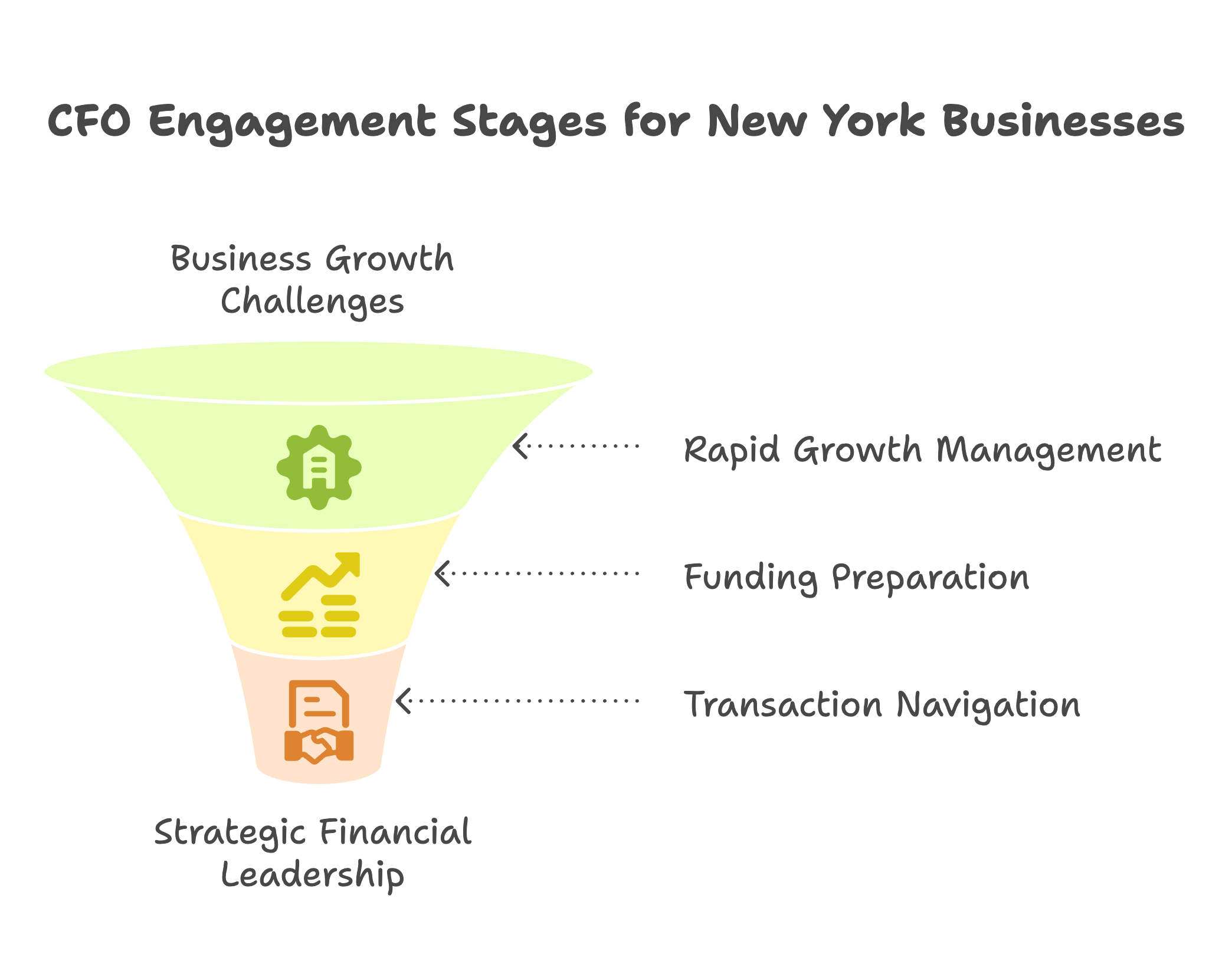
If only one or two signals apply, a project engagement may be enough. Our longer guide on when to hire a fractional CFO goes through each trigger with examples.
Scope the work before you compare providers. Write down the decisions you need help with in the next 12 months, the reports you want each month, and who will keep the books. Then test each candidate against it.
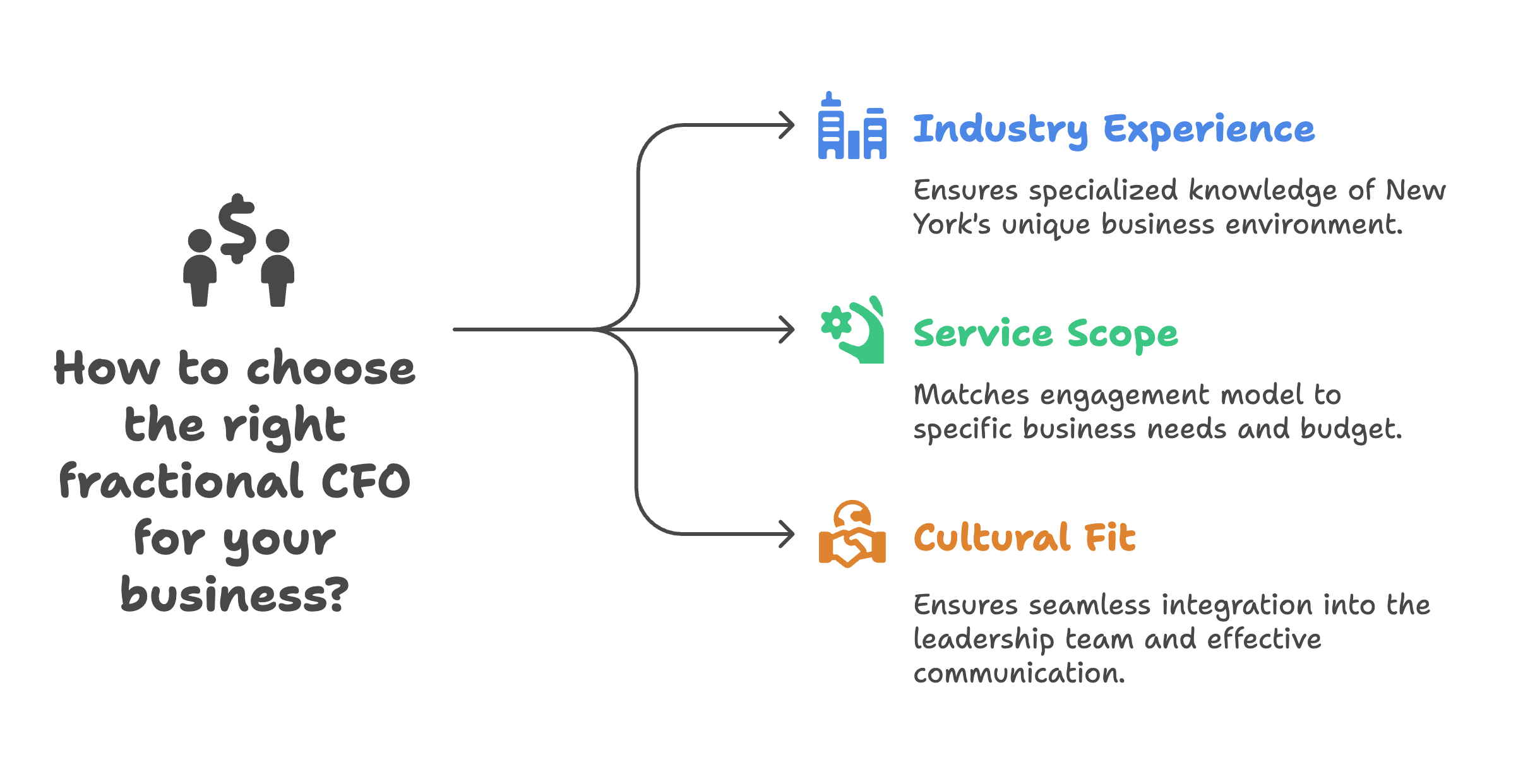
Ask each candidate how they would handle your PTET election, how they model city tax for your entity type, and which sector they have worked in most. Ask for a sample monthly reporting pack with client data removed. Confirm who does the underlying bookkeeping and close, since a CFO who has to fix transactions each month spends your hours on the wrong work. Agree on a defined number of days or hours, a review date after the first quarter, and the deliverables that will tell you whether the engagement is working.
What do New York fractional CFO services usually include? Forecasting and budgeting, monthly management reporting, cash planning, support with investors and lenders, and coordination with your CPA on New York tax decisions such as the PTET election and city business tax. Bookkeeping and the monthly close are usually handled by a separate team or controller.
Does a NYC S corporation pay city tax? Yes. New York City applies the General Corporation Tax to S corporations doing business in the city, with a main rate of 8.85% of allocated net income and a fixed dollar minimum based on city receipts.
When is the New York PTET election due? The election is made online each year between January 1 and March 15 for that tax year. An authorized person at the business has to make it, and tax professionals cannot elect for clients.
Who has to file the NYC Unincorporated Business Tax? An individual or unincorporated entity doing business wholly or partly in New York City with total gross income from all business above $95,000 must file. The tax is 4% of city taxable income, with a full credit when the liability is $3,400 or less.
How much does a full-time finance leader cost in New York? BLS reports a May 2025 mean annual wage of $250,570 for financial managers in the New York metro, about 34% above the national mean of $186,910. Benefits, payroll taxes and bonus add to that figure, which is why many growing companies start with a fractional arrangement.
Madras Accountancy supports US businesses and CPA firms with bookkeeping, monthly close, tax preparation, payroll support and CFO advisory work. If you want a clean set of books and reporting behind your New York finance decisions, contact our team to talk through your needs.

The section 4960 excise tax is 21% of nonprofit pay over $1M. From 2026 it covers all employees. See the medical carve-outs, Form 4720 and a worked example.

The paid family and medical leave tax credit is permanent from 2026. See the 12.5% to 25% rates, the premium option, the 6-month rule and how Form 8994 works.

Opportunity zones become permanent in 2027 under the One Big Beautiful Bill. See the new deferral, rural bonus, and the 2026 handoff.