


Offshore tax preparation means a CPA firm sends return preparation to a trained team in another country, usually India or the Philippines, while US staff review and sign. It adds busy-season capacity at lower cost. Before sharing any client data offshore, the firm needs the taxpayer's written Section 7216 consent.
Demand for tax work is steady, deadlines are fixed, and experienced staff are harder and more expensive to find. Accounting graduates and new CPA exam candidates both fell in recent years: 28,082 new candidates entered the CPA pipeline in 2024 (Journal of Accountancy). That is why more firms treat offshore tax preparation as part of their normal operating model rather than a fallback.
The 2025 National MAP Survey found that 29% of CPA firms already use offshore resources, and 74% of firms with $10 million or more in revenue do. Of those firms, 65% use India and 33% use the Philippines.
Done right, offshore preparation does not disrupt your tax workflow; it adds capacity to it. Offshore staff prepare returns in your software overnight US time, and your team reviews in the morning.
Hiring and keeping in-house tax staff is not getting easier or cheaper. When you outsource preparation, you can:
Savings depend on the provider, the pricing model and how much review time the work needs. Ask providers for a written quote and compare it with your fully loaded in-house cost per return.
Your in-house team can only stretch so far. Offshore support lets you:
Good offshore providers employ staff trained in US tax rules who work in common professional software such as UltraTax CS, Lacerte, ProConnect or Drake. That means:
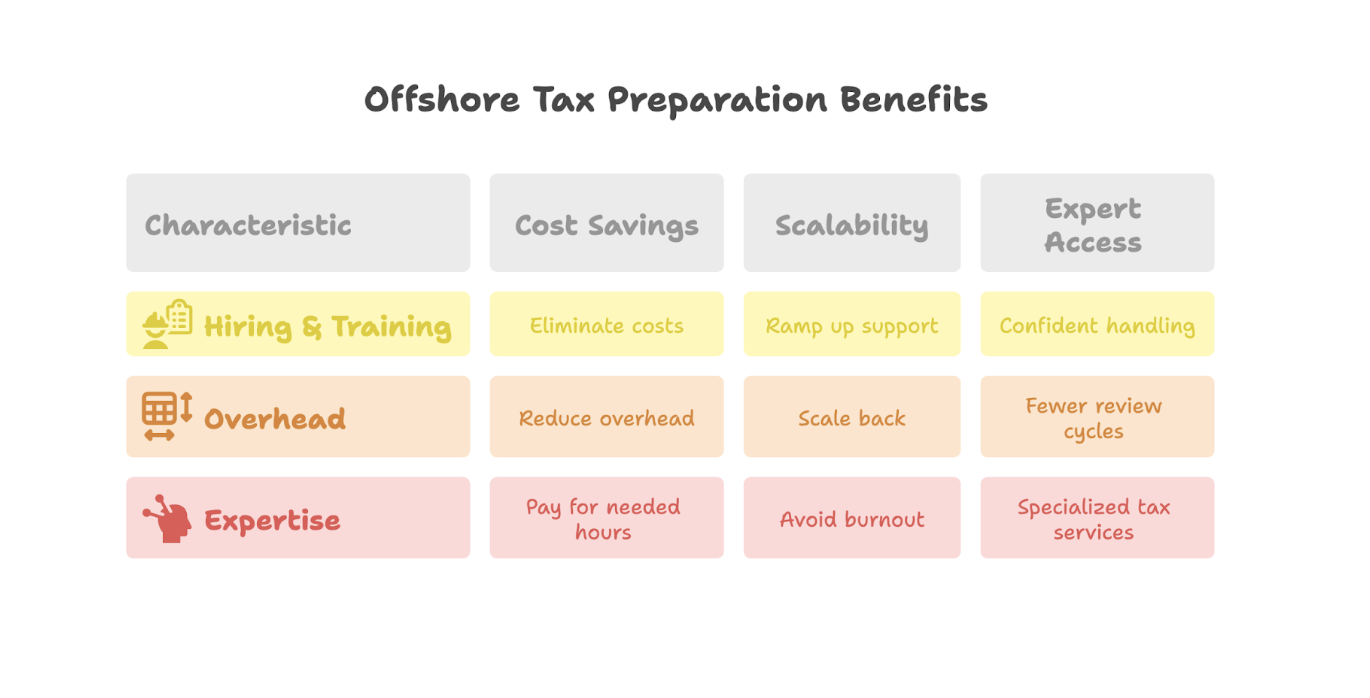
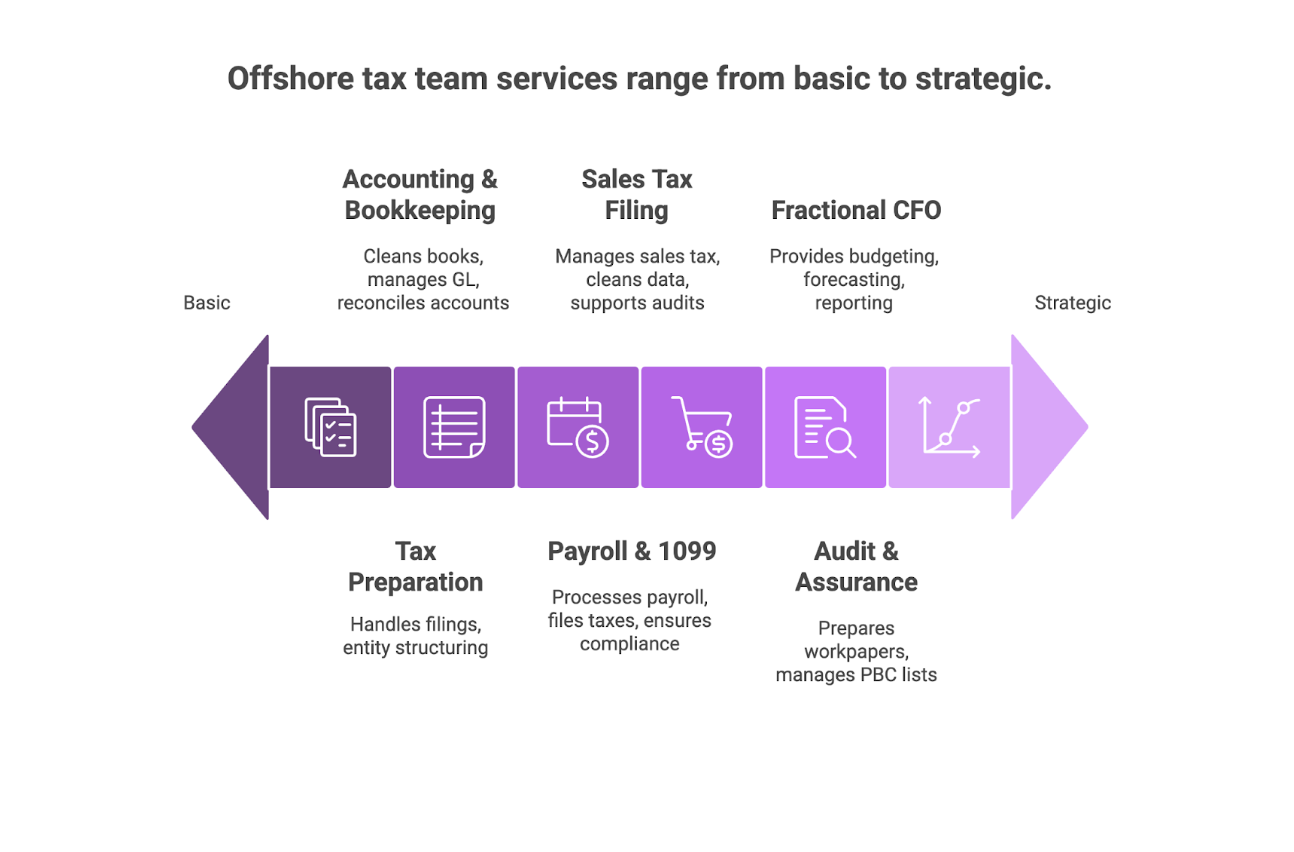
At Madras Accountancy, our offshore teams work inside your workflow and software. Typical work includes:
What this means for your firm: more returns completed without adding full-time staff, and your in-house team focused on review and clients.
Returns prepared from messy books take longer and cost more. We help clean up first:
Madras Accountancy has 160+ offshore staff and works with more than 60 US CPA firms, from small practices to multi-partner regional firms, according to our website. Our model is designed to:
Talk to us about the capacity you need before your next busy season.
Internal Revenue Code Section 7216 makes it an offense for a tax return preparer to disclose or use a client's tax return information without permission, except as the regulations allow. Sending information to another preparer inside the US for return preparation is generally permitted, but sending it to a preparer located outside the US requires the taxpayer's prior written consent (26 CFR 301.7216-3(a)(3)(i)(D)).
Key points for CPA firms:
The IRS FAQ page is marked as historical, so read the current regulation and revenue procedure, or ask your professional liability insurer, before finalizing your consent forms. For more detail, see our guide to Section 7216 consent for tax return preparers.
When you share client SSNs, EINs, bank records and investment details with an offshore team, the question is not only "Will they save us time?" but "Can they protect our clients and our firm?"
Your firm signs and takes responsibility for every return, so your offshore team must work within a US-compliant workflow. At Madras Accountancy, our preparers:
Ask any provider how data is stored, who can access it, and how access is monitored. At Madras, our website lists SOC 2 and ISO 27001 certification, and our controls include:
Whoever you work with, ask for a current SOC 2 report or ISO 27001 certificate and read the scope.
Firms often worry that offshore support will disrupt existing operations or create more fixing than saving. That risk is real unless the provider is set up to integrate. Our approach:
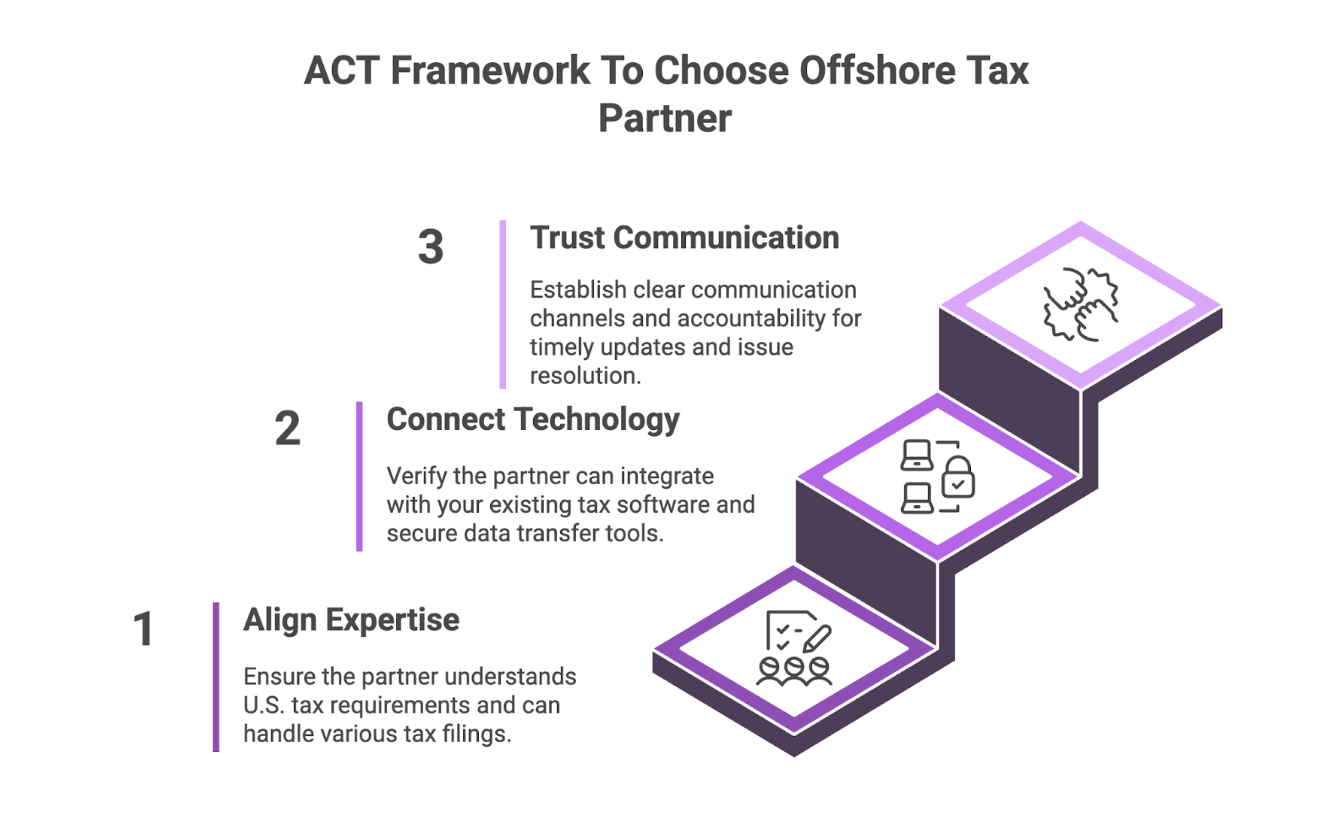
The right partner should feel like an extension of your team. This simple framework helps CPA firms find a match.
Ask:
Ask:
Ask:
How does outsourcing compare with keeping everything in-house?
Why many firms choose a hybrid model
For many small and mid-sized firms, the answer is both. Strategy, review and client contact stay in-house, while preparation and volume work go offshore. That gives you:
We act as an extension of US CPA firms for tax preparation, accounting, audit support and compliance work. Our dedicated offshore teams:
We work with more than 60 US CPA firms and report a 98% client retention rate on our website.
Reality: Established providers train staff specifically in US tax rules and software. Test this with a pilot batch of returns.
Reality: With planned handoffs, the time difference lets work continue overnight. Agree overlap hours for questions.
Reality: Your firm still reviews and signs every return. The right partner follows your workflows and standards.
Reality: Security depends on the provider's controls, not its location. Ask for independent reports, and use Section 7216 consents.
For firms handling international matters, an offshore team can add capacity for:
Yes, if you follow the rules. Under the Section 7216 regulations, you need the taxpayer's prior written consent, using IRS-prescribed wording, before disclosing tax return information to a preparer outside the US. SSNs on 1040-series returns must be masked unless the consent and data-protection safeguard requirements in Rev. Proc. 2013-14 are met. Your firm remains responsible for reviewing and signing the return.
If your team is overwhelmed in busy season, review is backing up, or you are turning away work, you are probably ready. Many firms also use outsourcing to free senior staff for review, planning and client service.
Ask which packages the provider's staff use and run a pilot. Our team works in common professional packages such as UltraTax CS, ProConnect, Lacerte and Drake.
We use encrypted file exchange, VPN connections, role-based access and continuous monitoring, and our website lists SOC 2 and ISO 27001 certification. We can provide documentation during onboarding.
Quality depends on process. Offshore teams that follow your checklists, review cycles and escalation rules can produce consistent work. Start with a pilot and track review notes.
Many can, including multi-state returns, partnerships and S corporations, international reporting and trusts. Match the work you send to the team's experience, and keep complex judgment calls with your senior reviewers.
Pricing varies by provider and model (hourly, per return, or dedicated full-time staff). Ask for written quotes and compare them with your fully loaded in-house cost, including the review time you will still spend.
Look at security reports, quality control, staff training, US tax experience, references from other CPA firms, software skills, time zone overlap and pricing transparency. Ask for a trial project before committing to a larger engagement.
Expect some setup work: consent forms, workflow documentation, access setup and training. Communication habits take a season to settle. Starting small and expanding once the process works reduces risk.
Yes. Section 7216 requires the taxpayer's consent before disclosure to an offshore preparer, so clients will know. Explain that your firm still reviews and signs the return and that offshore support helps you deliver on time.
Offshore tax preparation is a practical way for CPA firms to add capacity without burning out their teams. It works best with clear workflows, strong security, and Section 7216 consents in place before any data leaves the firm.
Whether you want help with routine returns, complex filings, or bookkeeping that feeds into tax work, the right offshore partner should fit your process rather than change it. If you are ready to explore what offshore could look like for your firm, we'd be glad to talk.
The section 4960 excise tax is 21% of nonprofit pay over $1M. From 2026 it covers all employees. See the medical carve-outs, Form 4720 and a worked example.

The paid family and medical leave tax credit is permanent from 2026. See the 12.5% to 25% rates, the premium option, the 6-month rule and how Form 8994 works.
Opportunity zones become permanent in 2027 under the One Big Beautiful Bill. See the new deferral, rural bonus, and the 2026 handoff.