


Adoption is one of the most meaningful things a family can do, and also one of the most expensive. Agency fees, legal work, court costs, and travel can add up to tens of thousands of dollars fast. The federal adoption tax credit exists to soften that hit, and thanks to a recent law it now does more than it used to.
Here is the headline that makes this worth reading in 2026: for the first time since 2011, part of the adoption credit is refundable. That single change turns it from a break only higher earners could fully use into something families with little or no tax bill can actually benefit from. Below is a plain walkthrough of what the credit is worth, what counts, who qualifies, when you can claim it, and how to put it on your return.
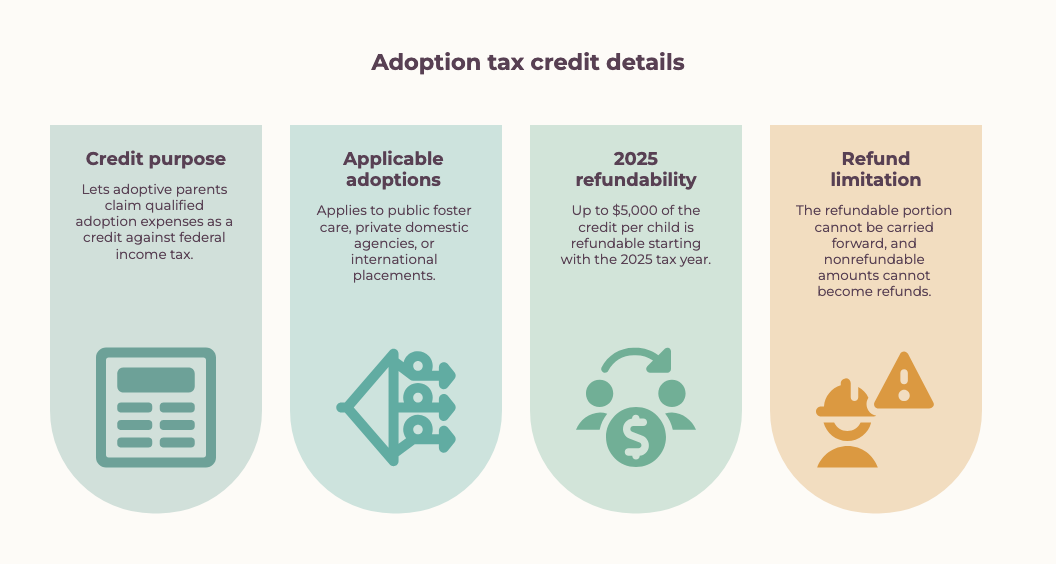
The adoption tax credit lets adoptive parents claim their qualified adoption expenses as a credit against federal income tax. It is one of the more generous family tax credits on the books, and it applies whether you adopt through public foster care, a private domestic agency, or an international placement.
The change that everyone should know about came from the One Big Beautiful Bill Act, signed in July 2025. Starting with the 2025 tax year, up to $5,000 of the credit per child is refundable. Before this, the adoption credit was fully nonrefundable, which meant it could shrink your tax bill to zero but never turn into a check. Now, if your credit is larger than what you owe, you can get up to that $5,000 back as a refund even with no tax liability at all. It is a real difference for lower and middle income families who adopt.
There is one catch worth filing away early: the refundable portion cannot be carried forward, and any nonrefundable amount you carry into a later year cannot later be turned into a refund.
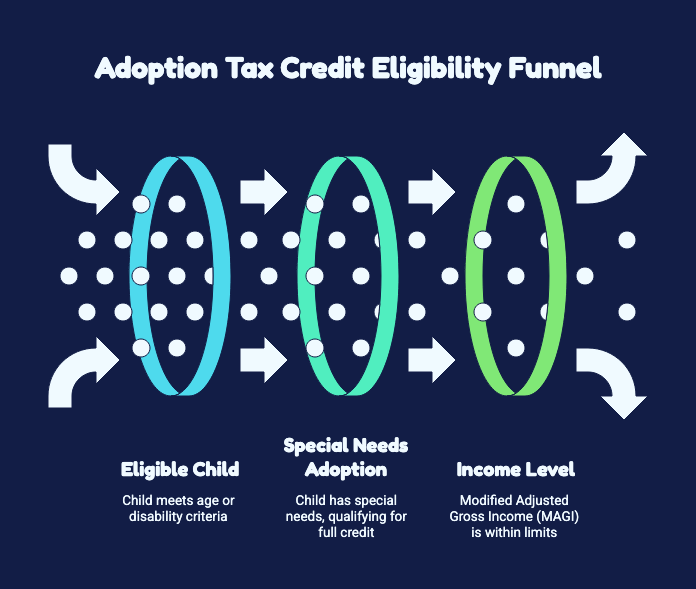
The credit amount is capped per eligible child and adjusts for inflation each year.
For the 2025 tax year, the maximum credit is $17,280 per child. Up to $5,000 of that is refundable, and the rest is nonrefundable. For the 2026 tax year, the maximum rises to $17,670 per child, with up to $5,120 refundable. Those numbers are per child, not per family, so adopting siblings can multiply the benefit.
Higher earners see the credit shrink. It begins to phase out once your modified adjusted gross income (MAGI) passes a threshold and disappears entirely above a ceiling. For 2025 the phase-out runs from $259,190 to $299,190 of MAGI. For 2026 it runs from $265,080 to $305,080. If your income lands inside that band, you get a reduced credit rather than the full amount. Families close to the line sometimes work with their accountant to bring MAGI down in the finalization year, for example by increasing pre-tax retirement or HSA contributions.
One more point that trips people up: the per-child cap is cumulative across years. If you claimed part of the credit for the same child in an earlier year, that reduces what is left to claim for that child now.
The credit is built on qualified adoption expenses, which the IRS defines as the reasonable and necessary costs directly tied to legally adopting an eligible child. In practice that usually means adoption agency fees, attorney fees and court costs, and travel expenses while away from home, including lodging and meals.
Some costs do not count, and knowing them saves headaches. You cannot use the credit for adopting your spouse's child, for surrogacy arrangements, for expenses that break state or federal law, or for anything reimbursed by an employer or a government program. That last one matters, because you are not allowed to claim the same dollar twice, a theme that comes up again with employer benefits below.
To claim the credit, you need an eligible child, which the tax code defines as someone under 18, or a person of any age who is physically or mentally unable to care for themselves. Married couples generally have to file a joint return to claim it.
Special needs adoptions get special treatment, and it is favorable. If you adopt a child that a state or, under a recent update, an Indian tribal government has determined to have special needs, you can claim the full credit for the year the adoption is finalized even if your actual expenses were lower or zero. This recognizes that these adoptions are often the hardest to place and the ones society most wants to encourage.
Income is the other gate. As covered above, once your MAGI climbs into the phase-out range your credit is trimmed, and past the top of that range you cannot claim the credit at all.
Timing is where a lot of otherwise correct returns go wrong, and the rules differ depending on where the child is from.
For a domestic adoption, you do not have to wait for everything to be final. Expenses you pay before the year the adoption becomes final are claimed on the tax return for the year after you paid them. Expenses paid in the year the adoption is finalized, or later, are claimed in the year you pay them. So a domestic adoption that stretches across tax years can still generate a credit along the way, and this holds even if the adoption is never completed for a U.S. child.
Foreign adoption works differently. For an international adoption, you can only claim the credit for the year the adoption becomes final. If a foreign adoption falls through and is never finalized, those expenses generally do not qualify at all.
And the carry forward safety net: any nonrefundable portion you cannot use because your tax liability was too low can be carried forward for up to five years. Use it or lose it after that window closes.
You claim everything on Form 8839, Qualified Adoption Expenses, which you attach to your Form 1040. The form figures both the credit and any employer adoption benefits you are excluding from income. When you file, the refundable part of the credit lands on Form 1040, and the nonrefundable part flows through Schedule 3.
Two practical notes. First, if the child does not yet have a Social Security number when you file, you can request an Adoption Taxpayer Identification Number (ATIN) to use in the meantime. Second, if your employer runs a qualified adoption assistance program, you may be able to exclude those reimbursed benefits from your taxable income, up to the same annual limit as the credit ($17,280 for 2025). You can use both the credit and the exclusion for one adoption, but never on the same expenses. Keeping a clean record of which dollars came from your own pocket versus your employer is what keeps that split honest.
Hang on to everything: agency and court records, receipts, travel logs, the special needs determination letter if you have one, and your employer's benefit statements. If the IRS ever asks, that paperwork is your case.
The adoption tax credit is one of the friendlier corners of the tax code right now, but the details, timing, phase-outs, and the credit versus exclusion split reward careful handling. If your adoption crosses tax years, involves an employer assistance program, or you are near the income phase-out, a second set of eyes pays for itself. Madras Accountancy can help you calculate the adoption tax credit correctly, time the expenses to the right year, and make sure you capture both the refundable and carried-forward pieces you are owed.
1. Is the adoption tax credit refundable now? Partly. Starting with the 2025 tax year, up to $5,000 per child is refundable, so you can get that portion back even if you owe no tax. The rest of the credit is nonrefundable. For 2026 the refundable amount is up to $5,120.
2. How much is the adoption tax credit for 2025 and 2026? The maximum credit is $17,280 per eligible child for 2025 and $17,670 for 2026. The same ceilings apply to the employer-provided adoption assistance exclusion.
3. What are qualified adoption expenses? Reasonable and necessary costs to legally adopt a child, such as agency fees, attorney and court fees, and travel including meals and lodging. Surrogacy, adopting a spouse's child, and expenses reimbursed by an employer or government do not count.
4. Who can claim the adoption credit? Anyone adopting an eligible child (under 18, or unable to care for themselves), subject to income limits. Married couples generally must file jointly. The credit begins to phase out at higher MAGI and disappears above the top threshold.
5. Can I claim the credit before the adoption is finalized? For a domestic adoption, yes. Expenses paid before the finalization year are claimed the year after you pay them. For a foreign adoption, you can only claim expenses in the year the adoption becomes final.
6. What happens to the credit if I cannot use it all in one year? The nonrefundable portion can be carried forward for up to five years. The refundable portion cannot be carried forward, so you either use it in the year of the adoption or lose that part.
7. How do I claim the adoption tax credit on my return? Use Form 8839, Qualified Adoption Expenses, attached to your Form 1040. It calculates both the credit and any employer benefit exclusion. The refundable amount goes on Form 1040 and the nonrefundable amount on Schedule 3.
8. Can I use both the adoption credit and employer adoption assistance? Yes, but not on the same expenses. You can exclude employer-provided adoption benefits from income and also claim the credit, as long as each dollar of expense is only counted once.
Section 4960's 21% excise tax now reaches far more nonprofit employees. See who is a covered employee in 2026 and what changed.

The Section 45S paid family leave credit is permanent for 2026 with new options. See who qualifies, the amounts, and how to claim it.

Opportunity zones become permanent in 2027 under the One Big Beautiful Bill. See the new deferral, rural bonus, and the 2026 handoff.