


The Form 7203 instructions tell an S corporation shareholder how to figure stock basis and debt basis, and how much of the corporation's losses and deductions that basis lets them claim on their Form 1040. You must file the form in any year you claim an S corporation loss, receive a non-dividend distribution, dispose of stock, or receive a loan repayment from the corporation.
This guide walks through the Form 7203 instructions part by part, using the current IRS revision (instructions revised 12/2022, page last reviewed by the IRS in April 2026), and finishes with a worked example you can follow line by line. Basis rises with income and contributions, falls with distributions, nondeductible expenses and losses, and can never go below zero.
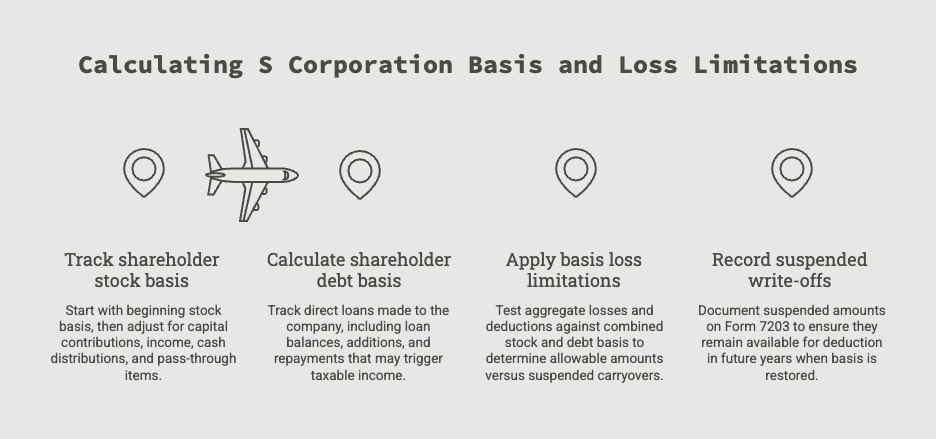
Form 7203, S Corporation Shareholder Stock and Debt Basis Limitations, replaced the three-part basis worksheet that used to sit inside the Shareholder's Instructions for Schedule K-1 (Form 1120-S). The IRS says shareholders use Form 7203 to figure the potential limitations of their share of the corporation's deductions, credits and other items that can be deducted on their individual returns.
The corporation does not track your basis for you. The Instructions for Form 7203 put it plainly: "You are responsible for keeping the information needed to figure the basis of your stock in the corporation." The K-1 gives you the year's numbers, and Form 7203 is where you carry them into a running basis history.
If the company only recently made its S corp election on Form 2553, the first Form 7203 sets the opening basis that every later year builds on, so it is worth getting right.
The Form 7203 instructions list four triggers. You file the form with your return if you:
Owners who pay themselves through distributions on top of the reasonable salary every S corp owner must take hit the second trigger almost every year. The IRS also notes that completing and keeping the form in years you are not required to file "will ensure their bases are consistently maintained year after year."
A few filing details from the instructions are easy to miss:
Part I starts with your stock basis at the beginning of the corporation's tax year. For a continuing shareholder that is last year's ending basis. For new stock, it is usually cost for purchased shares, fair market value at death for inherited shares, and the donor's basis for gifted shares, with the special rules the instructions cite.
The IRS S corporation stock and debt basis page sets out the annual ordering rule. Stock basis is adjusted as of the last day of the S corporation year in this order:
Because distributions come before losses, a year with both a distribution and a loss uses basis for the distribution first. That keeps the distribution tax-free and pushes more of the loss into suspension. A shareholder can elect under Regulations section 1.1367-1(g) to take losses before nondeductible expenses; the election is made by statement, applies to all later years for that corporation, and is reported in item E of the form.
Two income rules matter in practice. Line 3 takes only positive amounts from the K-1, and negative amounts go to Part III. Excluded discharge of indebtedness income under sections 108(a) and 108(d)(7)(A) does not increase basis, which is one reason cancellation of debt income at the corporate level needs separate tracking. In March 2025 the IRS also posted an update that amounts from K-1 box 13, code H reduce stock basis and are entered on Part III, line 45.
Distributions are tested against stock basis only. The IRS basis page states that "the shareholder looks solely to his/her stock basis (debt basis is not considered)" when deciding whether a distribution is taxable, and the Form 7203 instructions add that distributions do not reduce loan basis.
When a distribution is larger than stock basis before distributions, the line 6 note in the instructions says to report the excess as a capital gain on Form 8949 and Schedule D, and not to increase stock basis for that gain. Dividends paid out of accumulated earnings and profits from C corporation years arrive on Form 1099-DIV and stay off line 6.
This is the most common Form 7203 surprise for owners who switched from a sole proprietorship. The sole proprietorship vs S corp trade-offs often assume distributions are tax-free, and that holds only while stock basis covers them.
Part II applies only if you personally loaned money to the corporation. The regulations define debt basis as basis in "any bona fide indebtedness of the S corporation that runs directly to the shareholder" (Treas. Reg. 1.1366-2). A loan from a bank to the company, a loan from a related entity you own, or a credit line you guarantee gives you no debt basis on its own.
The same regulation says a shareholder "does not obtain basis of indebtedness in the S corporation merely by guaranteeing a loan or acting as a surety." Basis arises only when you actually make a payment on the guaranteed debt, and only to the extent of that payment.
The Form 7203 instructions add these tracking rules:
Partnership owners get basis from their share of entity liabilities, which is why the partnership outside basis and capital account rules work so differently from Part II.
Under section 1366(d), the aggregate losses and deductions you take into account "shall not exceed the sum of" your adjusted stock basis and your adjusted basis in debt the corporation owes you. Part III applies that cap.
Losses use stock basis first (column c) and then debt basis (column d). When basis is too small to absorb every loss and deduction item, the allowed amount is spread pro rata across the items, and each item keeps its character. Whatever is left goes in column (e) as a suspended amount. Section 1366(d)(2) treats a disallowed loss as incurred by the corporation in the next year for that shareholder, so it carries forward indefinitely until basis returns.
Basis is only the first gate. The instructions apply the limits in this order:
| Order | Limitation | Form |
|---|---|---|
| 1 | Stock and debt basis | Form 7203 |
| 2 | At-risk rules | Form 6198 |
| 3 | Passive activity loss rules | Form 8582 |
| 4 | Excess business loss limit | Form 461 |
A loss that clears Form 7203 can still be held back by the at-risk limits or the passive rules. The last gate is the excess business loss limitation under section 461(l). Pub. L. 119-21, the One Big Beautiful Bill Act signed on July 4, 2025, struck the January 1, 2029 end date from section 461(l) for tax years beginning after December 31, 2026, which makes the limit permanent.
Priya owns 100% of a calendar-year S corporation. Her stock basis on January 1 is $10,000. She also holds an $18,000 formal note from the company with full $18,000 debt basis. Her K-1 for the year shows:
Following the ordering rules:
| Step | Amount | Stock basis after step |
|---|---|---|
| Beginning stock basis | $10,000 | |
| Add interest income | +$2,000 | $12,000 |
| Subtract distributions | -$8,000 | $4,000 |
| Subtract nondeductible expenses | -$1,000 | $3,000 |
| Losses allowed from stock basis | -$3,000 | $0 |
The distribution is fully tax-free because $12,000 of basis was available before it.
Total losses and deductions are $36,000. Stock basis absorbs $3,000, split pro rata: $2,500 ordinary loss (30,000 / 36,000 x 3,000) and $500 section 179 (6,000 / 36,000 x 3,000). That leaves $33,000, and debt basis of $18,000 absorbs $18,000 of it: $15,000 ordinary loss and $3,000 section 179.
| Item | K-1 amount | Allowed from stock | Allowed from debt | Suspended |
|---|---|---|---|---|
| Ordinary business loss | $30,000 | $2,500 | $15,000 | $12,500 |
| Section 179 deduction | $6,000 | $500 | $3,000 | $2,500 |
| Total | $36,000 | $3,000 | $18,000 | $15,000 |
Priya deducts $21,000 this year, subject to the at-risk, passive and excess business loss limits. The $15,000 balance carries forward with its character. She ends the year with zero stock basis and zero debt basis on an $18,000 note. Until later income restores that debt basis, any principal the company repays on the note produces capital gain.
For a distribution case, assume a second owner starts with $5,000 of stock basis, receives $1,000 of income and takes a $9,000 distribution. Basis before the distribution is $6,000, so $3,000 is reported as capital gain on Form 8949 and ending stock basis is zero. Any loan that owner made to the corporation does not shelter the distribution.
Most problems come from the history behind the form. Watch for these:
For CPA firms, Form 7203 work sits inside the individual return but depends on the 1120-S, so it is practical to schedule it within the same 1040, 1065 and 1120 tax prep workflow so the K-1 and the basis schedule are reviewed together.
Do I attach Form 7203 to Form 1120-S or Form 1040? Form 7203 goes with the shareholder's individual return. The corporation files Form 1120-S and issues the K-1, and the shareholder uses the K-1 amounts to complete Form 7203.
Does a personal guarantee of the company's bank loan give me debt basis? No. Under Treas. Reg. 1.1366-2, guaranteeing a loan does not create debt basis. You gain basis only when you actually pay on the guarantee, and only for the amount you pay.
Can debt basis cover a distribution that exceeds my stock basis? No. Distributions are measured against stock basis alone. The excess over stock basis is reported as capital gain on Form 8949 and Schedule D.
What happens to losses I cannot deduct because of basis? They are suspended and carried forward indefinitely with their original character. You enter them in Part III, column (b), the following year and deduct them once you have enough stock or debt basis.
Is there a newer revision of the Form 7203 instructions? As of October 2026 the IRS lists the instructions revised 12/2022 as current, with a March 2025 update on reporting K-1 box 13, code H amounts on Part III, line 45. Check IRS.gov/Form7203 before filing for any later changes.
Madras Accountancy supports US CPA firms and their clients with tax preparation and bookkeeping, including S corporation returns, shareholder basis schedules and the Form 7203 work that goes with each K-1. To talk through your workload, contact our team.
The section 4960 excise tax is 21% of nonprofit pay over $1M. From 2026 it covers all employees. See the medical carve-outs, Form 4720 and a worked example.

The paid family and medical leave tax credit is permanent from 2026. See the 12.5% to 25% rates, the premium option, the 6-month rule and how Form 8994 works.
Opportunity zones become permanent in 2027 under the One Big Beautiful Bill. See the new deferral, rural bonus, and the 2026 handoff.



