



Direct Answer: What Is IRS Publication 463?
IRS Publication 463 is the Internal Revenue Service's official guide explaining which business-related travel expenses, car expenses, and gift expenses are deductible. It covers documentation requirements, reimbursement rules, and how to report these expenses on your tax return. For 2024, the standard mileage rate is 67 cents per mile for business use.
Most CPA firms reference this publication daily when processing client returns, as it directly impacts how businesses report ordinary and necessary expenses incurred for business purposes.
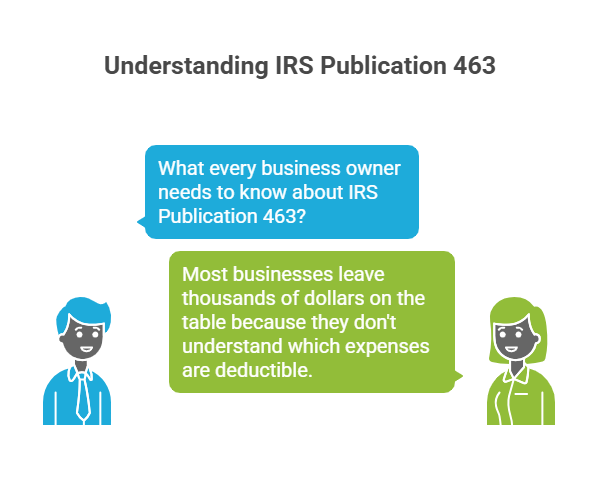
When your accounting team processes 50,000+ tax returns annually like we do at Madras Accountancy, you realize one thing: most businesses leave thousands of dollars on the table because they don't understand which expenses are deductible.
Publication 463 explains what business expense deductions you can claim, how to prove your expenses with adequate records, and what happens when your employer provides reimbursement for your travel expenses. The IRS updates this publication annually to reflect changes in standard mileage rates, depreciation limits, and documentation requirements.
The publication covers four main expense categories: travel away from home, transportation expenses, meal expenses while traveling, and car expenses for business activities. Understanding these categories helps businesses maximize deductions while maintaining compliance.
The IRS divides deductible business expenses into specific categories, each with distinct rules.
Travel Expenses: You can deduct travel expenses when you travel away from home on business for substantially longer than an ordinary workday. This includes airfare, lodging, taxi fares, and business-related meal expenses. Your tax home is generally your regular place of business or post of duty, not where your family lives.
For travel more than 100 miles from your tax home, you must keep detailed records showing the business purpose, dates, and amounts. The trip was primarily for business purposes if more than 50% of total days involved business activities.
Car Expenses: You have two methods to deduct car expenses: the standard mileage rate method or the actual expenses method. For 2024, the standard mileage rate is 67 cents per mile. The actual expenses method lets you deduct actual car expenses like depreciation, lease payments, gas, insurance, and repairs based on business use percentage.
Most firms choose standard mileage because it requires less documentation. However, if you use a car extensively for business, calculating actual expenses often yields larger deductions. You must decide which method to use in the first year you use your car for business.
Gift Expenses: Business gifts are subject to strict limits. You can deduct no more than $25 per person annually for business gifts you give directly or indirectly to clients or business associates. Items costing $4 or less with your name permanently imprinted don't count toward this limit.
Incidental costs like engraving or gift-wrapping aren't included in the $25 limit unless they add substantial value to the gift. Many businesses miss these deductions simply because they don't track gift expenses throughout the year.
Meal Expenses: Publication 463 addresses deductible meal expenses in detail. Business-related meal expenses while traveling away from home are generally 50% deductible. The cost of travel includes meals during business trips, but entertainment expenses are no longer deductible under current tax law.
You must keep receipts showing the date, place, amount, and business purpose for each meal expense exceeding $75. Many CPA firms recommend using expense tracking apps to maintain these records automatically.
Understanding how to report your expenses depends on whether your employer reimburses you under an accountable plan.
Accountable Plans: When your employer uses an accountable plan, reimbursements aren't included in your taxable income. To qualify, you must have a business connection for all expenses, submit expense reports with adequate documentation within 60 days, and return any excess expenses to your employer within a reasonable period.
Under accountable plans, employees don't report the expenses on their tax return because the employer handles the documentation. This simplifies reporting and reduces audit risk.
Non-Accountable Plans: If your employer provides a per diem or car allowance that doesn't meet accountable plan requirements, the reimbursement is treated as taxable wages. You must report it as income and then deduct your expenses as itemized deductions on Schedule A.
For employees with impairment-related work expenses, special rules apply. Impairment-related work expenses aren't subject to the 2% floor that affects other employee business expenses. These expenses help workers with disabilities perform their jobs effectively.
The internal revenue code requires adequate records to support your expenses. You must prove your expenses with sufficient evidence, which typically means maintaining a contemporaneous log.
For transportation expenses, document the date, destination, business purpose, and miles driven for each trip. Many professionals use mileage apps that automatically track business miles using GPS. These digital records satisfy IRS requirements when they capture all necessary data.
For travel expenses, keep receipts for lodging, airfare, rental cars, and meals exceeding $75. Credit card statements alone don't prove business purpose—you need documentation showing who attended, what was discussed, and how it related to your business.
The IRS can disallow deductions if you can't deduct expenses without proper documentation. In our experience processing tax returns for 200+ CPA firms, inadequate recordkeeping is the primary reason business expense deductions get challenged during audits.
Self-employed taxpayers report their business expenses on Schedule C as adjustments to income. This includes daily transportation expenses you incur going between business locations, not commuting from home to work.
If you lease a car primarily for business, you can deduct lease payments proportional to business use. Publication 463 also explains inclusion amounts for leased vehicles—additional income you must report based on the car's fair market value when you began the lease.
Operating and maintaining your car for business generates various deductible expenses: gas, oil changes, repairs, insurance, registration fees, and depreciation. You must divide your expenses between business and personal use based on actual mileage.
CPA firms see recurring errors when clients attempt to deduct transportation expenses and travel expenses without understanding Publication 463's requirements.
Mixing Personal and Business: You can't deduct expenses for travel that combines business and personal activities unless the trip was primarily for business purposes. If you extend a business trip for vacation, you must divide your expenses between deductible business days and non-deductible personal days.
Inadequate Records: Claiming you "probably drove about 10,000 business miles" won't satisfy IRS documentation requirements. You need contemporaneous records showing actual business use.
Entertainment Confusion: Many businesses still try to deduct entertainment expenses that haven't been deductible since 2018. Publication 463 explains that entertainment expenses, club dues, and entertainment facilities are no longer deductible expenses under current law.
Reimbursement Reporting Errors: Employees often report the expenses discussed in Publication 463 incorrectly when their employer uses an accountable plan. If you received full reimbursement under an accountable plan, you shouldn't report those expenses again on your tax return.
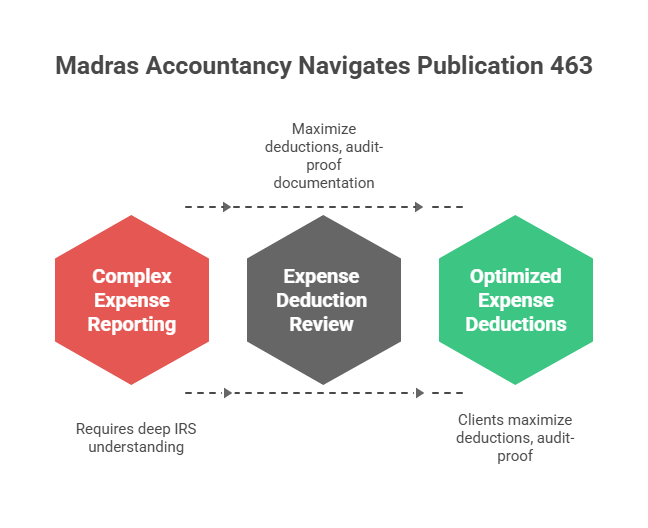
Since 2015, we've served as offshore partners to U.S. CPA firms, processing complex expense reporting that requires deep understanding of IRS Publication 463. Our team reviews thousands of business expense deductions monthly, ensuring clients maximize deductions while maintaining audit-proof documentation.
We help firms implement systems for tracking vehicle expenses, documenting business travel expenses, and properly categorizing expenses on Schedule C or Form 2106. This expertise means your clients save money while reducing compliance risk.
When you consult IRS Publication 463 alongside professional guidance, you ensure you're claiming every allowable business expense while maintaining the documentation necessary to support your expenses during an audit.
Publication 463 covers essential rules that directly impact your tax liability. The standard mileage rate method simplifies recordkeeping for most businesses. Understanding when you must use actual expenses versus when you can use standard mileage helps you choose the most beneficial approach.
Remember that ordinary and necessary expenses must serve a legitimate business purpose. Keep detailed records throughout the year rather than reconstructing them at tax time. Digital tools make it easier to track your expenses in real-time, dramatically reducing year-end stress.
For businesses operating across state lines or with significant travel requirements, proper expense tracking can generate deductions worth thousands annually. The key is understanding what Publication 463 explains about documentation requirements and implementing systems to capture that information consistently.
What is the difference between standard mileage and actual expenses methods?
The standard mileage rate (67 cents per mile for 2024) calculates deductions based solely on business miles driven. The actual expenses method deducts the business-use percentage of all car costs including depreciation, gas, insurance, and repairs. You must choose standard mileage in the first year to preserve the option of using it in future years.
Can I deduct meals while traveling for business?
Yes, you can deduct 50% of meal expenses while traveling away from your tax home on business. You must be away substantially longer than an ordinary workday and need sleep or rest. Keep receipts over $75 showing the date, location, business purpose, and participants. Per diem rates are also acceptable for meal deductions.
How long must I keep records for business expense deductions?
The IRS requires you to keep records for at least three years from the date you filed your tax return. For property-related deductions like car depreciation, maintain records until the period of limitations expires for the year you dispose of the property. Digital copies of receipts meet IRS requirements if they're legible and complete.
What happens if my employer reimburses me for business expenses?
Under an accountable plan, reimbursements aren't taxable income if you provide adequate documentation within 60 days and return excess amounts promptly. With non-accountable plans or if requirements aren't met, reimbursements are taxable wages. You then deduct qualified expenses as itemized deductions, though most employees can't deduct unreimbursed expenses under current law.
Can I deduct commuting expenses from home to my regular workplace?
No, daily transportation expenses between your home and regular workplace are personal commuting costs, not deductible business expenses. However, you can deduct transportation costs between your regular workplace and temporary work locations, or between different business locations throughout the day.
What business gifts qualify for the $25 deduction limit?
Any item given to a business associate, client, or customer counts toward the $25 annual limit per recipient. Exceptions include items costing $4 or less with your name permanently displayed, and promotional materials used at the recipient's business premises. Incidental costs like engraving don't count toward the limit unless they add substantial value.
Do I need receipts for every business expense I claim?
For expenses under $75, you can use other documentary evidence like credit card statements combined with a log showing business purpose. Lodging expenses require receipts regardless of amount. For car expenses using standard mileage, you need a mileage log but not gas receipts. The IRS expects contemporaneous records, not reconstructed ones.
How does Publication 463 apply to independent contractors versus employees?
Independent contractors report expenses on Schedule C as ordinary business expenses, directly reducing taxable income. Employees must itemize deductions on Schedule A to deduct unreimbursed employee business expenses, and these are no longer deductible for most workers under current tax law. Employees should seek reimbursement under an accountable plan whenever possible.
This guide reflects IRS Publication 463 guidance current as of 2024. Tax laws change regularly, so consult with qualified tax professionals for advice specific to your situation. Madras Accountancy provides comprehensive accounting and tax preparation services to CPA firms nationwide.
Section 4960's 21% excise tax now reaches far more nonprofit employees. See who is a covered employee in 2026 and what changed.

The Section 45S paid family leave credit is permanent for 2026 with new options. See who qualifies, the amounts, and how to claim it.

Opportunity zones become permanent in 2027 under the One Big Beautiful Bill. See the new deferral, rural bonus, and the 2026 handoff.