

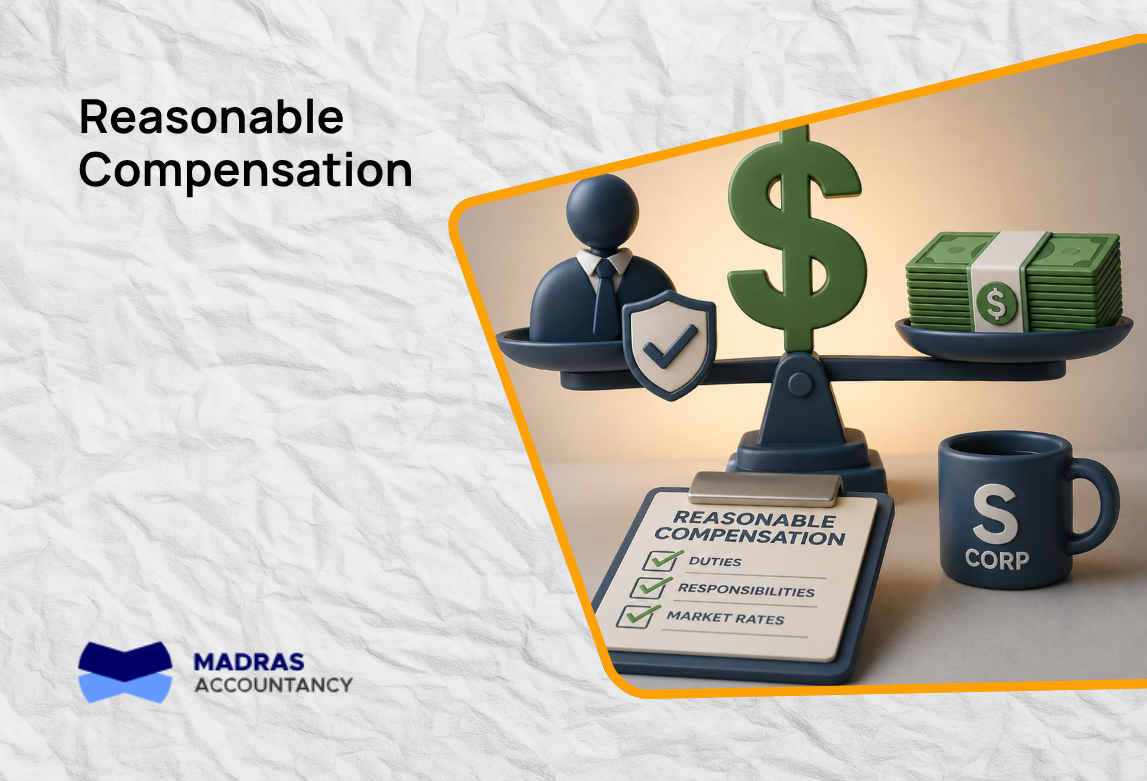

Running your business as an S corp comes with a real tax advantage. You can take part of your profit as distributions that skip payroll tax. But there is a catch that trips up a lot of business owners, and the IRS watches it closely. Before you touch that money, you have to pay yourself a salary the agency calls reasonable.
That phrase, reasonable compensation, is where owners get into trouble. Pay yourself too little to dodge taxes, and you are inviting an audit. Here is how the rule works, why it exists, and how to land on a number that keeps you safe.
The rule is simple to state. If you are a shareholder who also works in your S corp, you are a shareholder-employee, and the law says you must be paid reasonable compensation for that work before you take money out. These rules bind all shareholder-employees, and they all center on the words “reasonable compensation” written into the regulations.
This is not optional. Shareholders who perform services for the corporation are required by the Internal Revenue Service to receive a reasonable wage first. The reason the IRS requires it is plain. Distributions avoid payroll tax, so without this rule every owner would set salary at zero and call the rest a distribution. The S corp reasonable compensation standard stops that game. In short, you pay yourself reasonable compensation first, and paying the owner a fair wage is the price of the tax break.
To see why this matters, look at how the two kinds of pay are treated.
Your salary is a W-2 wage. It is subject to employment taxes, the same Social Security and Medicare that hit every paycheck, plus federal unemployment tax. Together those payroll taxes run about 15.3 percent on pay up to the Social Security wage base, which is 184,500 dollars for 2026. Distributions are different. They are your share of business income as an owner, and they are not subject to those payroll taxes at all.
That gap is the whole reason owners are tempted to take a small salary and large distributions. A dollar moved from wage to distribution can save roughly 15 cents in tax. Multiply that across a year, and the savings, or the temptation, gets real. It is also why some owners try to take distributions rather than salary entirely, which is exactly what the rule blocks.
Here is where the risk lives. If the IRS decides your pay was unreasonably low, it can reclassify your distributions as wages after the fact.
When that happens, the money you called a distribution can be reclassified as compensation you should have run through payroll. You owe the back payroll taxes on it, both the employee and employer share, plus interest and a penalty. That penalty applies even when no extra income tax was due. Those penalties stack quickly, and the IRS may also look into prior years, so one bad call can echo backward. The classic example is the Watson case, where a CPA paid himself 24,000 dollars while pulling more than 200,000 dollars in distributions. The court reset his reasonable wage to roughly 91,000 dollars, and the bill followed.
None of this means distributions are bad. It means the split has to be defensible. A low salary paired with high payouts is exactly the pattern that draws IRS scrutiny and triggers an audit. The IRS audits these splits regularly, and the cost of losing that audit can erase years of savings.
So what number is safe? There is no magic formula, and the IRS can't require a specific figure. What it can do is expect a reasonable salary backed by real evidence.
The way to determine a reasonable salary is to figure out what someone would pay for similar work. Look at what similar businesses pay people doing your job, with your experience, in your area. Good sources include Bureau of Labor Statistics wage data, salary surveys, and broader industry standards, all of which point to the market value of your role. The IRS uses these same benchmarks, so a salary comparable to the going rate is your strongest defense. There are no rigid IRS guidelines with a single number, but the IRS considers a consistent set of factors.
Those factors are common sense: your training and experience, your duties, the hours you put in, and what the business would pay someone else to do the job. A formal reasonable compensation analysis ties all of that together into a reasonable compensation based on data, not a hunch. Landing on an S corp reasonable salary this way is mostly research, and a few salary examples from comparable roles make the target concrete. To determine reasonable compensation well, write down the reasoning and data behind your figure, and know what owners pay themselves for the same job.
A number you cannot explain is almost as risky as a low one. The documentation is what protects you.
Keep your salary information and the comparison data in a file. Note the compensation levels you looked at, the sources you used, and how you landed on your figure. Setting reasonable compensation is easier to defend when you record the total compensation paid and the reasoning behind it in real time. If you chose a lower salary because the business had a slow year, write down why. These compensation decisions look very different to an examiner when documented up front versus reconstructed under audit. The standard is simple: the compensation is reasonable only if the reasonable compensation must rest on something more than a guess, and meeting that salary requirement is mostly about evidence.
On the paperwork side, your salary runs through normal payroll. You issue yourself a W-2 for the wages, and the company reports the payroll on IRS Form 941 each quarter. The amount paid by the S corporation is a deduction on the business return, which lowers the income tax the entity passes through.
The company itself files an income tax return for an S corporation, Form 1120-S, that shows both the wages and the distributions. Everything ties together, so the salary you set appears in several places and has to stay consistent across all of them.
Reasonable compensation sits right where tax planning meets payroll, and it is easy for a CPA firm to deprioritize until an audit notice lands. Running the comparables, processing the salary payments, and keeping documentation current takes time most teams are short on during the season.
That is where we help. Madras Accountancy offers small business payroll services and the tax preparation support behind reasonable compensation work, so your S corp owners get defensible numbers and clean filings under your firm's name. When the compensation reviews pile up, let us take them on.
These are common questions owners ask about paying themselves.
What is a reasonable salary for an S corp owner? There is no fixed answer. A reasonable salary for S corporation owners is whatever the market pays for the work you do, based on your role, experience, and location. Many owners set an annual salary near what they would pay an employee for the same job.
Is there a minimum salary or a 60/40 rule? No. There is no minimum salary written into the tax code, and the popular 60/40 split is a rule of thumb, not law. Your S corp salary has to reflect real work, so a percentage shortcut will not protect you in an audit.
Can I skip salary and take only distributions? If you work in the business, no. Some owners might prefer all payouts, but skipping a salary entirely is the fastest way to get reclassified. You have to receive a reasonable wage before distributions.
How is this different from a C corporation? A C corporation pays its owners as employees and is taxed on its own profit, so the reasonable pay pressure runs the other way. After an S corp election, the concern flips to making sure salary is not too low rather than too high.
What does the IRS look at to decide? It weighs your duties, experience, time spent, and what comparable roles earn. The same factors that set employee compensation for any hire are the ones used to test whether an owner's pay is fair.
What if my business has a rough year? Lower profits can justify salary reductions, within reason. Document the drop in business and tie the lower number to it, so the change looks like a response to results rather than low compensation to avoid taxes.
Do all S corp owners need a salary? Only those who work in the business. A passive S corporation owner who performs no services may not need a wage, while an active one does. When in doubt, treat owner salary like any other employee salary question and benchmark it.
What happens during an audit? The examiner compares your pay to your S corp distributions and your role. If the salary looks low for the work, expect questions, back taxes, and penalties, so be ready with the data that shows your compensation is reasonable.
Reasonable compensation is one of those rules where getting it slightly wrong is cheap to fix up front and expensive to fix later, often with penalties on top. Pay yourself a fair wage for the work you do, document how you got there, and keep the salary and distributions in a defensible balance. Do that, and the S corp tax advantage stays yours to keep.
This article is general education for small business owners and their advisors, not tax advice. Compensation rules turn on your specific facts, so review your salary and structure with a qualified professional before you file.
Section 4960's 21% excise tax now reaches far more nonprofit employees. See who is a covered employee in 2026 and what changed.

The Section 45S paid family leave credit is permanent for 2026 with new options. See who qualifies, the amounts, and how to claim it.

Opportunity zones become permanent in 2027 under the One Big Beautiful Bill. See the new deferral, rural bonus, and the 2026 handoff.