

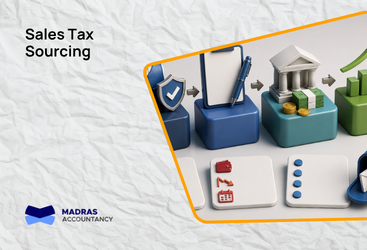

If you sell to customers in more than one location, figuring out which rate to charge is one of the trickiest parts of sales tax compliance. The answer depends on something called sourcing, and it is not the same in every state.
Sourcing means determining which jurisdiction's rate applies to a given transaction. Some states look at where the customer receives the product. Others look at where the seller is located. A few use a mix of both depending on what is being sold. Getting this right matters because charging the wrong rate can create problems when it is time to file. The buyer in each transaction determines which local tax applies, and mistakes add up fast.
The majority of states use destination-based sourcing. Under these rules, the tax is based on where the customer takes delivery. That address determines which state, county, and city sales tax rate gets applied to the transaction.
So if you are a seller in Dallas but ship a product to Houston, you would charge sales tax at the Houston rate, not the Dallas rate. The tax rate applied is the one at the delivery point, including any local sales tax that applies in that jurisdiction.
This is the approach favored by the Streamlined Sales Tax agreement, and it is where most states have landed. It makes sense from a policy standpoint because the person receiving the goods is using public services at that location, so that community gets the revenue.
For businesses, this method requires looking up rates for every delivery address. The correct sales tax rate can change from order to order depending on where each one ships. With thousands of tax jurisdictions across the country, this is where tax automation tools earn their keep.
A smaller group of states takes the opposite approach. Under this method, the rate is set by the seller's business location rather than the customer's address. You charge the rate where your operation sits, regardless of where the product ends up.
In states that follow this model, if your warehouse and office are in one city, every sale of tangible personal property ships at that rate. The delivery address does not change the amount charged.
This is simpler to manage because you are always working with the same numbers. But it can create friction when the customer is in a different area and expects their local rate on the invoice. It also means the appropriate local sales tax is not going to the community where the product is actually used.
States with this approach typically still require the destination method for certain sales that cross state lines. So even there, you may need to source to the delivery point for interstate shipments.
Some states do not fit neatly into either bucket. These states apply one method to certain types of transactions and another method to others.
For example, a state might charge based on the seller's location for in-store retail sales of tangible personal property, but switch to the destination method for online sales or remote sales. Others split by whether the transaction is intrastate or interstate.
This is where things get complicated. You need to know not just which state you are dealing with, but what type of sale it is and how that state's tax code treats the category. Checking the department of revenue website for each state you sell into is a good starting point, and many publish a sourcing chart that maps transaction types to rules.
Most sourcing rules were written with physical goods in mind: tangible personal property that ships from one place to another. Sales of services are a different story.
Service sourcing varies more from state to state than goods. Some states source to where the service is performed. Others look at where the benefit is received. A few look at where the customer is located. There is no single national standard.
For SaaS and digital products, the rules get even more specific. Some states treat digital goods the same as physical property and apply the same method. Others have carved out separate rules for digital transactions entirely.
If your business makes sales of services across state lines, the sourcing requirements deserve extra attention. Getting this wrong can mean collecting and remitting sales tax to the wrong jurisdiction, or missing the obligation to collect entirely.
Since the Wayfair decision in 2018, remote sellers with economic nexus in a state must register and collect sales tax there. But nexus only tells you whether to collect. Sourcing tells you how much.
For sales to customers outside your home state, nearly every state uses the destination method. Even states that normally use the seller's location for local transactions switch to the delivery address for remote sellers. That means if you are selling online to people across the country, you are almost always looking at the shipping address to determine the correct rate.
This is the practical challenge. You need accurate addresses, up-to-date rate tables, and a way to handle the fact that local sales or use tax rates can change quarterly. Many businesses collect and remit in dozens of states, each with its own filing schedule and sourcing requirements.
For firms handling sales tax compliance for clients with multi-state exposure, Madras Accountancy supports the research and filing process.
Use tax is the flip side of sales tax. When a taxable sale happens and the seller does not collect, the purchaser owes use tax to their home state. The sales and use tax rate is usually the same as what would have applied had the seller collected.
The sourcing here is straightforward: the purchaser owes based on where they make first use of the product. Once the buyer makes first use, that jurisdiction gets the revenue. If you buy equipment from an out-of-state vendor that does not collect tax, you remit use tax to your own state's department of revenue at the local rate.
Most businesses know this in theory but not always in practice. State sales tax auditors regularly check for unpaid amounts, and it is one of the most common findings.
1. What is sales tax sourcing? It is the process of determining which jurisdiction's rate applies to a transaction. The rules tell you whether to use the rate at the seller's location or the delivery address.
2. What is destination-based sourcing? The tax is based on where the customer receives the product. The state, county, and local rates at the delivery address determine the total charged.
3. What is origin-based sourcing? The rate is based on the seller's location. The rate at the seller's office, store, or warehouse applies regardless of where the product ships.
4. Which states use origin-based rules? A smaller group, including Texas, Ohio, Pennsylvania, and Virginia, use this model for at least some transactions. Most other states are destination-based.
5. How are services sourced? It varies by state. Some source to where the service is performed, others to where the benefit is received, and others to where the customer is located.
6. Do remote sellers use destination or origin rules? Nearly all states require remote sellers to use the destination method. Even states that are normally origin-based for local sellers apply destination rules to out-of-state sellers.
7. What is use tax? It is a companion to sales tax. When a seller does not collect on a taxable sale, the purchaser owes use tax at the applicable rate to their home state based on where they use the product.
8. How do I find the correct rate for a specific address? Check the state's revenue department website for rate lookup tools, or use a tax automation platform that maps rates to addresses in real time.
Section 4960's 21% excise tax now reaches far more nonprofit employees. See who is a covered employee in 2026 and what changed.

The Section 45S paid family leave credit is permanent for 2026 with new options. See who qualifies, the amounts, and how to claim it.

Opportunity zones become permanent in 2027 under the One Big Beautiful Bill. See the new deferral, rural bonus, and the 2026 handoff.