



When you buy a business, a big slice of the price rarely goes to things you can touch. You are paying for the customer list, the brand, the trained staff, the seller's promise not to open a competing shop down the street. Those are intangible assets, and the tax code has a clean, if slightly rigid, answer for how you deduct them. It is called Section 197 amortization, and once you see how it works, it stops feeling like a mystery. Let us walk through it together.
Amortization is just depreciation's cousin for intangible assets. Instead of writing off the cost of a delivery truck over its useful life, you write off the cost of an intangible over a set period. IRC 197, titled Amortization of Goodwill and Certain Other Intangibles, is the part of the Internal Revenue Code that governs this.
Before 1993, buyers and the IRS fought constantly over how to value and deduct intangibles. Section 197 swept that mess aside with one uniform answer. Take the cost of a qualifying intangible acquired in connection with a trade or business, and amortize it over 15 years. Same rule for almost every type of intangible, which is exactly why it made life simpler.
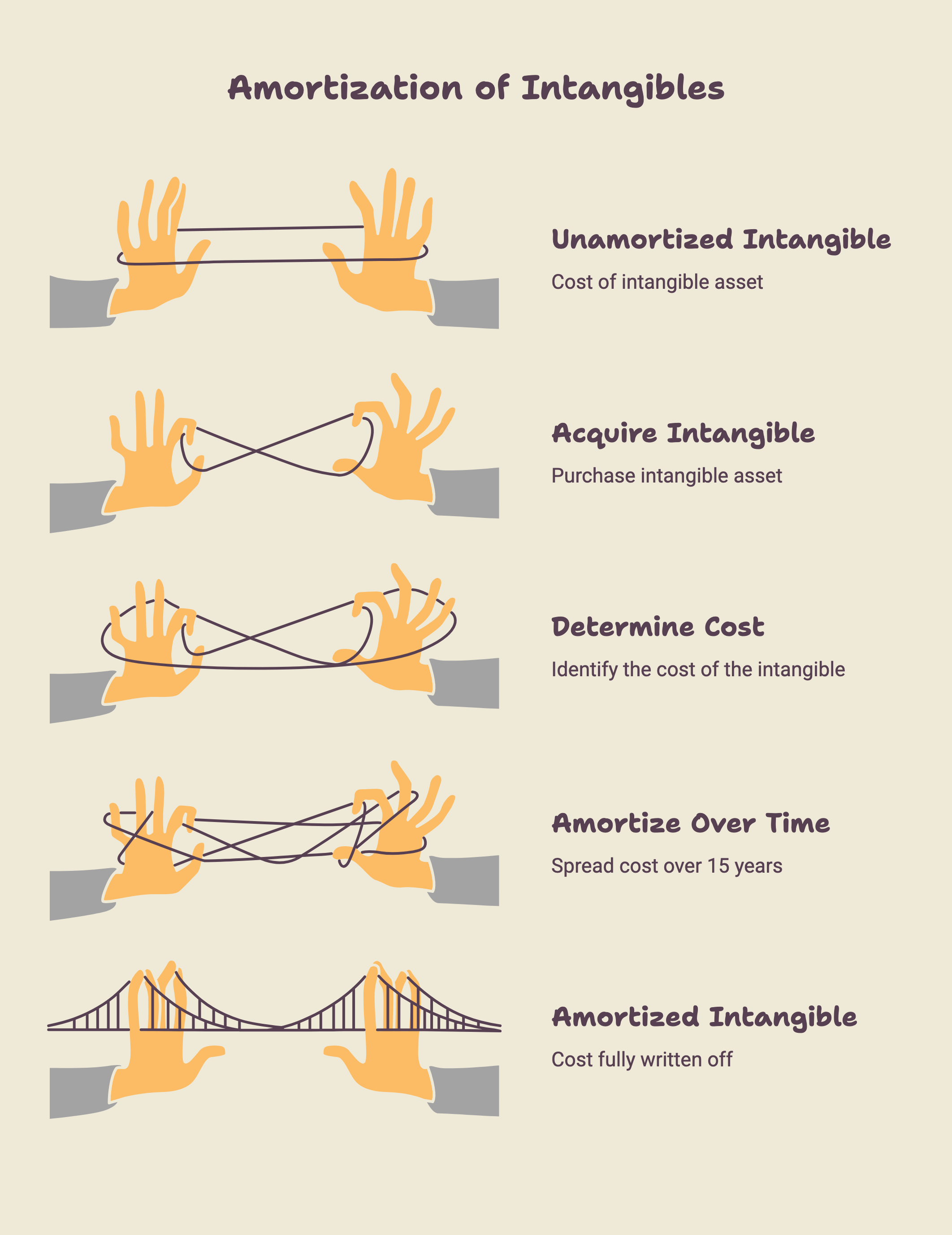
Here is the heart of it. A section 197 intangible must be amortized straight-line over 180 months, which is 15 years, starting with the month of acquisition. Straight-line simply means the same amount every month, no front-loading.
The math is friendly. Take the tax basis of the intangible, divide by 180, and that is your monthly amortization deduction. Say you buy a business and $900,000 of the purchase price is attributable to goodwill. Divide by 180 and you deduct $5,000 a month, which is $60,000 for a full tax year, every year for the next 15 years. If you acquired it in, say, October, your first year only counts the months from October forward, and you pick up the leftover months at the tail end.
One thing trips people up: the 15-year period is fixed by statute. It does not matter if the asset's real useful life is shorter. A covenant not to compete might run just three years on paper, but if it is a section 197 intangible, it still gets the full 15-year amortization schedule. There is no accelerated method and no bonus write-off here.
The list of qualifying intangible assets is broad, which is the point. As long as the asset is acquired as part of buying a trade or business, it generally lands in the section 197 bucket. Common ones include:
There is a useful catch to know about. Some assets with a determinable useful life, like software you buy off the shelf separately or a patent you license outside of a business purchase, may follow different rules. Section 197 is really built for intangibles you pick up when you buy a business, not for every intangible under the sun.
Before you can amortize anything, you have to know how much of the deal price belongs to each asset. When you buy a business, the total price gets split, or allocated, across everything you bought: the tangible property like equipment, and the intangibles like goodwill.
This allocation is not a guess you keep to yourself. Both the buyer and seller report it to the IRS on Form 8594, the Asset Acquisition Statement, and your numbers should match the seller's. Whatever is left after you assign value to identifiable assets usually ends up as goodwill, which is why goodwill is often the biggest section 197 line in a deal. For the accounting side of how a deal gets recorded, our ASC 805 guide to business combinations is a helpful companion, since the tax basis and the book treatment do not always line up. An appraisal is worth getting when the intangibles are large or hard to value.
Claiming the amortization deduction is refreshingly simple once the basis is set. You report it on Form 4562, Depreciation and Amortization, in the amortization section (Part VI). You list the intangible, the date you acquired it, the cost basis, the code section (197), and the amount you are deducting this tax year.
You file Form 4562 for the first year you start amortizing. In the years after, you keep claiming the annual amortization on your return even if you are not required to attach the form again, and a clean amortization schedule in your records keeps everything tidy. The IRS instructions for Form 4562 spell out the reporting details if you want the official word.
Here is the one trap worth flagging. Congress did not want people creating fresh amortization out of thin air by shuffling old intangibles between related parties. Imagine a business owner who has goodwill with no tax basis, then "sells" the business to a family member so the new owner can suddenly start deducting that goodwill over 15 years. That would be gaming the system.
The anti-churning rules in Section 197(f)(9) shut this down. They deny amortization when goodwill or similar intangibles held before Section 197 took effect in August 1993 are transferred to a related person and the actual user of the asset does not really change. The Section 1.197-2 regulations lay out the mechanics. For a normal arm's length purchase from an unrelated seller, this almost never comes up. But in family deals and internal restructurings, it can quietly wipe out the deduction, so it is worth a careful look before you close.
Do not confuse tax amortization with what happens on your financial statements. For book purposes, goodwill is generally not amortized on a set schedule; instead it is tested for impairment. That is a separate world from the 15-year tax write-off, and our piece on goodwill impairment covers that side. The takeaway is that your book goodwill and your section 197 amortization can look very different in the same year, and that is normal.
What is Section 197 amortization?
It is the tax rule that lets a buyer deduct the cost of goodwill and other acquired intangible assets. Under IRC 197, you amortize the cost straight-line over 15 years, or 180 months, starting the month you acquire the asset.
How long is the Section 197 amortization period?
Exactly 15 years, which is 180 months. This period is fixed by the tax code and applies even if the intangible's real useful life is shorter or longer.
What assets qualify as Section 197 intangibles?
Goodwill, going concern value, customer lists, a workforce in place, patents, trademarks, trade names, licenses, franchise rights, and covenants not to compete, when acquired in connection with buying a trade or business.
How do I calculate the amortization deduction?
Divide the asset's tax basis by 180 to get the monthly deduction, then multiply by the number of months you held it during the tax year. For a full year that is basis divided by 15.
Which form do I use to report Section 197 amortization?
Form 4562, Depreciation and Amortization. You report section 197 intangibles in the amortization section, Part VI, showing the description, date, basis, and current deduction.
Can goodwill be amortized for tax purposes?
Yes. Purchased goodwill acquired as part of a business is a section 197 intangible and is amortized over 15 years. This is different from book accounting, where goodwill is tested for impairment instead.
What are the anti-churning rules?
They are safeguards in Section 197 that deny amortization when pre-1993 intangibles are transferred between related parties without a real change in who uses the asset. They mostly affect family and related-party deals.
Is Section 197 amortization the same as depreciation?
They work alike but apply to different things. Depreciation covers tangible property like equipment, while amortization covers intangible assets. Both spread a cost over time, and both are reported on Form 4562.
The section 4960 excise tax is 21% of nonprofit pay over $1M. From 2026 it covers all employees. See the medical carve-outs, Form 4720 and a worked example.

The paid family and medical leave tax credit is permanent from 2026. See the 12.5% to 25% rates, the premium option, the 6-month rule and how Form 8994 works.

Opportunity zones become permanent in 2027 under the One Big Beautiful Bill. See the new deferral, rural bonus, and the 2026 handoff.