



A single-member LLC creates legal separation between you and your rental property, protecting personal assets from tenant lawsuits. The IRS treats it as a disregarded entity, you report rental income on Schedule E without filing separate returns. This provides liability protection without changing taxes, ideal for landlords owning 1-5 properties seeking asset protection.
You own two rental properties free and clear. A tenant slips on ice, sues for $500,000. Your insurance covers $300,000. Without an LLC, they can pursue your personal savings, retirement accounts, and home for the remaining $200,000.
This drives landlords to form LLCs. A single-member LLC creates a legal shield, tenants can only sue the LLC and access property it owns, not your personal assets.
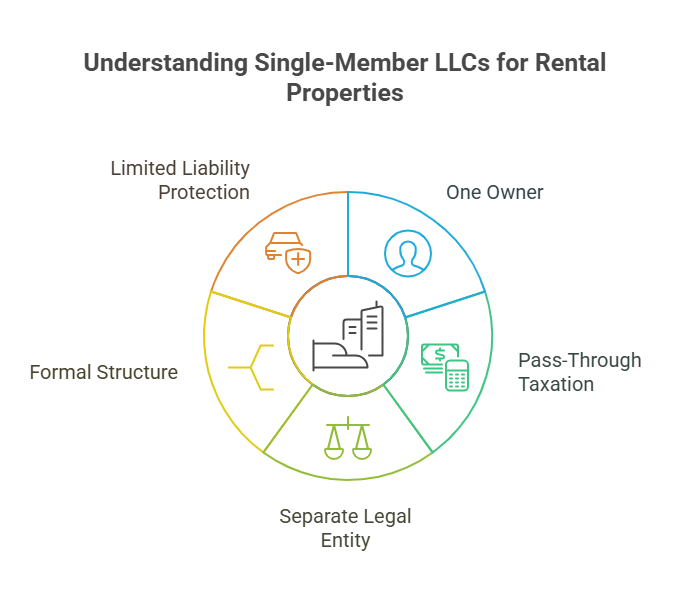
A single-member LLC is a limited liability company with one owner creating legal separation between you and your rental property. When you form an LLC, the LLC owns the real estate, not you directly. This separation protects your personal assets.
The IRS classifies single-member LLCs as "disregarded entities." The LLC doesn't file its own income tax return. You report rental income on Schedule E of your Form 1040, exactly as if you owned property personally. The LLC provides legal protection without changing taxes.
Key Characteristics: One owner, pass-through taxation, separate legal entity, requires formal structure (operating agreement, separate bank account), and provides limited liability protection.
The IRS disregards single-member LLCs, they're treated as if they don't exist for taxes. You report rental income and expenses on Schedule E using your Social Security number. The LLC doesn't need an EIN unless it has employees.
Pass-through taxation means rental profits flow to your personal return. You pay income tax at personal rates. Most rental owners qualify as passive investors exempt from self-employment tax.
Some states impose excise tax: California charges $800 annual franchise tax. Check your state's requirements, they impact whether forming an LLC makes financial sense.
LLCs protect personal assets from rental liabilities. If tenants sue, they can only access LLC assets, not your personal savings, home, or retirement accounts. LLCs provide privacy, property deed lists LLC name rather than yours. "Smith Properties LLC" looks professional.
However, LLCs create costs: formation fees ($50-500), annual state fees ($0-800), registered agent fees ($100-300 yearly). Lenders charge 0.25-0.50% higher interest rates. Mixing personal and LLC finances destroys protection through "piercing the veil."
Advantages: Asset protection, privacy, professional image, easier to add partners.
Disadvantages: Annual fees, complex bookkeeping, higher mortgage rates, strict finance separation required.
Form an LLC by filing Articles of Organization with your state's Secretary of State. Choose a unique LLC name, designate a registered agent, and pay filing fees ($50-500). Processing takes 1-3 weeks.
Draft an operating agreement establishing how you'll run the LLC. This strengthens liability protection by proving genuine business operations. Open a dedicated business bank account immediately. Never mix personal and rental funds.
Formation Checklist: Choose LLC name, file Articles, pay fees, create operating agreement, obtain EIN, open bank account, transfer property deed, update insurance, notify lender.
Hire an attorney for property transfers. Professional deed preparation costs $500-1,500 plus transfer taxes but prevents title insurance problems.
Transfer property by executing and recording a quitclaim or warranty deed from you (individual) to your LLC. Record with your county recorder ($25-200 fees).
Mortgaged properties create complications. Most mortgages have due-on-sale clauses allowing lenders to demand full payoff. Federal law provides exemptions where borrower maintains beneficial ownership.
Contact your lender before transferring. Many waive the clause for single-member LLCs. Get written approval. Some require personal guarantees reducing protection.
Buy new rentals directly in LLC name to avoid complications. If you own property already, wait until refinancing to transfer. Many investors handling multiple property accounting find this simplifies bookkeeping.
For one property with minimal equity, LLC costs often outweigh benefits. Property worth $200,000 with $180,000 mortgage has only $20,000 equity at risk. Liability insurance ($1-2 million umbrella costing $200-400 annually) might protect better than an LLC costing $500-1,000 yearly.
However, if you own property free and clear, have substantial personal assets, or own high-risk properties, forming an LLC makes sense.
Consider long-term plans. If this is your first rental with plans for more, forming an LLC now establishes structure for growth.
Form if: You own property free and clear, have significant assets, own high-risk properties, plan multiple properties, or work in lawsuit-prone profession.
Skip if: You have minimal equity, have adequate insurance, are in low-risk market, forming costs exceed risk, or can't maintain LLC formalities.
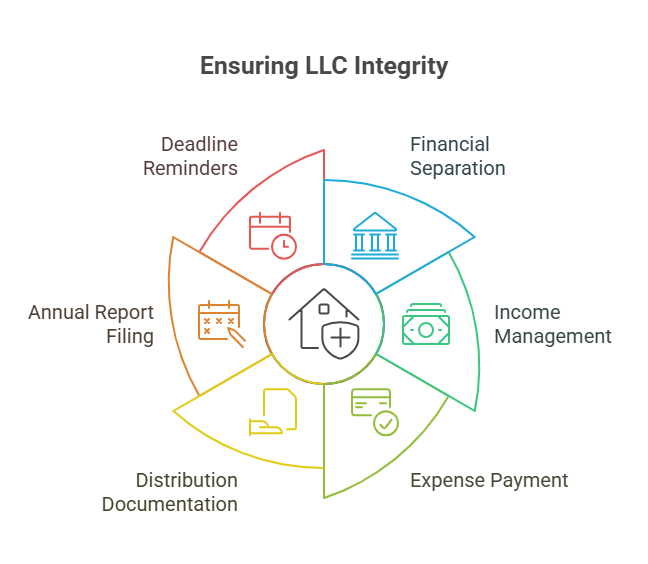
Maintain strict separation between personal and LLC finances. All rental income deposits into LLC account. All property expenses pay from LLC account. Taking cash? Formally document it as an owner distribution. Courts can "pierce the corporate veil" if you treat it as your personal account.
File all required annual reports with your state on time. Missing filings can result in administrative dissolution, costing you LLC status and liability protection. Set calendar reminders for deadlines.
Keep LLC documents current. Update your operating agreement to reflect reality. Courts examining your LLC will check whether you followed stated procedures. Proper documentation proves your LLC operates as legitimate business.
Annual Tasks: File state reports, pay franchise taxes, renew registered agent, reconcile accounts monthly, maintain separate records per property, document distributions, update operating agreement, ensure adequate insurance.
Insurance remains essential even with LLC protection. Your LLC needs comprehensive rental insurance (typically 25% more than homeowner's policies). Add $1-2 million umbrella policy. Landlords managing comprehensive budgets should factor insurance as non-negotiable.
Yes, if you want liability protection separating personal assets from rental risks. An LLC shields personal finances if tenants sue. However, single-member LLCs don't provide tax benefits, the IRS treats them as disregarded entities taxed on your personal return. Main value is legal protection, not tax savings.
The IRS treats single-member LLCs as disregarded entities. You report rental income on Schedule E of your 1040, just like owning property individually. The LLC doesn't file separate returns. You can elect corporate taxation if it provides advantages, but most stick with default pass-through treatment.
Formation varies by state: $50-500 filing fees, plus annual taxes/reports ($0-800). Add $500-1,500 for legal assistance. Ongoing costs include registered agent fees ($100-300 annually), separate bank accounts, and higher insurance. Budget $1,000-2,500 first year, then $300-1,000 annually.
Yes, but watch complications. Transfer triggers due-on-sale clauses allowing lenders to demand full payment. Many waive this for single-member LLCs. You'll pay recording fees, potential transfer taxes, and may need lender approval. Consult an attorney before transferring mortgaged properties.
Depends on risk tolerance and budget. Separate LLCs provide maximum protection, one property's lawsuit won't affect others. However, each costs $300-1,000 annually. For 2-3 properties, one LLC often suffices. Beyond 5 properties, consider separate LLCs or series LLCs.
Single-member LLCs have one owner and file Schedule E. Multi-member have 2+ owners, file Form 1065, and issue K-1s. Multi-member LLCs offer stronger protection in some states and more distribution flexibility. Choose single-member for solo ownership simplicity; multi-member when co-owning.
Yes, with limitations. LLCs shield personal assets from tenant lawsuits and business debts. However, they don't protect against personal loan guarantees, tax debts, or fraud. You must maintain corporate formality, separate finances, proper documentation, adequate insurance, or courts can pierce the veil.
Yes. Madras Accountancy provides comprehensive tax preparation for rental property LLCs, handling Schedule E reporting, depreciation calculations, and state compliance. We ensure proper documentation while maximizing deductions. We serve real estate investors nationwide with same-day support at 40% lower cost.
Assess whether LLC benefits justify costs for your situation. If you own property with substantial equity, have personal assets to protect, or plan to grow a rental portfolio, forming an LLC makes sense. Most landlords form LLCs in the state where properties are located to avoid foreign LLC registration.
Work with professionals for setup. A real estate attorney ensures proper formation and property transfers. An accountant sets up bookkeeping correctly from day one. The $1,500-2,500 investment prevents costly mistakes.
Madras Accountancy specializes in tax preparation and bookkeeping for rental property LLCs. We handle Schedule E reporting, depreciation tracking, and multi-state compliance. Our team ensures proper records while maximizing deductions, all at 40% lower cost through our offshore partnership model.

Section 4960's 21% excise tax now reaches far more nonprofit employees. See who is a covered employee in 2026 and what changed.

The Section 45S paid family leave credit is permanent for 2026 with new options. See who qualifies, the amounts, and how to claim it.

Opportunity zones become permanent in 2027 under the One Big Beautiful Bill. See the new deferral, rural bonus, and the 2026 handoff.