


A profitable company that keeps piling up cash instead of paying it out seems like it is just being careful. The IRS sometimes sees it differently, and there is a special penalty built for exactly that situation.
That penalty is the accumulated earnings tax, a 20% charge the Internal Revenue Service can impose on a C corporation that holds onto too much of its profit for the wrong reason. The idea is simple: if a corporation stockpiles earnings mainly to spare its shareholders the income tax they would owe on dividends, the government wants its cut anyway. This guide explains what the AET is, when it applies, the cushion that protects most companies, and how to stay clear of it. The good news is that it rarely surprises a business that plans ahead.
Most companies never owe a cent of it.
The ones that get caught are usually sitting on cash with no clear reason, and that is a fixable problem once you understand the rules.
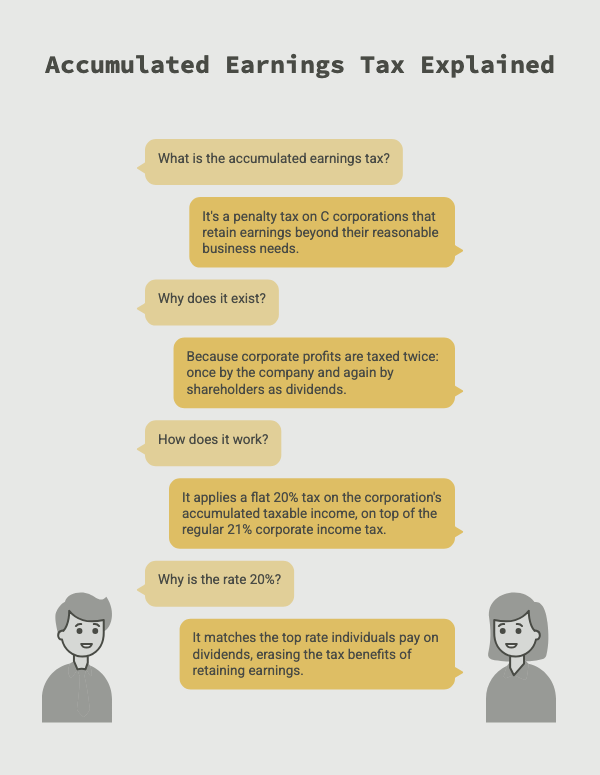
The accumulated earnings tax is a penalty tax on a C corporation that retains earnings beyond what its business reasonably needs.
It exists because of how corporate profit is taxed twice. The company pays tax on its taxable income, and shareholders pay again when those earnings come out as dividends. Since the Tax Cuts and Jobs Act set the corporate income tax rate at 21%, this corporate-level tax plus the individual tax on dividends, including the 3.8% net investment income tax, is the double hit the rules assume shareholders want to dodge for tax purposes. A corporation could dodge that second layer by simply never paying dividends and letting profit build up inside the company, which lets a shareholder avoid income tax on distributions they never receive. The AET closes that gap. It applies a flat 20% to the corporation's accumulated taxable income, on top of the regular 21% corporate income tax, so the strategy of hoarding to avoid tax stops paying off.
The rate is not an accident.
It matches the top rate individuals pay on dividends, which is the whole point, to erase the tax benefits of retaining a large amount of earnings rather than distributing them.
Two things have to be true before the tax can bite, and both matter.
First, the corporation must have accumulated earnings beyond the reasonable needs of the business. Second, that accumulation must be for the purpose of avoiding income tax on its stockholders. The second part is the trigger, a purpose to avoid tax, but the law makes it easier for the IRS to prove: if a corporation keeps accumulating earnings past its reasonable needs, a tax avoidance purpose is presumed unless the company can show otherwise. That presumption is what can create the tax liability. The tax applies to any regular corporation, closely held or public, though it does not apply to a personal holding company, which faces its own penalty instead. This is why the reasonable needs question ends up being the whole ballgame.
Intent is hard to see, so the law reads it from the balance sheet.
An unreasonable accumulation of earnings with no business explanation looks like tax avoidance, and that presumption is what the corporation has to overcome.
Here is the cushion that keeps the penalty off most businesses: the accumulated earnings credit.
Every corporation gets to accumulate a baseline amount without having to justify a thing. The law grants a minimum accumulated earnings credit of $250,000, or $150,000 for personal service corporations in fields like health, law, engineering, accounting, and consulting. Below that line, there is nothing to defend. The credit is actually the greater of that minimum or the amount your business genuinely needs, so a company with real plans can accumulate far more than $250,000. An accumulation above the minimum is not by itself a sign of anything wrong, since the tax law treats it as excess accumulated earnings only when the reasonable needs of the business cannot carry the extra weight.
The threshold is a floor, not a ceiling.
Cross it and you are not automatically taxed, you simply move into territory where documentation starts to matter.
This is where most of these questions are won or lost, because the reasonable needs of the business is a facts-and-circumstances test.
The tax code accepts accumulations tied to specific, definite, and feasible plans. That includes working capital for day-to-day operations, funding a real expansion, retiring debt, replacing plant and equipment, and meeting reasonably anticipated future needs of the business. Vague intentions do not count, the plan has to be concrete and documented in board minutes, forecasts, and the like. On the other side, certain moves signal an unreasonable accumulation: loans to shareholders, undistributed earnings in investments with no relationship to the business, a weak dividend history, and cash set aside against unrealistic hazards. Those are the patterns tax examiners look for.
Documentation is the defense.
A corporation that can point to written plans for its retained profit is in a far stronger position than one holding cash it cannot explain.
Unlike most taxes, the AET is not something a corporation calculates and pays on its own return.
There is no line for it on the federal income tax return. Instead, the IRS raises it during an audit, when tax examiners look at a corporation's accumulated earnings and decide the pile has grown past what the business needs. At that point the burden is on the corporation to prove its accumulations were reasonable. If it cannot, the IRS assesses the tax, and the tax imposed at the 20% tax rate means the corporation can suddenly owe tax it never planned for, with interest running from the original due date of the corporate tax return. A corporation that disagrees can take the fight to Tax Court, which is where many reasonable needs disputes are settled.
This is a tax you argue about, not one you file.
Because it surfaces on audit, the time to build your case is long before an examiner ever asks, not after.
Staying clear of this penalty is mostly about two habits, and neither is complicated.
The first is paying dividends, the direct way to avoid the income tax the penalty is built around. Distributing earnings to shareholders reduces the corporation's accumulated earnings balance and cuts the accumulated taxable income the tax is based on, and dividends paid within the first two and a half months after year-end still count for the prior year. The second is documentation. If you are going to retain earnings, tie the cash to specific business plans and record the reasoning contemporaneously, so a reasonable business need is on paper before anyone asks. A deliberate approach to retained earnings, revisited each tax year, is what keeps a growing company out of trouble.
The fix is rarely dramatic.
A well-timed dividend or a clearly documented plan usually resolves the exposure long before it becomes a real problem.
The AET has a cousin that trips people up, the personal holding company tax.
Both are flat 20% penalties aimed at undistributed corporate earnings, but they target different situations and never apply to the same company in the same year. The personal holding company tax hits closely held companies that earn most of their income passively, from dividends, interest, rents, and royalties, and it is self-assessed by filing Schedule PH with the federal income tax return. The AET, by contrast, is not automatic and applies to operating companies that simply retain too much. A corporation subject to the PHC tax is not also hit with the AET, since those holding company rules take priority. The tax treatment and the tax consequences depend on which set of rules applies.
Same rate, different targets.
One catches passive investment vehicles automatically, the other catches operating companies on audit, and knowing which one is in play changes the entire tax computation.
For a CPA firm, this penalty is a planning issue where the work happens years before any audit.
Tracking a client's accumulated earnings and profits, documenting the reasonable needs of the business behind retained cash, calculating that accumulated income, and timing dividends to manage exposure is exactly the kind of ongoing corporate work that protects a client from a surprise assessment. At Madras Accountancy, we help U.S. CPA firms handle the tax preparation and planning around corporate earnings, from building the documentation that supports an accumulation to modeling dividend strategies, backed by the fractional CFO support that keeps a client's cash and profit-retention decisions defensible.
The goal is a paper trail, not a scramble.
Document the business reasons as the cash accumulates, and a corporation is ready long before an examiner ever raises the question.
This article is general information, not tax advice, so check the current IRS rules or a tax professional for your situation.
What is the accumulated earnings tax? The accumulated earnings tax is a 20% penalty the IRS can impose on a C corporation that retains earnings beyond the reasonable needs of its business for the purpose of avoiding income tax on its shareholders. It applies to that accumulated income and sits on top of the regular corporate income tax.
How much is the AET? The tax is a flat 20% of the corporation's accumulated taxable income. That rate matches the top individual rate on dividends, and it is imposed in addition to the 21% corporate income tax the company already pays on its earnings.
How much can a corporation accumulate before the tax applies? Every corporation gets a minimum accumulated earnings credit of $250,000, or $150,000 for personal service corporations. A company can retain more than that if it can show the accumulation meets the reasonable needs of the business, since the credit is the greater of the minimum or what the business genuinely requires.
What counts as reasonable business needs? Reasonable needs include working capital, a specific and feasible expansion, debt retirement, equipment replacement, and reasonably anticipated future needs. The plans must be concrete and documented. Loans to shareholders, unrelated investments, and a weak dividend history point the other way.
How does the IRS assess the AET? The tax is not self-assessed on the return. The IRS raises it during an audit if it finds an unreasonable accumulation of earnings, and the burden is on the corporation to prove its accumulation was reasonable. Disputes can go to Tax Court, and interest runs from the original return due date.
How can a corporation avoid the tax? The two main ways are paying dividends to reduce the accumulated earnings balance and documenting the business reasons for any earnings the company retains. Dividends paid within two and a half months after year-end can count for the prior tax year.
What is the difference between the accumulated earnings tax and the PHC tax? Both are 20% penalties on undistributed earnings, but the PHC tax is self-assessed and targets closely held corporations with mostly passive income, while the accumulated earnings tax is assessed on audit and targets operating companies that retain too much. The two never apply to the same corporation in the same year.
Does the AET apply to S corporations? No. The AET applies to C corporations, because their earnings face the double tax the penalty is designed to protect. S corporation income generally passes through to shareholders and is taxed to them directly, so there is no retained corporate profit for this tax to reach.

The section 4960 excise tax is 21% of nonprofit pay over $1M. From 2026 it covers all employees. See the medical carve-outs, Form 4720 and a worked example.

The paid family and medical leave tax credit is permanent from 2026. See the 12.5% to 25% rates, the premium option, the 6-month rule and how Form 8994 works.

Opportunity zones become permanent in 2027 under the One Big Beautiful Bill. See the new deferral, rural bonus, and the 2026 handoff.



