


For almost forty years, the interest on your personal car loan was just a cost you ate. It was never deductible. That rule just changed, and a lot of car buyers have no idea the money is now on the table.
The One Big Beautiful Bill created a brand new auto loan interest deduction that lets you write off part of your interest payments on a qualifying loan, up to $10,000 a year. Some people call it no tax on car loan interest, though it is really a deduction, not a full tax on car loan interest holiday. This new tax break runs for tax years 2025 through 2028, and the best part is you do not have to itemize to get it. If you bought a new vehicle with a loan in 2025, some of what you are paying the lender may come back to you at tax time. This guide breaks down what the loan interest deduction is, which vehicles and loans qualify, the income limits, and how to claim it.
The rules are strict but simple once you see them laid out.
Get the vehicle, the loan, and your income right, and this new tax benefit can take a real bite out of the cost of borrowing.
The car loan interest deduction is a new write-off that lets eligible taxpayers deduct the interest paid on a qualifying vehicle loan.
It came out of the One Big Beautiful Bill, the tax law signed in 2025, and it is temporary by design. It is available for tax year 2025 through 2028, after which it expires unless Congress extends it. You can deduct up to $10,000 of car loan interest per year, and that maximum deduction is the same whether you file single or jointly. This vehicle loan interest deduction, sometimes written as a loan interest tax deduction, applies once you have a qualified vehicle and loan. If you are paying off more than one qualifying loan, you can combine the interest from each to reach the $10,000 cap. This is a genuine tax cut aimed squarely at people financing a new car.
The number that matters is the interest, not the loan payment.
Only the interest portion of what you pay counts, so the deduction follows the amount of interest you paid over the year, not your total monthly bill.
Here is what makes this deduction unusual and genuinely useful: it sits above the line.
Most deductions only help if you itemize, which most people no longer do since the standard deduction got so large. This one is different. The break is available whether you itemize or take the standard deduction, so you claim the deduction on your tax return without giving up the standard deduction you were already taking. If you are eligible for the deduction, you keep the write-off on your tax return either way. You report it on Schedule 1-A of your Form 1040. That single detail is why this break reaches far more people than a typical one, since you do not have to change how you file to benefit.
Most tax breaks force a choice.
This one does not, which is exactly why it is worth checking whether your loan qualifies before you file.
Not every car on the lot makes the cut, and the vehicle rules are where most people get tripped up.
To qualify, the vehicle must be new, meaning you are the first owner, and it has to be a vehicle for personal use. That vehicle must be new to count as a qualified vehicle. Used vehicles are completely excluded. It has to be built for personal use, not a business fleet, and it needs a gross vehicle weight rating under 14,000 pounds, which covers the typical car, minivan, van, SUV, pickup truck, or motorcycle. The single rule that catches people off guard is final assembly. The vehicle's final assembly must have happened in the United States, and you can confirm that from the VIN before you buy. Electric vehicles count too, as long as they check the same boxes.
The new requirement is the one to watch.
A car can be sold by a US brand and still fail the test if its final assembly happened in another country, so the VIN is worth checking.
The vehicle is only half of it. The loan has to qualify on its own terms.
The loan must have started after December 31, 2024, so financing from an earlier purchase does not count. It also has to be secured by a first lien on the vehicle, which is the standard setup for a normal auto loan from a bank, credit union, or dealer. A lease does not qualify, because a lease is not a purchase secured by that first lien. Borrowing from a family member does not qualify either. If you refinance later, you generally keep the auto loan interest deduction as long as the new loan stays a first lien on the same vehicle, even if the loan amount changes from the original loan. In that case you may be able to deduct car loan interest on the refinanced balance too.
This is the part people assume they meet without checking.
Confirm the origination date and the lien on a qualifying vehicle loan, and the loan side of the test is usually straightforward.
There is an income ceiling on this one, and it is based on your modified adjusted gross income.
The full deduction is available up to a modified adjusted gross income of $100,000 if you are single and $200,000 if you are married filing jointly. Above those thresholds you can no longer claim the full deduction, and it is reduced rather than cut off all at once. For every $1,000 your MAGI runs over the threshold, the amount is reduced by $200, so it phases down gradually and can reach zero once your income climbs high enough. This means a taxpayer just over the line still keeps most of the benefit, while for higher earners the deduction is limited and eventually disappears.
The phaseout rewards checking your number.
If your MAGI is close to the threshold, a smart move on other parts of your return can be the difference between a reduced deduction and the full one.
Claiming it is not complicated, and your lender does most of the paperwork for you.
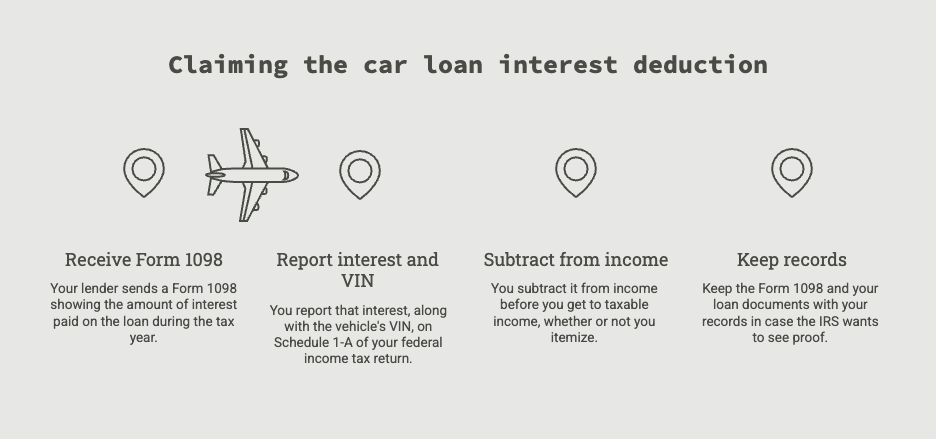
Your lender sends a Form 1098 showing the amount of interest paid on the loan during the tax year, which is the figure your deduction is built on. You report that interest, along with the vehicle's VIN, on Schedule 1-A of your federal income tax return, which is how you are able to deduct interest paid during the year. This tax deduction for interest paid, sometimes called a deduction for interest paid on a qualified passenger vehicle loan interest balance, is claimed right there on the return. Because it is above the line, you subtract it from income before you get to taxable income, whether or not you itemize. Keep the Form 1098 and your loan documents with your records in case the IRS wants to see proof of the interest paid on a qualifying loan.
The lender hands you the number.
Match the Form 1098 to your return, add the VIN, and claiming the full deduction is mostly a matter of putting the right figure in the right place. For most people, claiming the auto loan interest deduction takes only a few extra minutes.
For a CPA firm, a brand new tax break like this one is exactly where clients need guidance, because the rules are specific and the savings are real.
Checking that a vehicle's final assembly qualifies, confirming the loan is a first lien started after 2024, running the MAGI phaseout, and placing it correctly on Schedule 1-A is detailed work that repeats across every client who financed a car. At Madras Accountancy, we help U.S. CPA firms handle the tax preparation behind new provisions like the car loan interest deduction, from verifying eligibility to calculating the phaseout, supported by clean bookkeeping that keeps each client's interest and loan records in order.
The value is catching the deduction clients would miss.
Apply the new car loan interest deduction correctly for the 2025 tax year and again for the 2026 tax year, and a client who financed the right car keeps money that used to go straight to the lender. The deduction for car loan interest rewards getting the details right.
This article is general information, not tax advice, so check the current IRS rules or a tax professional for your situation.
What is the new car loan interest deduction? It is a write-off created by the One Big Beautiful Bill that lets eligible taxpayers deduct up to $10,000 of interest paid on a qualifying auto loan each year. It applies to tax years 2025 through 2028 and is available whether you itemize or take the standard deduction.
Do I have to itemize to claim the car loan interest deduction? No. This is an above-the-line break, so you can claim it whether you itemize or take the standard deduction. You report it on Schedule 1-A of your Form 1040 without giving up the standard deduction.
How much car loan interest can I deduct? You can deduct up to $10,000 of qualifying car loan interest per year. The maximum deduction is the same regardless of your filing status, and you can combine interest from more than one qualifying loan to reach the cap.
Which vehicles qualify for the deduction? The vehicle must be new, purchased for personal use, have a gross vehicle weight rating under 14,000 pounds, and have undergone final assembly in the United States. Cars, minivans, vans, SUVs, pickup trucks, and motorcycles can qualify, including electric vehicles that meet the rules.
Which loans qualify for the car loan interest deduction? The loan must have started after December 31, 2024, and be secured by a first lien on the vehicle. Standard auto loans from a bank, credit union, or dealer qualify. Leases, used-car purchases, and loans from family members do not.
What are the income limits for the deduction? The full deduction is available up to a modified adjusted gross income of $100,000 for single filers and $200,000 for married filing jointly. Above those thresholds the deduction is reduced by $200 for every $1,000 of MAGI over the limit, and it can phase out completely at higher incomes.
How do I claim the car loan interest deduction? Your lender sends a Form 1098 showing the interest paid during the year. You report that amount, along with the vehicle's VIN, on Schedule 1-A of your federal tax return. Keep the Form 1098 and loan records with your tax filing.
How long will the car loan interest deduction last? Under current law, the deduction is available for tax years 2025 through 2028. It is a temporary provision of the One Big Beautiful Bill and expires after 2028 unless Congress votes to extend it.
Section 4960's 21% excise tax now reaches far more nonprofit employees. See who is a covered employee in 2026 and what changed.

The Section 45S paid family leave credit is permanent for 2026 with new options. See who qualifies, the amounts, and how to claim it.

Opportunity zones become permanent in 2027 under the One Big Beautiful Bill. See the new deferral, rural bonus, and the 2026 handoff.