



If you run a business and pay contractors, vendors, or landlords, the 1099 rules just shifted under your feet. For years, the magic number was $600. Cross it, and you had to send someone a 1099. Starting with the 2026 tax year, that number changes, and a separate rule for payment apps flipped back to where it was a decade ago.
The good news is that both changes mean fewer forms for most businesses. The tricky part is knowing which threshold goes with which form, and when the new rules actually kick in. Let us walk through the 2026 1099 reporting threshold rules so you know exactly what you must file and when.
Here is the headline. The One Big Beautiful Bill Act raised the 1099 reporting threshold for Form 1099-NEC and Form 1099-MISC from $600 to $2,000, for payments made after December 31, 2025. In plain terms, for the 2026 tax year you only have to report payments to a payee once they hit $2,000 or more in a calendar year.
A few details worth pinning down:
Not every box on these forms changed, though. Some 1099-MISC thresholds stay put, like the $10 floor for royalties, and the rules for proceeds paid to attorneys keep their own treatment. If you want the full box-by-box picture, our 1099-NEC and 1099-MISC filing requirements guide breaks down the exceptions.
The Form 1099-K story is a reversal, and it is the one that confused everyone for years. Form 1099-K is the form payment apps and online marketplaces send, think PayPal, Venmo, Cash App for Business, Etsy, and eBay, to report payments you received for goods or services.
The American Rescue Plan Act of 2021 tried to slash that threshold from $20,000 down to $600. The IRS delayed it three times, then the One Big Beautiful Bill Act repealed the change entirely and restored the original rule, retroactive to 2022. So a third-party settlement organization only has to file Form 1099-K when a payee tops $20,000 in gross payments and more than 200 transactions in a calendar year. Both conditions have to be met, and the IRS confirmed this in its updated guidance. Unlike the 1099-NEC threshold, the 1099-K number is not adjusted for inflation, so it stays fixed.
One common mistake is applying the $2,000 figure to Form 1099-K. It does not belong there. The $2,000 threshold is for 1099-NEC and 1099-MISC only. For the deeper dive on how these 1099-K reporting requirements play out, see our 1099-K reporting threshold explainer.
It helps to see the main forms side by side, since each 1099 form carries its own reporting threshold:
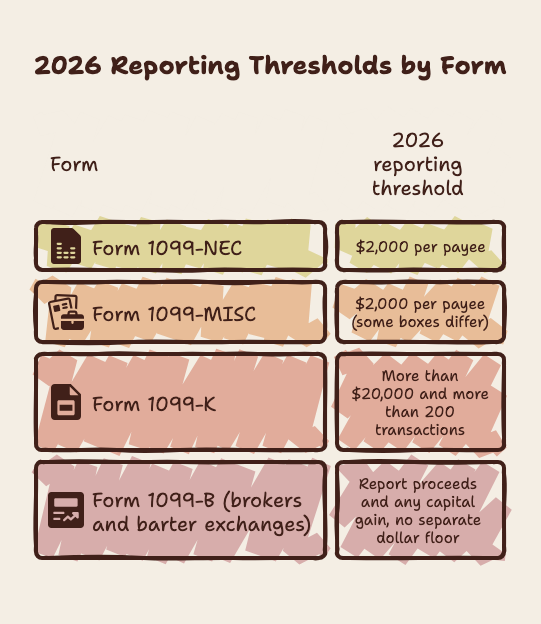
Keep this handy at year-end. Mixing up the 1099-NEC and 1099-K numbers is the single most frequent 1099 filing error, and it is an easy one to avoid once you know each form has its own rule.
For most small businesses, the practical effect is a shorter stack of forms. A company that paid 50 vendors an average of $1,200 each could see its filing count drop sharply, since many of those payments now fall under the $2,000 mark. That is real time saved every January. The trade-off is that you can no longer lean on the form itself to tell a vendor what they earned, so your own records matter more than ever. Track payments by vendor throughout the year, not at the last minute, and the smaller pile of forms actually becomes easier to get right.
This is where good people slip. The new $2,000 threshold applies to payments made during the 2026 calendar year, which you report on forms filed at the start of 2027. It is not retroactive.
So the 1099 forms you filed in January 2026, covering your 2025 payments, still used the old $600 threshold. If you are cleaning up last season, use $600. If you are planning for the current year, use $2,000. The IRS has already rewritten the Form 1099-MISC and 1099-NEC instructions around the new figure, so the change is locked in for 2026 and beyond.
Before you shred half your vendor list, remember what did not move.
All income is still taxable, whether or not a form shows up. A contractor who earns $1,800 from you still owes income tax on it and must report that income to the IRS on their tax return, usually on Schedule C flowing to Form 1040, even though no 1099 is required. The Internal Revenue Service treats the form as a paperwork trigger, not the thing that creates the tax. So issuing fewer forms does not let anyone off the hook. It just trims the pile of information reporting your business has to produce.
A handful of other rules also stand firm:
Handling this well is mostly about clean books and good vendor onboarding through the year, not a scramble in January. That is exactly the kind of repeatable work Madras Accountancy supports for US CPA firms, keeping 1099 reporting accurate so nothing gets missed and no one gets a surprise notice.
Get the thresholds right, match each payment to the correct form, and the 2026 filing season becomes a lot calmer than the last few were.
What is the 1099 reporting threshold for 2026? For the 2026 tax year, the 1099-NEC and 1099-MISC threshold is $2,000 per payee, up from $600. The 1099-K threshold is more than $20,000 in payments and more than 200 transactions. Each form has its own rule.
When does the new $2,000 1099 threshold take effect? It applies to payments made after December 31, 2025, which you report on forms filed in early 2027. Payments made during 2025 still use the old $600 threshold.
What is the 1099-K threshold for 2026? A third-party settlement organization must file Form 1099-K only when a payee exceeds $20,000 in gross payments and 200 transactions in the year. Both conditions must be met, and this threshold is not indexed for inflation.
Did the 1099-K $600 rule go away? Yes. The One Big Beautiful Bill Act repealed the American Rescue Plan Act change and restored the $20,000 and 200-transaction threshold, retroactive to 2022. The planned $600 and $2,500 thresholds never took effect.
Do I still owe tax if I do not receive a 1099? Yes. All income is taxable and must be reported on your tax return whether or not a 1099 form is issued. The reporting threshold only decides whether a payer must send the form.
Which 1099 forms are affected by the $2,000 threshold? Only Form 1099-NEC and Form 1099-MISC. The $2,000 figure does not apply to Form 1099-K, which keeps its own $20,000 and 200-transaction rule.
Does the $2,000 threshold change every year? The 1099-NEC and 1099-MISC threshold is adjusted annually for inflation starting with 2027 payments, so it will rise in small increments. The 1099-K amount stays fixed at $20,000.
Do states follow the federal 1099 reporting threshold? Not always. Several states set lower limits or separate filing requirements, so a payee can receive a 1099 below the federal amount. Always verify the rules for each state where you operate or have payees.

Section 4960's 21% excise tax now reaches far more nonprofit employees. See who is a covered employee in 2026 and what changed.

The Section 45S paid family leave credit is permanent for 2026 with new options. See who qualifies, the amounts, and how to claim it.

Opportunity zones become permanent in 2027 under the One Big Beautiful Bill. See the new deferral, rural bonus, and the 2026 handoff.



