


If your business is putting money into solar panels, battery storage, or other clean energy gear, there is a federal tax credit that can pay back a big share of the cost. It is called the energy investment tax credit, or ITC for short, and at its best it can cover well over half of a project's price tag.
The catch in 2026 is that the rules moved. The One Big Beautiful Bill Act, signed in July 2025, rewrote the deadlines and shortened the runway for some of these tax credits while leaving others alone. So before you plan an energy project, it helps to know exactly what the credit is worth today and which clock you are racing. Let us break it down.
The investment tax credit rewards a taxpayer for building qualifying energy property. Put simply, you invest in the equipment, place it in service, and claim a percentage of that investment back as a dollar-for-dollar credit against your federal tax liability.
There are really two versions running side by side. The original energy credit lives in Internal Revenue Code Section 48. Then the Inflation Reduction Act (IRA) of 2022 created a newer, technology-neutral version, the clean electricity investment credit under Section 48E. The 48E ITC covers any facility that generates electricity with zero or negative emissions, plus energy storage technology, which means it reaches solar, wind, geothermal, fuel cells, batteries, clean hydrogen, and thermal energy without naming each one. The IRA also built a sibling on the output side, the clean electricity production tax credit under Section 45Y, which pays based on electricity produced rather than dollars invested, alongside separate manufacturing tax credits like the Section 45X production credit for building the equipment itself.
Both credits work the same way at their core: a base credit rate, boosted sharply if you meet labor rules, plus a set of bonus credits stacked on top.
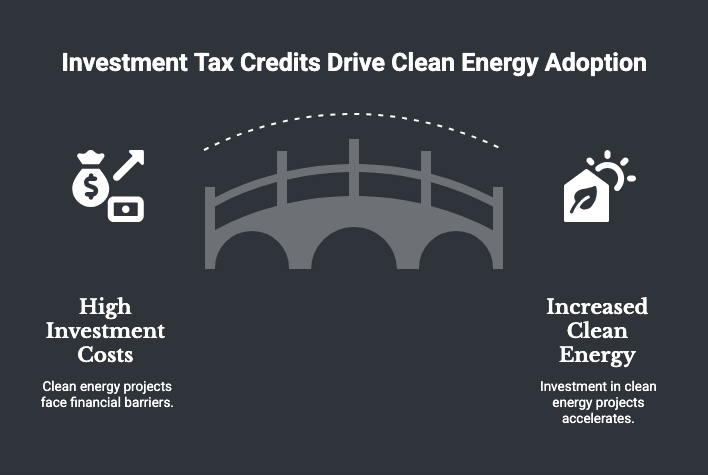
Here is where the numbers get interesting. The base credit is only 6% of the investment. But if your project meets the prevailing wage and apprenticeship requirements, that jumps five times over to 30%. Smaller projects under one megawatt get the 30% rate automatically, without the labor rules.
From there, several bonus credits can stack on:
Add it all up and the credit can climb toward 70% of the cost of an eligible renewable energy project. That is a serious dent in the price of a renewable energy build, which is exactly what the IRA's clean energy tax credits set out to do when these rules took full effect in 2023.
The dividing line is when construction started. Energy property that began construction before January 1, 2025 generally stays under the older Section 48 rules. Projects that begin construction after 2024 fall under the technology-neutral Section 48E clean electricity investment credit. For most people planning something new, 48E is the regime that matters.
The good news is that the bonus credit structure carries over. Prevailing wage and apprenticeship, domestic content, and energy communities all still apply under 48E, so the way you get from 6% to 30% and beyond looks familiar whether you are under the old section or the new one. You can see the full framework on the IRS clean electricity investment credit page.
This is the part that trips people up right now. The One Big Beautiful Bill Act kept these energy tax credits alive but split technologies into two very different tracks.
For wind and solar, the window slammed shut fast. Under OBBBA, the Section 48E and Section 45Y credits terminate for wind and solar facilities placed in service after December 31, 2027, unless construction began on or before July 4, 2026, as Grant Thornton lays out. That construction-start deadline has already passed. So if you did not break ground on a wind or solar project by that date, the only path left is to finish and place it in service before the end of 2027. The IRS spelled out what counts as starting construction in Notice 2025-42, and after a court ruling, taxpayers can again use either the physical work test or the five percent safe harbor to lock in their date, as The Tax Adviser explains.
Other technologies got a much longer runway. Energy storage, geothermal, nuclear, fuel cells, and similar clean energy technologies keep the full credit for projects that begin construction through 2033, then phase down to 75% in 2034, 50% in 2035, and zero in 2036, per Eide Bailly. OBBBA also raised the domestic content thresholds and added new restrictions that block credits for projects tied to certain foreign entities. If you are weighing a battery or geothermal project, the energy storage side of the credit is in far better shape than solar and wind.
One of the most useful features from the Inflation Reduction Act survived OBBBA fully intact. If your business cannot use the whole credit against its own tax bill, you have options.
Transferability lets you sell your tax credits to another taxpayer for cash, in a one-time transfer, which opened these deals up to businesses that never had enough tax liability to benefit before. And tax-exempt entities like cities, schools, and nonprofits can use direct pay, receiving the credit as a cash payment instead. Both routes make the energy credit far more flexible than a typical tax break.
You claim the credit for the year the property is placed in service. Legacy Section 48 projects use Form 3468, while the newer 48E clean electricity investment credit uses Form 7211, and either way the amount flows into the general business credit on Form 3800 on your tax return.
A few things keep the claim clean. Document your prevailing wage and apprenticeship records from day one, since that is what supports the 30% rate. Keep proof for any bonus credits you claim, like domestic content certifications. And remember that energy property still qualifies for bonus depreciation on top of the credit, so the two incentives work together rather than against each other. If you want a wider view of what is still available, this guide to green energy tax credits is a good next read.
The energy investment tax credit is still one of the strongest incentives in the code, but 2026 is all about matching your project to the right timeline. Get the technology, the deadlines, and the bonus credits lined up, and the savings are real. Madras Accountancy helps US CPA firms handle exactly this kind of detailed credit work, so the calculations and documentation hold up when it counts.
What is the energy investment tax credit? It is a federal tax credit that lets a business recover a percentage of what it spends on qualifying energy property, such as solar, wind, or energy storage. It exists under Section 48 and the newer technology-neutral Section 48E.
How much is the Section 48E ITC worth? The base credit is 6%, rising to 30% if the project meets prevailing wage and apprenticeship requirements or is under one megawatt. Bonus credits for domestic content, energy communities, and low-income communities can push it toward 70%.
What did OBBBA change about the energy investment tax credit? It accelerated the end of the credit for wind and solar. Those facilities must have begun construction by July 4, 2026, or be placed in service by December 31, 2027. Energy storage, geothermal, and other technologies keep the credit through a longer phase-down ending in 2036.
Which technologies still qualify for the credit in 2026? Energy storage, geothermal, nuclear, fuel cells, and similar clean energy technologies remain eligible with a long runway. Wind and solar are largely limited to projects that already started construction or finish by the end of 2027.
What are the bonus credits under the ITC? The main adders are 10% for domestic content, 10% for building in an energy community, and 10% to 20% for qualifying low-income communities projects. They stack on top of the base or 30% credit.
What are the prevailing wage and apprenticeship requirements? To earn the full 30% rate rather than 6%, larger projects must pay laborers prevailing wages and use registered apprentices for a set share of the work hours. Projects under one megawatt are exempt.
Can I sell or transfer the energy tax credit? Yes. Transferability lets you sell the credit to another taxpayer for cash, and tax-exempt entities can take direct pay instead. Both survived OBBBA and remain available.
How do I claim the energy investment tax credit? Claim it for the year the property is placed in service, using Form 3468 for Section 48 or Form 7211 for 48E, then carry it into the general business credit on Form 3800. Keep documentation for wage, apprenticeship, and bonus credit requirements.

The 2026 1099 reporting threshold changed: 1099-NEC and 1099-MISC now start at $2,000, and 1099-K is back to $20,000. Here is what you must file.

A plain guide to how a 2026 sales tax holiday works, which items are exempt, and the rules on price caps, refunds, and rain checks.
Form 7004 buys a 6-month extension of time to file business returns like 1065, 1120-S and 1120. Deadlines, e-file steps and the payment trap.