


If your business earned more than one tax credit this year, you cannot just add them to your return and move on. You have to run them through IRS Form 3800, the form used to claim the general business credit. Skip it, and you risk leaving money on the table or filing a return the IRS kicks back.
Here is the part that confuses people. The general business credit is not a single credit. It is an umbrella that pulls together more than two dozen separate business tax credits, from the R&D credit to the work opportunity credit, into one combined number. Form 3800 is where you total those credits, apply the limits, and figure out how much you can actually use against your tax bill this year.
This guide keeps it practical. It walks through what the general business credit is, who needs to file Form 3800, how the form is structured, the limit on how much credit you can claim, and what happens to the credits you cannot use right away. By the end you should understand exactly what this form does and why it matters for your small business tax return.
The general business credit is best thought of as a container, not a credit of its own. Under the tax code, dozens of individual business credits are grouped together and claimed as one aggregate amount, and Form 3800 is the tax form that adds them up. You figure each credit on its own source form first, then carry the totals onto Form 3800.
A few of the common ones show how varied they are. The R&D credit for increasing research activities is claimed on Form 6765. The work opportunity credit for hiring from certain groups is claimed on Form 5884. There is an investment credit, a disabled access credit, credits for small employer pension and childcare costs, and many more. Each starts on its own form, then feeds into the general business credit total. Our guide on maximizing R&D tax credits digs into one of the most valuable of these.
One thing to be clear on early: the general business credit is a nonrefundable credit. It can cut your income tax bill down to zero, but it will not create a refund on its own. That single fact shapes almost everything else about how the credit works.
The rule is simple. If you are claiming more than one general business credit, or you are carrying a credit back or forward between years, you must file Form 3800 and attach it to your tax return. Even a single credit often routes through the form. It is the IRS form businesses use to bring every credit into one place.
Form 3800 is not limited to one entity type either. A sole proprietor reports it through Form 1040, a C corporation through Form 1120, and an estate or trust through Form 1041. Partnerships and S corporations generally pass the underlying credits through to their owners, who then handle Form 3800 on their own returns. So whether you are a solo founder or a growing company, small business owners claiming these business credits all file this form. If you run a young company chasing credits, our CPA for startups guide covers where they fit into the bigger picture.
Form 3800 has three main parts, and they are not filled out in numerical order, which trips up first-timers. The work actually starts at the back.
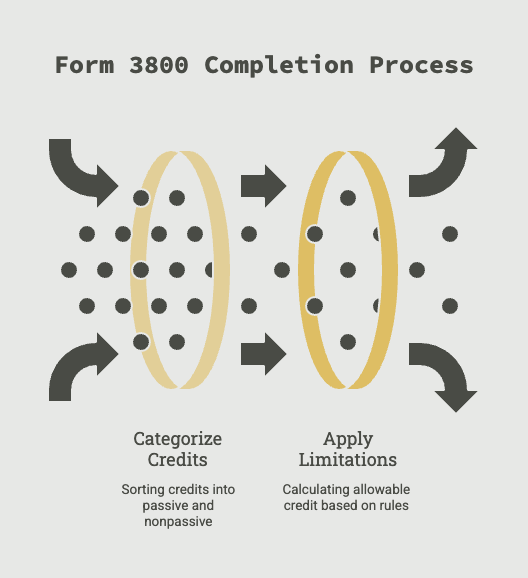
Part III is where you list every individual credit you are claiming, grouped by type and identified by the source form each came from. This is the inventory of your credits. Part I then handles the current year credit, sorting credits into passive and nonpassive activity categories. Part II is where the real math happens, because it applies the limitation rules and determines the overall allowable credit you can use this year. Completing Form 3800 means moving from the detailed list in Part III up through the limit calculation in Part II. The IRS Form 3800 instructions lay out the line-by-line detail, and they are worth having open while you work.
Because the general business credit is nonrefundable, there is a ceiling on how much you can claim in a single tax year, and Part II exists to calculate it. You do not simply subtract the full credit from your tax and stop.
The credit allowed is capped by your tax liability. In broad terms, the credit cannot reduce your federal tax below your tentative minimum tax, the figure that comes out of the alternative minimum tax rules, plus a share of your regular income tax liability above $25,000. If your total credits exceed that limit, you cannot use all of them this year. There is a helpful exception worth knowing: an eligible small business, generally one with average annual gross receipts under a set threshold, can use certain general business credits to offset the alternative minimum tax, which frees up more of the credit. Because this calculation ties into the same AMT machinery reported on Form 6251, it is one of the spots where a tax professional earns their fee.
Hitting the limit does not mean the leftover credit disappears. Unused general business credits are not lost, they move to other tax years. This is one of the most valuable features of the credit and a big reason to file Form 3800 carefully even in a low-tax year.
The general rule is that you carry back an unused credit one year first, letting you amend the prior year and claim a refund of tax already paid, and then carry it forward for up to 20 years. So a credit you cannot use in the current tax year can still deliver value, either by recovering last year's tax or by waiting for a future year when your tax liability is higher. Your general business credit for any year is really the sum of current-year credits plus any credit carryforward from earlier years, adjusted for carrybacks. Tracking those carryforwards accurately over time is its own small discipline, and it is easy to lose value if the records slip.
It helps to see the range of what qualifies, because many business owners claim business credits without realizing they all funnel through this one form. The general business credit includes the investment credit, the work opportunity tax credit, the R&D credit, the low-income housing credit, the disabled access credit, credits for employer-provided childcare and small employer pensions, various energy and fuel credits, and more.
Each of these has its own eligibility rules and its own form, but Form 3800 is the common destination. One clarification that saves confusion: not every credit with "tax credit" in the name belongs here. The foreign tax credit, for example, is claimed separately and is not part of the general business credit, and neither are personal credits like education credits. The general business credit is specifically about credits tied to business activities. When you are unsure whether a credit belongs on Form 3800, checking its source form or the IRS business tax credits list is the fastest way to confirm.
Form 3800 has grown more complex in recent years. The Inflation Reduction Act added new ways to monetize certain credits, including elective payment, sometimes called direct pay, and the transfer of some credits to other taxpayers. The Internal Revenue Service rebuilt the form to handle these options, which is part of why it looks more intimidating than it used to.
For most small businesses claiming ordinary credits like the R&D or work opportunity credit, those new sections will not apply, and the core general business credit calculation is what matters. But it is a reminder that the form changes, and that the version and instructions for the current tax year are the ones to follow. When a credit is large or the rules are unfamiliar, confirming the current treatment beats relying on how the form worked a few years ago.
Worth saying plainly. Form 3800 is one of the more tedious forms in the return. The IRS itself estimates it takes the average filer more than 30 hours, between gathering each credit, completing the source forms, and running the limitation math without errors.
That is the kind of work we take on at Madras Accountancy. As an offshore tax preparation and accounting and bookkeeping partner to U.S. CPA firms, we help identify which credits a client qualifies for, complete the source forms, aggregate everything correctly on Form 3800, and track carryforwards year over year so no credit gets wasted. Since 2015 we have handled detailed, high-volume tax work like this so firms can focus on advising clients. If your firm has clients claiming business credits, talk to our team and we will take it from there.
What is IRS Form 3800? IRS Form 3800, General Business Credit, is the form used to claim the general business credit on your tax return. The general business credit is not a single credit but a combined total of more than two dozen separate business tax credits, such as the R&D credit and the work opportunity credit. You figure each credit on its own form, then carry the amounts to Form 3800, which totals them, applies the limits, and determines how much you can use against your tax this year.
What is the general business credit? The general business credit is an aggregate of many individual business tax credits grouped together under the tax code and claimed as one amount. It includes the investment credit, work opportunity credit, R&D credit, disabled access credit, low-income housing credit, and many others. Rather than claiming each separately, you total them on Form 3800. The credit is nonrefundable, so it can reduce your tax liability to zero but will not generate a refund by itself, and unused amounts carry to other years.
Who needs to file Form 3800? You need to file Form 3800 if you are claiming more than one general business credit, or if you are carrying a business credit back or forward between tax years. Even claiming a single credit often requires it. The form applies across entity types: sole proprietors file it with Form 1040, corporations with Form 1120, and estates or trusts with Form 1041. Partnerships and S corporations pass credits through to owners, who complete Form 3800 on their own returns and attach it.
Is the general business credit refundable? No. The general business credit is a nonrefundable credit, which means it can lower your tax bill to zero but cannot create a refund on its own. If your credits exceed the amount you are allowed to claim in the current tax year, the excess is not refunded to you. Instead, the unused portion is carried back one year and then forward for up to 20 years, so you can still capture the value in a different year rather than losing it.
How do you claim the general business credit on Form 3800? Start by figuring each individual credit on its own source form, like Form 6765 for the R&D credit or Form 5884 for the work opportunity credit. Then complete Form 3800, beginning with Part III, where you list every credit by type and source. Part I sorts the current year credits, and Part II applies the limitation rules to determine your allowable credit. Finally, attach Form 3800 to your business tax return. The total flows through to reduce the tax you owe.
Can you carry forward unused general business credits? Yes. If the limit stops you from using all of your general business credits in the current year, the unused amount is not lost. The general rule is that you carry the unused credit back one year first, which can produce a refund of tax already paid, and then carry any remaining credit forward for up to 20 years. This makes it worth filing Form 3800 accurately even when your tax liability is low, since the credit can pay off in a higher-tax year down the road.
What credits are included in the general business credit? Many business credits flow into the general business credit, including the investment credit, work opportunity tax credit, R&D credit, low-income housing credit, disabled access credit, empowerment zone credit, and credits for employer-provided childcare and small employer pensions, among others. Each has its own form and rules but is totaled on Form 3800. Note that some credits, like the foreign tax credit and personal education credits, are claimed separately and are not part of the general business credit.
How does Madras Accountancy help with Form 3800? Madras Accountancy handles the detailed work behind Form 3800. As an offshore partner to U.S. CPA firms, we help identify which business tax credits a client qualifies for, prepare the individual source forms, aggregate the credits correctly on Form 3800, apply the limitation rules, and track carryforwards across years so no credit is wasted. Form 3800 is time-consuming and error-prone, so firms rely on us to get it right. You can reach our team through the contact link above.
Section 4960's 21% excise tax now reaches far more nonprofit employees. See who is a covered employee in 2026 and what changed.

The Section 45S paid family leave credit is permanent for 2026 with new options. See who qualifies, the amounts, and how to claim it.

Opportunity zones become permanent in 2027 under the One Big Beautiful Bill. See the new deferral, rural bonus, and the 2026 handoff.