



A company signs an interest rate swap or a currency forward to protect itself from risk, and then watches that contract swing its reported profit up and down every quarter for reasons that have nothing to do with the business. That mismatch is exactly the problem hedge accounting was built to solve.
The rules live in ASC 815, Derivatives and Hedging, the FASB standard that governs how companies account for derivatives and the hedges built on them. Its starting point is strict: every derivative goes on the balance sheet at fair value, and changes in fair value run straight through net income. Hedge accounting is the optional path that lets you line up the timing of those gains and losses with the item you were hedging, so the income statement reflects the economics instead of the noise. This introduction to hedge accounting walks through the definition of a derivative, the default rule, and the three types of hedges ASC 815 allows.
The whole topic comes down to one question.
Not whether to record a derivative at fair value, because you always do, but where the changes in fair value land: in net income now, or somewhere else until the timing is right.
ASC 815 is the FASB accounting guidance for derivatives and hedging activities.
It defines what counts as a derivative instrument, sets the default accounting for derivatives, and lays out the hedge accounting guidance for companies that want to reduce income volatility. ASC 815 provides guidance and provides an overview of the accounting and reporting for these contracts, with interpretive guidance that builds an understanding of accounting for complex instruments. A derivative is a financial instrument whose value is derived from an underlying, like an interest rate, a price, or an exchange rate, that requires little or no initial net investment and settles at a specified future date. That definition of a derivative instrument covers financial instruments and nonfinancial ones, since companies use a derivative to mitigate risk on a financial asset or a commodity alike. Interest rate swaps, foreign currency forwards, and commodity options all meet the definition. ASC 815 also reaches embedded derivatives, including embedded derivatives tucked inside another contract, such as a conversion option in a bond, and it may require those embedded derivatives to be separated from the host and accounted for on their own before you can build an effective hedge.
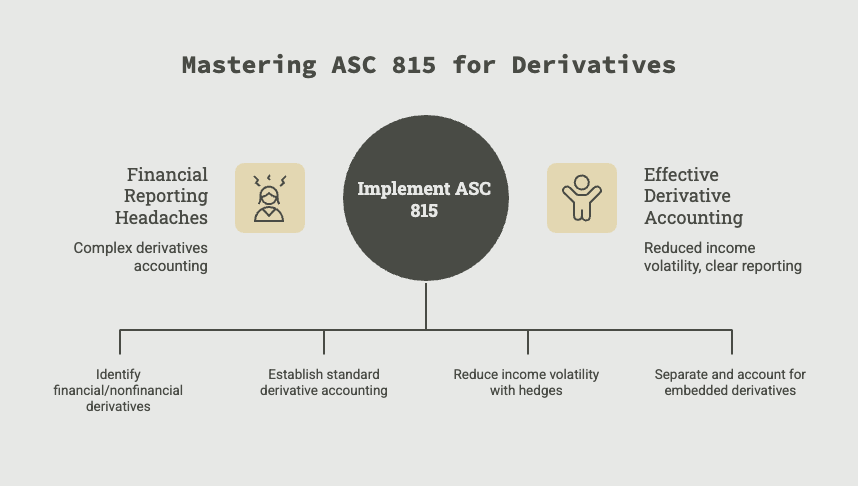
This is the standard behind a lot of financial reporting headaches.
Derivatives are powerful risk mitigation tools, but the accounting for derivatives is unforgiving, and getting the definition of a derivative instrument right is where the whole analysis starts.
Before you get to hedging, you have to understand what happens without it.
The treatment of a derivative starts here: ASC 815 outlines that every derivative is recorded on the balance sheet at fair value, and each period the changes in the fair value of the derivative are recognized in earnings. The recognition of changes this way, before you meet the ASC 815 requirements for hedging, is the default. That is clean in theory, but it creates a real problem. Your hedge might economically cancel a risk perfectly, yet the derivative gets marked to market through the income statement now, while the thing it hedges lands later. The result is volatility in reported net income that does not reflect how the business actually performed.
That timing gap is the entire reason hedge accounting exists.
Without it, a company doing exactly the right thing to manage risk can look like its earnings are lurching around, purely because of when gains or losses on the derivative get recognized.
Hedge accounting is an optional election that changes where and when the gains and losses on a hedging instrument show up.
Instead of running every change through earnings immediately, applying hedge accounting lets you match the derivative's effect to the hedged item, so both hit reported results in the same period. It is not automatic. To qualify for hedge accounting, a company has to formally designate the hedging relationship at inception, document it, identify the hedged risk and the eligible hedged items, and show the hedge is highly effective at offsetting the exposure being hedged. Without a designated hedging relationship, ASC 815 would leave every change in earnings, so miss the documentation at inception and you lose hedge accounting treatment entirely, even if the hedge offsets the risk of changes economically.
The paperwork is not a formality here.
ASC 815 requires that designation and documentation up front, and there is no way to apply it retroactively once the period has closed.
The first type of hedge protects against changes in the value of something you already have on the books.
A fair value hedge covers exposure to changes in the fair value of a recognized asset or liability or an unrecognized firm commitment, tied to a particular hedged risk like interest rate risk. The fair value of the hedged item, and the value of the hedged item on the books, both move. The key feature is this: the changes in fair value of both the hedging instrument and the hedged item, for the risk being hedged, run through net income in the same period. Because the two move in opposite directions, they offset, and the earnings effect of the hedged item nets against the derivative, so the effect of the hedged item on income is only the small piece that does not perfectly match. The carrying value of the hedged item gets adjusted on the balance sheet to reflect the change attributable to the hedged risk.
Think of this hedge as pulling the hedged item forward.
You mark both sides to market at once, so the gain on one largely cancels the loss on the other, and the income statement shows the true economic result.
The second type deals with future cash flows rather than the value of something already recognized.
A cash flow hedge covers exposure to variability in future cash flows, usually from a forecasted transaction or a variable-rate instrument, such as an anticipated inventory purchase or floating-rate debt. The treatment is different from a fair value hedge. The effective portion of the gain or loss on the hedging instrument goes into other comprehensive income rather than net income, sitting in accumulated other comprehensive income until the moment the hedged transaction actually affects earnings. At that point, when the hedged item affects earnings, the amount is reclassified out of OCI into the same income statement line item as the hedged item, so the line item reflects the economics.
This is how the volatility gets deferred.
By parking the change in fair value in OCI until the forecasted transaction hits, a cash flow hedge keeps reported results smooth until the economics catch up.
The third type addresses a very specific foreign currency exposure.
This third hedge protects the value of a net investment in a foreign operation against foreign currency movements, the same exposure that drives currency translation adjustments when you consolidate a foreign subsidiary. The gain or loss on the hedging instrument is recorded in other comprehensive income, as part of the cumulative currency translation adjustment, where it cancels the translation of the investment in a foreign operation itself. It stays in equity until the foreign operation is sold or substantially liquidated.
This one looks a lot like a cash flow hedge.
The gains or losses sit in OCI rather than net income, which makes sense, because the thing being hedged, a net investment in a foreign operation, does not hit earnings until you dispose of it.
None of the three hedges qualify unless the relationship is highly effective, and you have to prove it.
Across the types of hedging relationships, once a derivative is designated, ASC 815 requires an effectiveness assessment at inception and on an ongoing basis, testing whether the derivative instrument actually counters the changes in fair value or cash flows attributable to that risk. Companies pick a method of assessing effectiveness, quantitative or, in many cases now, qualitative. The 2017 amendments in ASU 2017-12 simplified this considerably, easing the effectiveness testing and expanding the eligible hedged items, which made hedge accounting more accessible than it used to be. If a hedge stops being effective enough, hedge accounting is discontinued going forward.
Effectiveness is the ongoing price of admission.
You do not simply qualify once, you keep assessing effectiveness every period, because the moment the relationship is no longer highly effective, the special treatment ends.
For a CPA firm, ASC 815 is one of the most technical corners of GAAP, where valuation, documentation, and financial reporting all have to line up.
Valuing derivatives, drafting hedge documentation that holds up, running the effectiveness assessment, and getting the presentation and disclosure right across fair value and cash flow hedges, plus net investment hedges, is detailed, judgment-heavy work, since the fair value and cash flow hedges each report differently. At Madras Accountancy, we help U.S. CPA firms handle derivatives and hedging under ASC 815 for their clients, from the bookkeeping behind fair value measurement to the audit-ready documentation the standard demands.
The goal is earnings that tell the real story.
Handle the designation, the effectiveness, and the disclosures correctly, and hedge accounting does its job: financial statements that show how a company actually managed its risk.
What is ASC 815? ASC 815, Derivatives and Hedging, is the FASB standard that governs how companies account for derivatives and hedging activities. It requires derivatives to be recorded on the balance sheet at fair value, with changes in fair value in earnings, unless the derivative is designated in a qualifying hedge accounting relationship.
What is hedge accounting? Hedge accounting is an optional election under ASC 815 that lets a company match the timing of gains and losses on a hedging instrument with the hedged item. It reduces the earnings volatility that would otherwise result from marking a derivative to fair value through net income every period.
What are the three types of hedges under ASC 815? The three types are the fair value hedge, the cash flow hedge, and the net investment hedge. A fair value hedge protects a recognized asset, liability, or firm commitment, a cash flow hedge protects variable future cash flows, and a net investment hedge protects a net investment in a foreign operation.
How is a fair value hedge accounted for? In a fair value hedge, changes in the fair value of both the hedging instrument and the hedged item, attributable to the hedged risk, are recognized in earnings in the same period. Because they move in opposite directions, they largely cancel out, leaving only the ineffective portion in net income.
How is a cash flow hedge accounted for? In a cash flow hedge, the effective portion of the gain or loss on the hedging instrument is recorded in other comprehensive income and held in accumulated OCI. It is reclassified into earnings when the hedged forecasted transaction affects earnings, which defers the volatility until then.
What qualifies as a derivative under ASC 815? A derivative is a financial instrument whose value is derived from an underlying such as a rate, price, or index, that requires little or no initial net investment and provides for net settlement. ASC 815 also covers embedded derivatives, which may need to be separated from a host contract and accounted for separately.
What does it take to qualify for hedge accounting? A company must formally designate the hedging relationship at inception, document the hedged item, the hedging instrument, and the hedged risk, and demonstrate that the hedge is highly effective. Effectiveness must be assessed at inception and every period, or hedge accounting is discontinued.
What changed under ASU 2017-12? ASU 2017-12 simplified hedge accounting by easing effectiveness testing, allowing qualitative assessments in more cases, and expanding the eligible hedged items. It made hedge accounting easier to apply and better aligned the accounting with a company's actual risk management strategy.

The section 4960 excise tax is 21% of nonprofit pay over $1M. From 2026 it covers all employees. See the medical carve-outs, Form 4720 and a worked example.

The paid family and medical leave tax credit is permanent from 2026. See the 12.5% to 25% rates, the premium option, the 6-month rule and how Form 8994 works.

Opportunity zones become permanent in 2027 under the One Big Beautiful Bill. See the new deferral, rural bonus, and the 2026 handoff.