


When a company owns property, equipment, or other assets it plans to use for years, those assets sit on the balance sheet at their book value. But what happens when value drops and the asset is no longer worth what the records say? That is where impairment testing comes in.
ASC 360 is the accounting standards codification topic that covers the impairment or disposal of long-lived assets and discontinued operations. It tells you when to test, how to measure the loss, and how to handle assets the company no longer plans to keep. This guide walks through how the impairment model works.
The scope of ASC 360-10 includes tangible assets like property, plant, and equipment, as well as finite-lived intangibles like patents, customer lists, and software. These are the long-lived assets that are held and used in operations or that a company plans to dispose of.
What is not covered: goodwill and indefinite-lived intangibles. Those fall under ASC 350, which uses a different testing approach. If you are working with both types, ASC 350 and ASC 360 will both apply, but the models are not the same.
Financial assets, right-of-use lease assets, and certain other items also have their own rules and are outside the scope of this guidance.
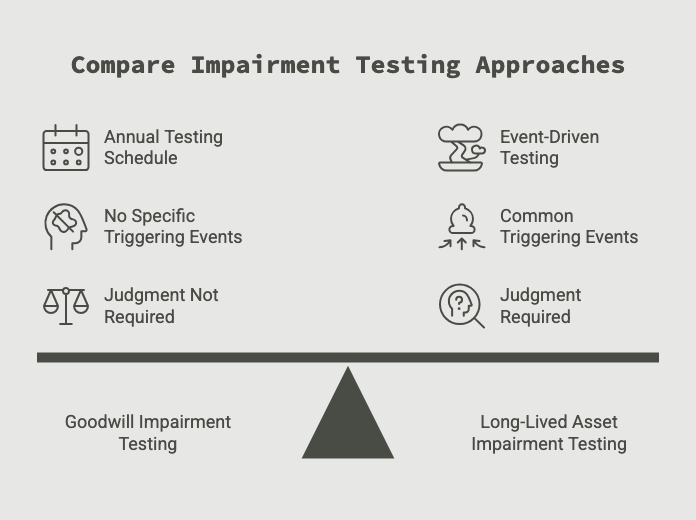
Unlike goodwill impairment testing, which can be done annually, long-lived asset impairment testing is event-driven. You do not test on a set schedule. Instead, you test when indicators of impairment are present.
Common triggering events include:
A significant drop in market price. A major change in how the asset is being used or a plan to dispose of it. A significant adverse change in the business climate or legal environment. Operating losses or negative cash flow tied to the asset. An expectation that it will be sold significantly before the end of its useful life.
The standard does not give an exhaustive list. You use judgment. The question is whether events suggest that the book value may not be recoverable. If the answer is yes, you perform the impairment test.
This is an area where going concern assessments can overlap. If the company faces questions about its ability to continue operating, that alone can be an indicator of impairment for long-lived assets within its operations.
Once a triggering event is identified, the process has two steps.
Step 1: Recoverability test. Compare the asset's carrying amount to the undiscounted cash flows expected from its use and eventual disposal. If the projected cash flows exceed what is on the books, the asset is recoverable and no write-down is needed. You stop here.
If those projections fall short, the asset fails the recoverability test, and you move to Step 2.
Step 2: Measurement of impairment. Compare the book value to the asset's fair value. The gap between the two is the write-down. An impairment loss is recognized as a charge to earnings, and the recorded amount is adjusted to fair value. That new figure becomes the cost basis going forward. Under GAAP, the write-down cannot be reversed in future periods.
The use of undiscounted cash flows in Step 1 is a key feature of this model. It is a lower bar than using fair value upfront, which means some assets will pass recoverability even when their market value is below what is on the books. The idea is that if the company can recover the balance through future use, no write-down is warranted.
In most cases, individual assets do not generate cash flows on their own. A machine in a factory does not produce revenue by itself. It works alongside other assets and liabilities as part of a larger operation. That is why the standard uses the concept of an asset group.
An asset group is the lowest level at which identifiable cash flows are largely independent of the cash flows of other assets. It might be a production line, a store location, or a business unit. You test the group as a whole.
This grouping decision matters. If you define it too narrowly, you might trigger a write-down that would not exist at a broader level. Too broadly, and you might mask a problem by mixing strong and weak performers.
The guidance in ASC 360-10-35 says to look for the lowest level where cash flows can be identified. In practice, this often aligns with how management tracks performance.
When a write-down is recognized at the group level, it gets allocated to the long-lived assets in the group on a pro-rata basis. But you cannot write an individual asset below its fair value. If one asset's fair value is known, it acts as a floor.
When a company decides to sell a long-lived asset (or a group), the accounting changes. Assets classified as held for sale move out of the "held and used" category and into a different measurement framework.
Assets to be disposed of by sale are measured at the lower of book value or fair value less costs to sell. Depreciation stops. The asset is reported separately on the balance sheet, and any loss on the reclassification is recognized immediately.
To qualify, the asset has to meet several criteria, including management commitment to a plan of sale, availability for immediate sale, and an expectation that the sale will close within one year.
If the sale falls through and the asset goes back to operations, the company remeasures it and may need to catch up on depreciation that was suspended.
For companies going through restructurings or portfolio changes, the held-for-sale classification and its interaction with discontinued operations reporting can add complexity.
People often mix these up. Goodwill impairment falls under ASC 350 and uses a different model. Goodwill is tested at the reporting unit level, can be tested annually or when triggered, and compares fair value of the reporting unit to its total book value.
Long-lived asset impairment is tested only when triggered, uses the two-step model described above, and operates at the asset group level. The two standards also interact: performing impairment testing for long-lived assets should generally happen before testing goodwill, since a write-down of long-lived assets within a reporting unit changes the numbers used in the goodwill test.
Indefinite-lived intangibles and goodwill sit outside this standard's scope entirely.
1. What does ASC 360 cover? It covers accounting for the impairment or disposal of long-lived assets and discontinued operations. The guidance applies to tangible long-lived assets and finite-lived intangible assets.
2. What triggers an impairment test? You test for impairment when a triggering event occurs. Events include significant drops in market value, changes in asset use, operating losses, or plans to sell or dispose early.
3. What is the recoverability test? Step 1 of the process. You compare book value to expected undiscounted cash flows. If the cash flows exceed the recorded amount, no write-down is needed.
4. How is the loss measured? In Step 2, compare what is on the books to fair value. The difference is the write-down, charged to earnings.
5. What is an asset group? The lowest level at which identifiable cash flows are largely independent of the cash flows of other assets. Testing happens at the group level rather than for individual assets.
6. Can a write-down be reversed? No. Under GAAP, once a long-lived asset is written down, the reduced figure becomes the new cost basis. Reversal is not permitted.
7. How are assets held for sale treated? They are measured at the lower of book value or fair value less costs to sell. Depreciation stops, and they are reported separately on the balance sheet.
8. Does this standard cover goodwill? No. Goodwill is tested for impairment under ASC 350, which uses a different model. This guidance covers tangible and finite-lived intangible assets only.

The 2026 1099 reporting threshold changed: 1099-NEC and 1099-MISC now start at $2,000, and 1099-K is back to $20,000. Here is what you must file.

A plain guide to how a 2026 sales tax holiday works, which items are exempt, and the rules on price caps, refunds, and rain checks.
Form 7004 buys a 6-month extension of time to file business returns like 1065, 1120-S and 1120. Deadlines, e-file steps and the payment trap.