



If you work at a private company with a December year end, this one is happening to you right now. Not next year. This year.
Here is the quick version. ASU 2023-09, Income Taxes (Topic 740): Improvements to Income Tax Disclosures, took effect for public business entities for annual periods beginning after December 15, 2024. Calendar-year public filers already lived through it in the 10-Ks they filed in early 2026. Everyone else follows one year later, for annual reporting periods beginning after December 15, 2025. For a calendar-year private company, that means the statements you are building right now.
There was no deferral. Early adoption was allowed but the window for treating this as a future problem has closed.
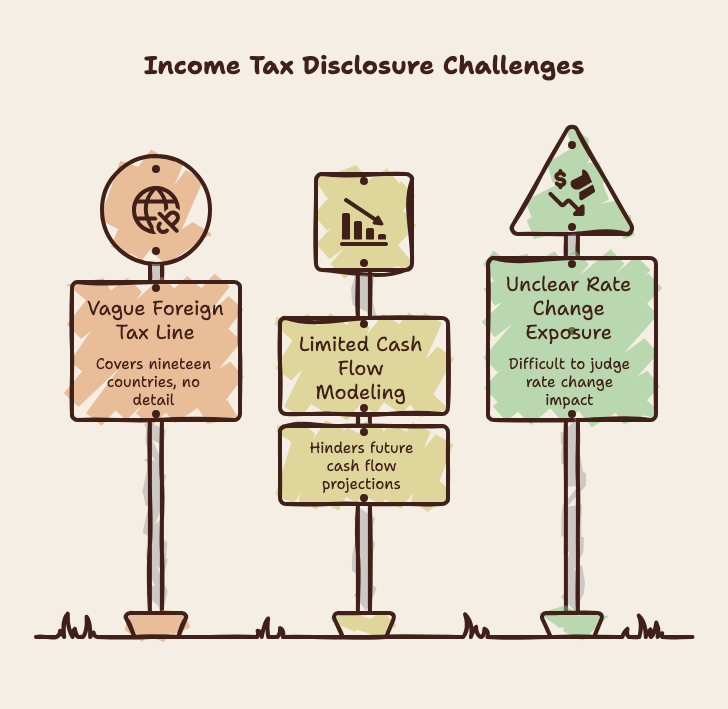
Investors kept saying the same thing during outreach. The income tax footnote told them almost nothing useful about where a company actually earns money and where it actually writes checks to tax authorities. A single "foreign" line covering nineteen countries does not help anyone model future cash flows or judge exposure to a rate change in one place.
So the FASB rebuilt two things: the income tax rate reconciliation, and the disclosure of income taxes paid. Almost every other disclosure requirement in Topic 740 stayed where it was. If you want the underlying mechanics of provisions and deferreds, our plain English guide to ASC 740 covers that ground.
Public business entities have to present the tax rate reconciliation between reported income tax expense from continuing operations and the amount computed by multiplying income from continuing operations before tax by the statutory tax rate, broken into eight named buckets:
Two things changed beyond the labels. First, you now show both dollars and percentages for every line. The old rules effectively let you pick one. Second, any reconciling item that hits 5% of pretax income multiplied by that rate has to be broken out separately by its nature. At 21%, the threshold works out to roughly 1.05% of book income before tax, which is a low bar for a company with any complexity.
Foreign tax effects get an extra layer. Items clearing that same 5% test have to be split by jurisdiction, so "foreign" as a single number is finished. And within the state and local category, you owe a written description of which states make up more than half of the balance.
One nuance that trips people up. As RSM points out, reconciling items outside the foreign and unrecognized tax benefit lines carry only the federal effect, so the state line sweeps up everything state related except prior year reserve movements.
This is the part that surprises controllers.
Non-public entities do not have to produce the numeric tabular reconciliation at all. Instead they give a qualitative description of the categories and the individual jurisdictions that cause a significant difference between the statutory rate and the effective tax rate. No percentages, no eight-column table.
What does apply in full is the income taxes paid piece. Every entity has to disclose it, whatever its filing status. Cohen & Co flagged this as the provision most likely to catch private companies short, and not-for-profits with taxable subsidiaries sit inside the scope too.
Here is what you disclose annually: the amount of income taxes paid, net of refunds received, split by federal, state and foreign. Then, separately, any individual jurisdiction where the net amount paid reaches 5% of the total.
Read that carefully. It is cash, not expense. Most tax provision workpapers were never built to answer it. A company might book a modest tax charge and still discover it paid meaningful cash to four states and two countries, none of which the trial balance tracks that way. Refunds complicate it further, because a large state refund can pull a jurisdiction below the threshold in one year and back above it the next.
You also disaggregate income from continuing operations before tax between domestic and foreign, and income tax expense from continuing operations by federal, state and foreign. Public filers already did this under Regulation S-X. Now it applies to everyone.
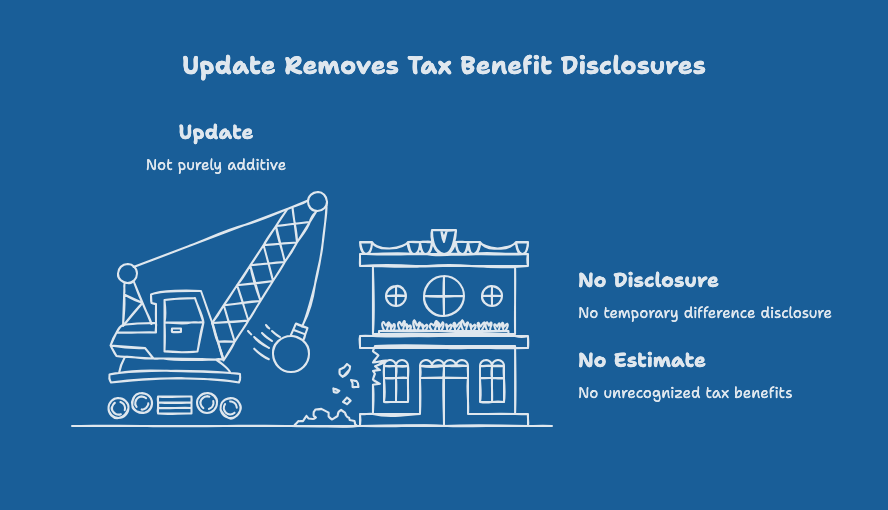
The update is not purely additive, which is easy to miss when you are reading a list of new requirements.
Gone is the requirement to describe the nature and estimated range of a reasonably possible change in unrecognized tax benefits within the next twelve months, or to state that no estimate can be made. Also gone is the requirement to disclose the cumulative amount of each type of temporary difference where a deferred tax liability is not recognized, mostly undistributed foreign earnings. The board reasoned that this had lost relevance after the 2017 law made repatriation cheap.
Do not delete the first one on autopilot, though. The board noted in its basis for conclusions that Topic 275 on risks and uncertainties can still require something similar. The tabular rollforward of reserves also stays exactly as it was.
This is the genuinely interesting part of the 2026 cycle, and it is where judgment shows up.
The One Big Beautiful Bill Act was enacted July 4, 2025. Its effects have to land somewhere in that eight-category structure, and the FASB has not spoken directly on how.
Take a valuation allowance that a company released after remodeling deferreds because of the new law. Does that sit in "changes in valuation allowances" or in "effect of changes in tax laws or rates enacted in the current period"? Baker Tilly's analysis treats the valuation allowance category as the general home, with a policy election available to classify the law-driven portion under tax law changes if you disclose the reasoning and clear it with your auditor. Foreign valuation allowances go in foreign tax effects, broken out by country. State ones fold into the state line.
A shift in an uncertain position triggered by the same law generally belongs in the reserves category, not in the law changes bucket.
And for the international provisions, GILTI renamed as NCTI and FDII renamed as FDDEI, the effects generally stay in the cross-border tax laws category rather than migrating to enacted law changes. Those rules bite from 2026 onward, so this is the first reporting cycle where it matters.
Write the policy down before the auditor asks. That single habit saves more time than any template.
BDO refreshed its ASC 740 publication in August 2026 specifically to capture observations from that first public filing season. The themes were not about interpreting the words in the standard, and none of them involved reading the required disclosures differently. They were about plumbing: documenting how you categorize items so the treatment is consistent year to year, deciding early between prospective and retrospective adoption, and rebuilding the data flow so jurisdictional cash payments are captured during the year rather than reconstructed in February.
On that adoption choice, prospective is the default and retrospective is optional. Retrospective costs more work upfront and buys you comparability, which matters if lenders or a private equity sponsor will ask why the footnote suddenly looks different.
Controls deserve a mention too. A disclosure built from a spreadsheet somebody assembled the week before issuance is a control weakness waiting to be written up, and it is the kind of finding that shows up in year one adoptions across every standard.
For CPA firms running dozens of December year ends at once, the crunch is real. Madras Accountancy supports US firms with provision preparation and footnote work through busy season, so review capacity goes where the judgment calls are.
1. When is ASU 2023-09 effective? Public business entities applied it to annual periods beginning after December 15, 2024. All other entities apply it to annual periods beginning after December 15, 2025, meaning calendar-year 2026 financial statements.
2. Does this apply to private companies? Yes, though the requirements are lighter. Private entities give a qualitative explanation of significant reconciling items and jurisdictions rather than the numeric table, but the taxes paid rules apply in full.
3. What are the eight required categories? State and local tax net of federal effect, foreign tax effects, enacted law or rate changes, cross-border tax laws, tax credits, valuation allowance changes, nontaxable or nondeductible items, and changes in tax reserves.
4. What is the 5% threshold? Any reconciling item equal to or above 5% of book income before tax multiplied by the applicable statutory rate must be shown separately. The same test drives which individual jurisdictions get named in the taxes paid note.
5. Are interim periods affected? The new requirements are annual. Interim reporting under Topic 740 is unchanged.
6. Do we have to restate prior years? No. Prospective application is the default, with retrospective permitted if you prefer comparable periods.
7. What was removed? The twelve-month reasonably possible change estimate for tax reserves, and the cumulative temporary difference amount where a deferred tax liability is not recognized.
8. Where do the disclosures physically go? The rate reconciliation belongs in the income tax note. For taxes paid, the standard does not dictate placement, so either the cash flow statement face or the notes is acceptable.
This article is general guidance, not accounting or tax advice. Application depends on your facts, so work through the judgment calls with your auditors.

The 2026 1099 reporting threshold changed: 1099-NEC and 1099-MISC now start at $2,000, and 1099-K is back to $20,000. Here is what you must file.

A plain guide to how a 2026 sales tax holiday works, which items are exempt, and the rules on price caps, refunds, and rain checks.

Form 7004 buys a 6-month extension of time to file business returns like 1065, 1120-S and 1120. Deadlines, e-file steps and the payment trap.