



If your company is based outside the United States but earns income here through a branch, there is a good chance you have heard about the branch profits tax. And if you have not, this is a conversation worth having before your next tax return is due.
This additional tax catches a lot of companies off guard. It sits on top of the regular corporate tax and can add up to a significant bill if you are not planning around it. This guide breaks down how it works, what triggers it, how to calculate it, and where treaties might help you out.
The branch profits tax is an additional 30% tax imposed on foreign corporations that earn income through a trade or business within the United States. It was introduced by the Tax Reform Act of 1986, and the logic behind it is pretty straightforward.
When a domestic corporation earns profits and pays dividends to its foreign parent, those dividends get hit with a withholding tax. Congress noticed that companies operating in the U.S. through a branch rather than a subsidiary were skipping that second layer entirely. This tax closes that gap.
Under Section 884 of the Internal Revenue Code, the IRS taxes the earnings that are deemed repatriated back to the home country. The idea is to create the same two levels of tax that a subsidiary structure would face.
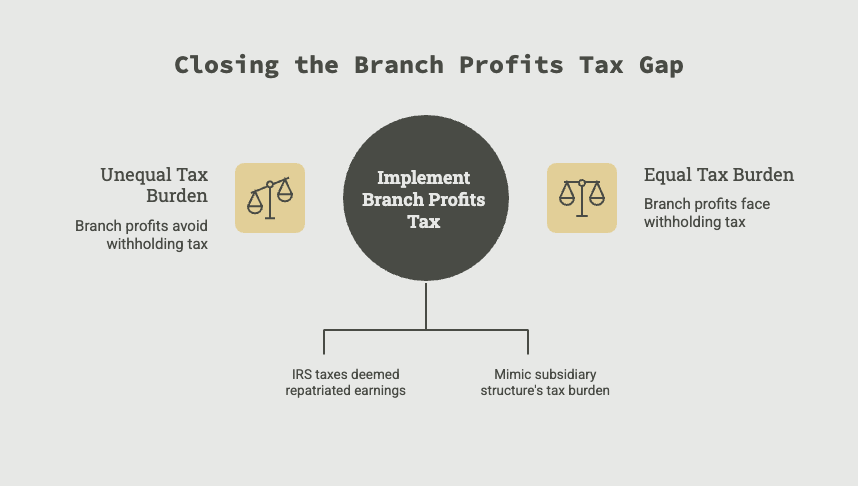
Here is how the two-tier system plays out:
Level one: The company pays regular federal tax on its effectively connected income under Section 882. This is the standard corporate tax on branch income earned through a U.S. trade or business.
Level two: The branch profits tax kicks in on top of that. It applies to the portion of after-tax earnings treated as if they were dividends paid to the foreign parent. Even though no actual dividend changes hands, the tax law treats it as if one did.
Without this second layer, a company could set up a branch in the U.S., earn income, and pull profits back home without ever paying the equivalent of a dividend withholding tax. That is the gap Congress wanted to close.
Not everything earned in the U.S. falls under this tax. The starting point is effectively connected income (ECI), which is income tied to the company's trade or business within the United States.
Think of it this way: if the income would not exist without the branch's day-to-day operations, it probably qualifies. Rental income from U.S. real property, fees earned from U.S. clients, and gains tied to the branch's activities all typically qualify. Income treated as effectively connected also includes certain gains on the disposition of a real property interest under FIRPTA rules.
The tax on this income under Section 882 is the first step. Once you know that number, you can start working toward the calculation for the additional tax. The concept that ties them together is something called effectively connected earnings and profits.
Effectively connected earnings and profits (ECEP) is really just the after-tax version of that income. You take it, subtract the income tax imposed by Section 882, and make the usual earnings and profits adjustments that the tax rules require.
ECEP represents the pool of money that could, in theory, be pulled out of the U.S. and sent to the parent company. That is why it matters so much for computing earnings and profits attributable to the branch, and why it is the foundation for the next step: the dividend equivalent amount.
The dividend equivalent amount (DEA) is the number that actually gets taxed. Think of it as the portion of ECEP that the company did not reinvest back into its U.S. operations.
Here is the basic formula:
DEA = ECEP for the year, adjusted for changes in net equity
If U.S. net equity increases during the year (meaning the company put more money into branch assets or kept earnings stateside), that increase reduces the DEA. Money that stays in the business is not being repatriated, so it should not be taxed as a deemed dividend.
On the flip side, when net equity decreases, that decrease gets added back. When assets shrink or money flows out, the IRS treats that as branch earnings being pulled out of the country.
The calculation of the DEA is where most of the complexity lives. If a company can show that it continued putting money back into its U.S. operations, the DEA drops and so does the tax liability.
Net equity is the adjusted basis of the branch's U.S.-connected assets minus its U.S. liabilities. Think of it as the company's financial footprint in the United States.
Changes here are what make the DEA go up or down year to year. Buying new equipment, taking on a new lease, or holding onto cash in the U.S. all push the number up and lower the taxable amount. Selling off assets or letting the balance sheet shrink has the opposite effect.
The Treasury regulations spell out exactly which assets and liabilities count, and the adjusted basis rules apply. This is one area where getting the numbers wrong can mean a much bigger bill than expected.
If your firm handles international tax compliance for clients with U.S. branches, keeping a close eye on these movements year over year is one of the most practical things you can do.
The standard rate is 30%, but many companies can bring that number down significantly through an applicable tax treaty.
The U.S. has income tax treaties with dozens of countries, and many include provisions that reduce or even eliminate this tax. The treaty rate depends on which country the company calls home (the treaty partner) and what the specific agreement says.
For example, some treaties reduce the rate to 5% or 10%. Others may exempt certain types of income entirely. A few things to keep in mind:
The company has to be a qualified resident of the treaty partner country. Just being incorporated there is usually not enough. The applicable treaty also needs to specifically address branch profits. Some older agreements do not.
It is worth noting that the reduced rate applies to the DEA, not to the full ECEP. So even with a lower rate, the calculation still matters.
If you are working with a client that operates through a U.S. branch, reviewing the applicable treaty early in the engagement can change the entire tax treatment and save a lot of money. Madras Accountancy regularly supports U.S. CPA firms with this kind of cross-border tax work.
A few areas tend to trip people up:
Insurance businesses. If the company is in the insurance business, there are special rules around minimum net investment income and investment income of an insurance business that can change the calculation entirely.
U.S. real property dispositions. Gains on the disposition of a real property interest can count as ECI and feed into ECEP. Companies that buy and sell U.S. real estate through a branch need to factor this in.
Certain income of foreign governments. Sovereign wealth funds and government-owned entities sometimes assume they are fully exempt under Section 892. While certain income of foreign governments is excluded, the additional tax can still apply if the entity is engaged in a commercial trade or business.
Filing and reporting. The tax gets reported on Form 1120-F, the U.S. tax return for foreign corporations. Missing the deadline or getting the DEA calculation wrong can lead to penalties on top of everything else.
1. What is the branch profits tax rate? The standard rate is 30% of the dividend equivalent amount. An applicable treaty between the U.S. and the company's home country can reduce this to a lower rate.
2. Who pays it? It is imposed on foreign corporations that have effectively connected income from a U.S. trade or business. Domestic corporations do not pay it.
3. How is the dividend equivalent amount calculated? The DEA starts with ECEP for the year. It increases when net equity decreases (earnings are deemed repatriated) and decreases when net equity increases (earnings are reinvested in the U.S.).
4. Can a company avoid this tax by reinvesting in its U.S. business? Partially. Increasing net equity through more U.S. branch assets lowers the DEA and reduces the current year tax. But the earnings are deferred, not permanently excluded.
5. How do treaties affect it? Many U.S. tax treaties reduce the 30% rate or eliminate it entirely. The company must be a qualified resident of the partner country, and the agreement must specifically cover branch profits.
6. What is the difference between operating as a branch vs. a subsidiary? A subsidiary is a separate domestic corporation. It pays regular corporate tax and withholding tax on dividends paid to the parent. A branch is not a separate entity, so this tax is designed to replicate that same two-tier structure.
7. Is ECI the same as all U.S.-source income? No. ECI is specifically income connected to the company's U.S. trade or business. A company can have U.S.-source income (like portfolio interest) that is not ECI and would not trigger this additional tax.
8. Where is it reported? On Form 1120-F, the federal tax return for foreign corporations doing business in the United States. The DEA calculation is worked through on the return itself.

The 2026 1099 reporting threshold changed: 1099-NEC and 1099-MISC now start at $2,000, and 1099-K is back to $20,000. Here is what you must file.

A plain guide to how a 2026 sales tax holiday works, which items are exempt, and the rules on price caps, refunds, and rain checks.

Form 7004 buys a 6-month extension of time to file business returns like 1065, 1120-S and 1120. Deadlines, e-file steps and the payment trap.