



You sold some coins, made a profit, and now you need to report the sale. The tax you owe does not depend on the sale price alone. It depends on the gap between that price and your basis, and getting that number wrong is the fastest way to overpay or invite an audit. Your basis is the quiet center of every tax bill.
Think of it as cost basis 101 for crypto, a plain guide to crypto and its tax math. It covers what basis is, how to calculate it, the methods you can use, and the 2025 rule change that caught a lot of investors off guard.
Cost basis is what you paid to acquire an asset. For crypto, that means the price of crypto at purchase plus any fees, which together form your acquisition cost. Because the IRS treats it as property, not currency, every sale triggers a capital gain or loss, and the basis of an asset is what you subtract from the sale proceeds to find that gain or loss.
Here is the whole idea in one line: proceeds minus basis equals your capital gain, which is how you calculate your capital gains. Sell crypto for 5,000 dollars that cost you 3,000 dollars, and your crypto gains come to 2,000 dollars. That is the capital gain the IRS taxes. A wrong cost basis would throw off everything: get the cost basis of your crypto wrong and every other number, from your capital gains tax to whether the gain is short or long term, is wrong too. This is why cost basis in crypto trips up so many crypto investors holding crypto assets.
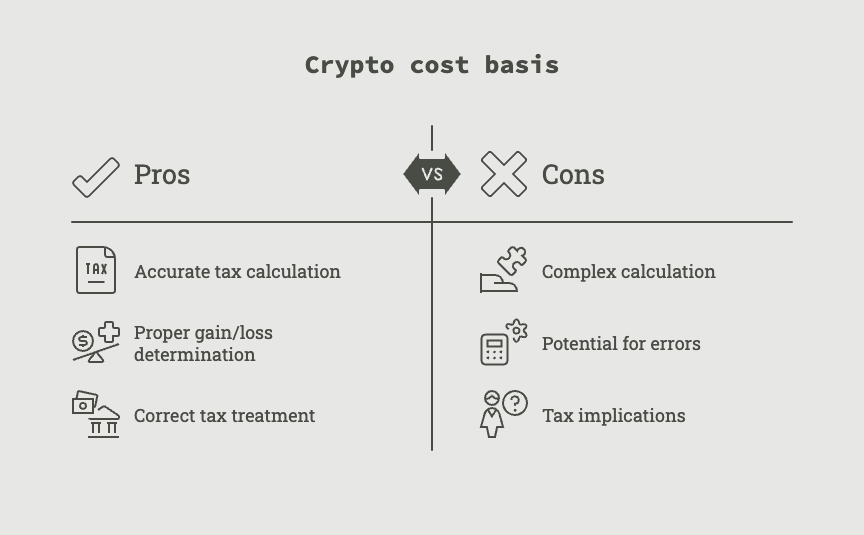
To do this, you add the purchase price to any transaction fees. If you bought one coin for 2,000 dollars and paid a 50 dollar fee, your basis is 2,050 dollars. That fee-inclusive figure is your adjusted cost basis, and this adjusted cost basis method of adding fees, and using it rather than the raw purchase price is how you calculate your cost basis correctly and avoid overpaying.
The trickier part is when coins did not come from a simple purchase. If you were paid in crypto for work, your basis is the market value of your crypto on the day you received it. The same logic sets the value of the crypto you got from an airdrop or a fork. Once you know how each unit entered your crypto portfolio, you can determine the cost basis for every lot, and your gain is simply the sale price minus that number, so once you have sold your crypto the cost basis of the asset decides the tax. Any decent crypto cost basis calculator will calculate your crypto taxes and run these basis calculations for you, but knowing how the basis is worked out, and seeing the cost basis calculated line by line, lets you check the result instead of trusting it blindly.
When you hold several lots of the same coin bought at different prices, you need a rule for which lot you sold. There are many different cost basis methods, and the one you pick changes your tax bill. You can even change your cost basis method year to year, picking whichever method saves taxes. The two that matter in the US are First In First Out and Specific Identification.
FIFO is the default method. It assumes the first crypto purchases you made are the first ones sold, which is simple but rarely the option where the method saves taxes. Specific Identification lets you choose exactly which lot you sold, so you can pick the highest cost lot to shrink the gain, sometimes called HIFO, or the lowest cost basis lot when that suits you better. Specific ID is the best cost basis method for many active traders, but it only works if you document the lot before the trade, not after. Choosing between these crypto cost basis methods is one of the highest-value decisions here, because the same sale can produce very different crypto gains and losses depending on which units you treat as sold.
One method you cannot freely use is the average cost basis method. Averaging the cost of all your units into one blended number is common for mutual funds and is how much of UK crypto reporting works under pooling rules, but the US does not allow it here. American taxpayers are limited to FIFO or Specific Identification.
This catches people who moved over from other countries or other asset classes. If you are used to UK crypto pooling, the switch to lot-by-lot tracking feels like extra work, and it is. For the full picture of how crypto is taxed on both sides, our UK crypto guide covers the HMRC treatment, while the broader crypto tax guide explains how crypto is treated once you are calculating crypto gains for a US return.
The biggest recent change to cost basis rules landed in 2025. Under Revenue Procedure 2024-28, you must now track basis on a wallet-by-wallet, account-by-account basis. The old universal method, where you pooled every unit of a coin across every wallet and exchange into one basis, is gone.
That means tracking your cost basis across multiple wallets separately, with each wallet holding its own lots and its own basis history. A safe harbor let taxpayers allocate their unused basis across wallets as of January 1, 2025, and if you missed it, you are locked into wherever the basis sat. Going forward, basis only moves when you actually move coins. So keeping this basis across multiple wallets accurate is no longer optional, it is the rule, and sloppy records can leave you defaulted to FIFO with a bigger gain than you expected.
Not every unit arrives through a trade, and the source sets the basis. If you received crypto from mining or staking, your basis is the fair market value on the day it hit your wallet, and that same amount is also taxed as income when you receive it. Crypto from mining or staking therefore has two tax moments, receipt and later sale.
Moving crypto between wallets you own is not a taxable event, but you still have to carry the basis with it, so tracking your cost basis across those transfers matters. If you transferred your crypto to your own cold storage, nothing is taxed, yet the original cost basis follows the coin. Giving crypto to someone else is different again: a gift generally passes your basis to the recipient. In each case, the rule is the same, keep track of your cost basis so the eventual sale is reported correctly.
Reporting is tightening fast. Brokers have started issuing Form 1099-DA, and the rollout is staged: for 2025 crypto transactions they report gross proceeds, and adjusted basis reporting begins with 2026 activity. That means the IRS will soon see both sides of many trades.
The catch is that broker figures may not match your own records, especially for coins you moved in from self-custody where the broker never saw the original purchase. If your numbers and theirs disagree, you want your own basis reporting to be the defensible one. When you cannot substantiate a figure, the IRS can treat the basis as zero, taxing the entire sale as gain, so the correct cost basis on your records is worth real money.
For anyone with more than a handful of trades, spreadsheets stop working quickly. This is where crypto tax software earns its keep, pulling in your crypto activity across exchanges and wallets and keeping the per-wallet tracking the new rules demand. Good software applies your chosen accounting method consistently and flags gaps where a transfer left basis behind.
Even so, software is only as good as its inputs. When you have traded crypto across several platforms over the years, you may have to reconstruct basis for older lots by digging up old records, and that reconstruction is exactly the kind of detail that decides whether your report crypto numbers hold up. This careful, unglamorous work is what Madras Accountancy handles for US CPA firms, cleaning up messy digital asset records so the cost basis for crypto is solid before a return is filed. If you want to talk through your firm's workload, you can reach out here. This is general information, not tax advice, so confirm the specifics for any client with their preparer, and you can check the official IRS digital assets page for current rules.
1. What is cost basis in crypto? It is what you paid to acquire a coin, including fees. Because crypto is treated as property, this basis is subtracted from the sale proceeds to figure your capital gain when you sell.
2. How do I calculate cost basis for crypto? Add the purchase price to any transaction fees to get your adjusted cost basis. For crypto you did not buy, such as mined or airdropped coins, the basis is the fair market value on the day you received it.
3. Which methods can I use for my coins? In the US you can use FIFO, which sells your oldest units first, or Specific Identification, which lets you choose the exact lot. HIFO and LIFO are lot-selection strategies applied within Specific Identification, not separate methods.
4. Can I use average-cost pricing for my coins? Not in the US. Averaging like that is used for mutual funds and in UK crypto pooling, but American taxpayers must use FIFO or Specific Identification for their digital assets.
5. What changed for basis tracking in 2025? Revenue Procedure 2024-28 requires you to track basis wallet-by-wallet instead of pooling everything together. Each wallet and account now keeps its own lots, and a one-time safe harbor let you allocate old basis across wallets.
6. Is transferring crypto between wallets taxable? No. Moving crypto between wallets you own is not a taxable event, but you must carry the basis with the coins so the gain is right when you eventually sell. Losing track of basis on transfers is a common crypto tax mistake.
7. What is my basis for mined or staked crypto? Your basis is the fair market value on the day you received it, which is also the amount taxed as income at receipt. When you later sell, your gain is the sale price minus that value.
8. Does crypto tax software track basis for me? Yes, good software imports your transactions and applies your chosen method per wallet. It still needs complete records, so you may have to reconstruct basis for older lots the software cannot see.

The section 4960 excise tax is 21% of nonprofit pay over $1M. From 2026 it covers all employees. See the medical carve-outs, Form 4720 and a worked example.

The paid family and medical leave tax credit is permanent from 2026. See the 12.5% to 25% rates, the premium option, the 6-month rule and how Form 8994 works.

Opportunity zones become permanent in 2027 under the One Big Beautiful Bill. See the new deferral, rural bonus, and the 2026 handoff.