


If you have ever stared at a company income statement and wondered what is actually buried inside a line like "cost of sales" or "SG&A," you are in good company. Investors have asked that same question for years. The FASB finally answered it.
In November 2024 the FASB issued ASU 2024-03, a standard most people just call DISE, short for Disaggregation of Income Statement Expenses. It does not change how your income statement looks. It asks public companies to break down what sits inside their biggest expense lines, in a new table tucked into the footnotes.
Here is what the rule requires, who it hits, when it starts, and how to get ready without turning your close into a scramble.
DISE adds a new subtopic to US GAAP called ASC 220-40. The face of the income statement stays exactly as it is today. What is new is a tabular disclosure in the notes, where you take certain expense lines and show the natural expense categories hiding inside them.
Picture a single "cost of sales" figure. Under DISE, you reveal how much of it is inventory purchases, how much is employee pay, how much is depreciation, and so on. The total never changes. The detail behind it becomes visible for the first time.
This one is for public business entities, the PBEs defined in US GAAP. Private companies are not required to apply it, though the FASB has signaled it may revisit that later.
The timing is where people slip, so read it slowly. The rules apply to annual periods beginning after December 15, 2026, and interim periods beginning after December 15, 2027. In plain terms, a calendar-year public company first reports this in its fiscal 2027 annual report, filed in early 2028, with quarterly disclosures following through 2028. A follow-up standard, ASU 2025-01, cleaned up the interim timing for companies whose year does not end in December. Early adoption is allowed if you want to get ahead of it.
You apply the rules going forward, although you can choose to show prior years too if that tells a clearer story.
For each expense line that qualifies, you split the amount into five natural expense categories, where they apply:
Whatever is left in that line and does not fit one of these gets grouped as "other," along with a short written description of what it holds. You also pull in a handful of amounts that GAAP already makes you disclose elsewhere, so they now sit in the same table.
A caption is "relevant," and therefore in scope, if it appears on the face of your income statement within continuing operations and includes at least one of those five categories. The usual suspects are cost of sales, SG&A, and research and development.
There is a welcome shortcut here. If a line already consists entirely of one category, say a standalone depreciation line, you do not break it down further, because nothing is hidden inside it. And your share of earnings from equity-method investments is not treated as a relevant caption at all, so you can leave it out of the exercise.
On top of the table, DISE asks for the total amount of your selling expenses. Then, once a year in the annual report, you also have to spell out how your company defines selling expenses, since that term gets used loosely from one business to the next. It is a small ask, but it forces discipline and lets readers compare companies on the same footing.
A quick example makes it click. Say a manufacturer reports a single cost of sales line of $500. The DISE table for that caption might read like this:
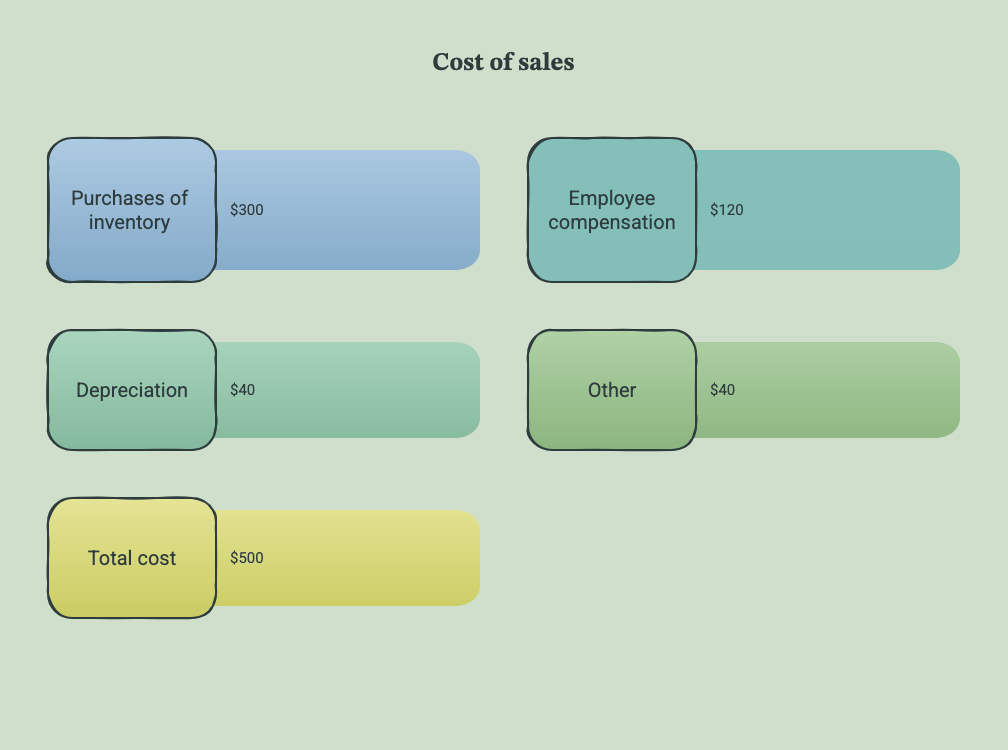
Same $500 that was always there, now with the pieces on display. A services firm or a bank would show different categories, but the idea holds: every relevant caption ties back to the number already on the income statement.
The FASB knew that tracing every dollar to the penny is not realistic, so it built in some relief. You can use reasonable estimates or other methods that get you close to the required amounts. Immaterial items are off the table entirely. And if one category makes up substantially all of a line, a short qualitative note can stand in for full disaggregation.
The one condition is consistency. Whatever method you land on, apply it the same way across every period you present. If you change how you display the disclosure later, you explain why. That kind of shift is a presentation choice, not a change in accounting principle, so it does not carry the same baggage.
The hard part is rarely the disclosure itself. It is pulling the numbers. Most general ledgers are built to report by function, like cost of sales or SG&A, not by natural category like employee pay or depreciation spread across every function. Bridging those two views is where teams lose the most time.
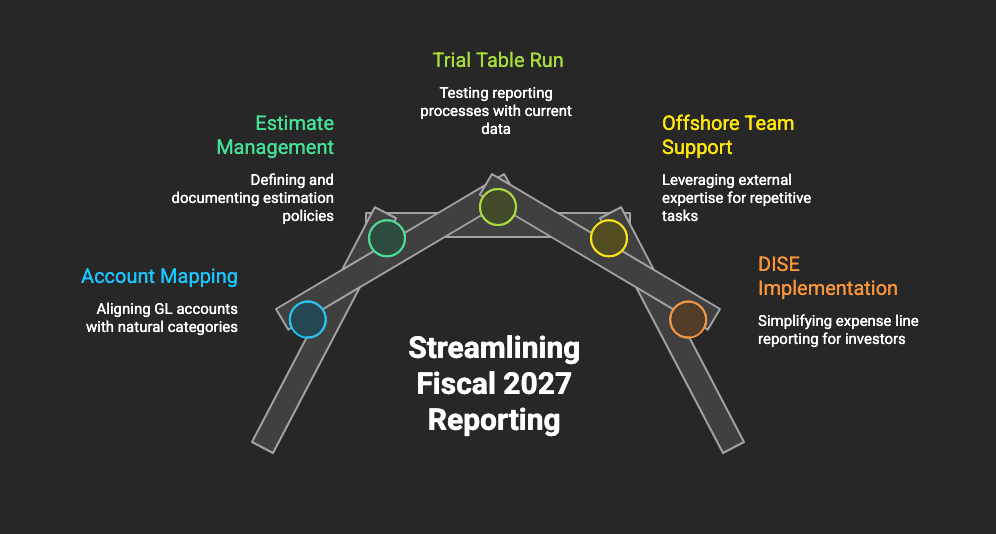
A few moves make fiscal 2027 far less stressful. Map your GL accounts to the five categories now, while you have room to think. Decide up front where estimates are acceptable and document how you build them. Then run a trial table using current numbers, so any gaps surface early instead of in the middle of the audit. This is exactly the kind of repeatable, detail-heavy work that a strong offshore team can carry. Madras Accountancy backs US CPA firms on precisely this sort of prep, keeping the account mapping clean and the disclosures ready for review.
DISE looks intimidating on first read, but its goal is simple: show investors the moving parts inside a few big expense lines. Sort your account mapping early, use the estimate relief where it fits, and the first reporting cycle turns into routine.
What is the disaggregation of income statement expenses (DISE)? DISE is a new US GAAP disclosure requirement, added by ASU 2024-03 as ASC 220-40. It makes public companies break certain income statement expense lines into natural categories, such as employee pay and depreciation, in a table in the footnotes.
What is ASU 2024-03? It is the Accounting Standards Update the FASB issued in November 2024 that created the DISE rules. It expands expense disclosures without changing the recognition or measurement of anything on the income statement.
Who has to comply with DISE? Public business entities, as defined in US GAAP. Private companies are not required to follow it, although the FASB has left the door open to extending it in the future.
When does ASU 2024-03 take effect? It applies to annual periods beginning after December 15, 2026, and interim periods beginning after December 15, 2027. For a calendar-year company, that means the fiscal 2027 annual report filed in early 2028, with quarterly disclosures starting in 2028. Early adoption is permitted.
What expense categories must be disaggregated? Five natural categories where they apply: purchases of inventory, employee compensation, depreciation, intangible asset amortization, and depreciation, depletion, and amortization from oil- and gas-producing activities or other depletion. Anything else in the line is shown as "other."
Does DISE change the face of the income statement? No. The income statement itself looks the same. All of the new detail lives in a tabular disclosure within the notes to the financial statements.
What is a relevant expense caption? It is an expense line shown on the face of the income statement within continuing operations that contains at least one of the five required categories. Cost of sales, SG&A, and research and development are the common ones.
Can companies use estimates to meet the DISE requirements? Yes. The standard allows reasonable estimates and other methods that approximate the required amounts, exempts immaterial items, and lets a qualitative note replace full detail when one category makes up substantially all of a line.

The 2026 1099 reporting threshold changed: 1099-NEC and 1099-MISC now start at $2,000, and 1099-K is back to $20,000. Here is what you must file.

A plain guide to how a 2026 sales tax holiday works, which items are exempt, and the rules on price caps, refunds, and rain checks.
Form 7004 buys a 6-month extension of time to file business returns like 1065, 1120-S and 1120. Deadlines, e-file steps and the payment trap.



