

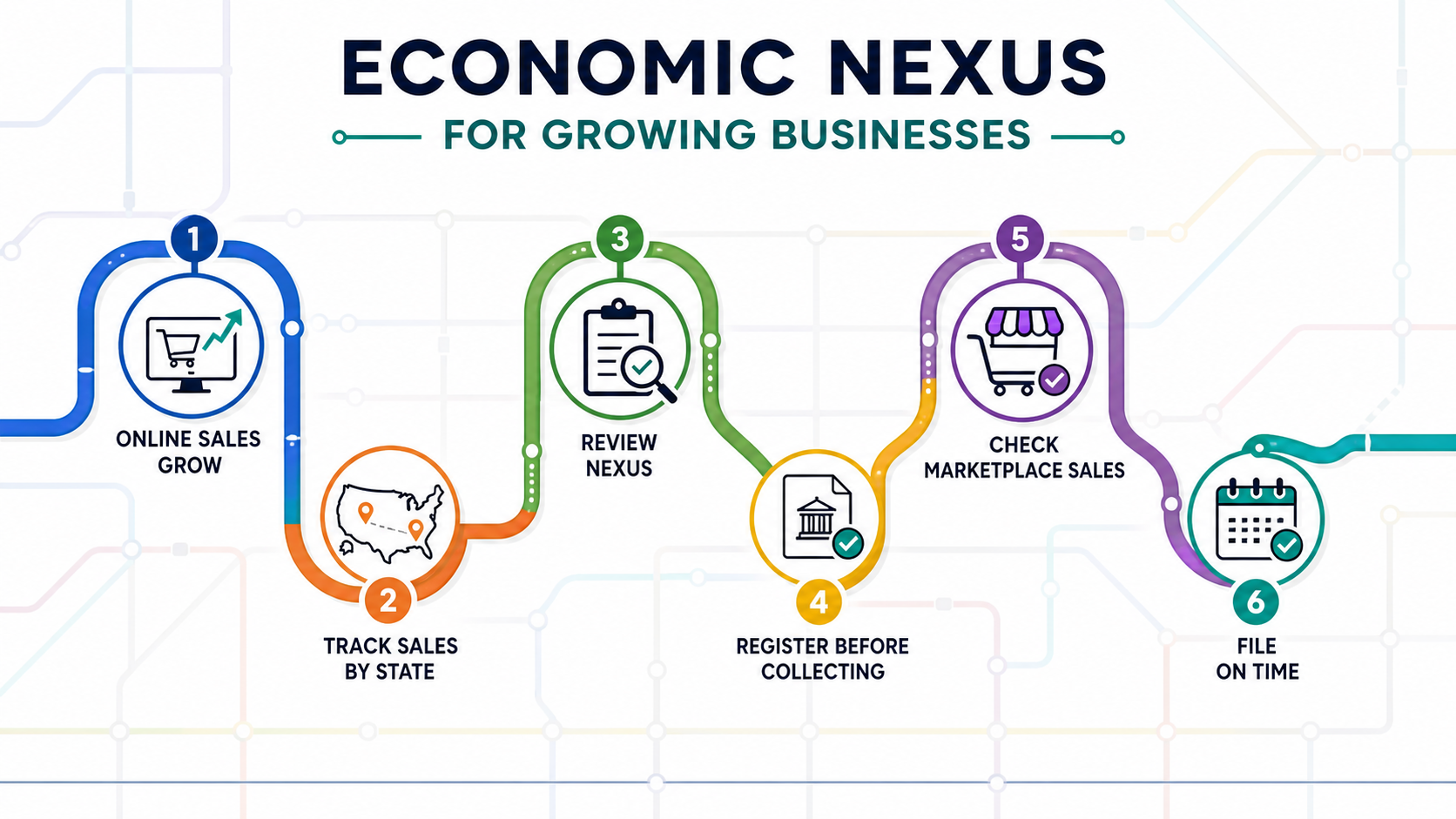

Economic nexus thresholds by state are the sales levels at which an out-of-state seller must register for, collect and remit a state's sales tax, even with no office, staff or inventory there. Many states use $100,000 in annual sales into the state, a few set the line at $250,000 or $500,000, and a shrinking group still counts the number of transactions as well.
For a growing business, the practical job is to compare your own sales by state against each state's dollar figure, transaction rule and measurement period, and to do it often enough that you register before collection is due. This guide explains how economic nexus thresholds by state work in 2026, shows the rules for several large and recently changed states, and walks through a worked example of a quarterly review.
Until 2018, a state could only require a seller to collect its sales tax if the seller had a physical presence there, such as an office, employees or a warehouse. That changed with the Supreme Court's decision in South Dakota v. Wayfair. The South Dakota law at issue applied to sellers that, on an annual basis, delivered more than $100,000 of goods or services into the state or made 200 or more separate transactions there. The Court held that the physical presence rule from Quill and National Bellas Hess was overruled.
Every state with a statewide sales tax has since adopted its own remote seller rule. Alaska, Delaware, Montana, New Hampshire and Oregon have no statewide sales tax, so they do not have a statewide economic nexus test for it. Alaska is a partial exception in practice, since many of its local governments that levy sales tax apply a shared remote seller rule. The other states set their own thresholds, and those thresholds keep moving. For the wider set of obligations that follow from selling in several states, including income tax and payroll, see our multi-state tax compliance guide for growing businesses.
Physical presence still counts. A seller that stores inventory in a state, including stock held in a marketplace's fulfillment center, or that has employees working there, can have nexus regardless of its sales volume. The economic thresholds below apply to sellers that would otherwise be outside the state's reach.
Comparing economic nexus thresholds by state only works if you look at three details together.
The dollar amount. This is the headline figure. Check which sales count toward it. Texas, for example, measures total revenue from taxable and nontaxable sales into the state, so exempt sales and sales for resale still add to the total. Alabama counts retail sales made directly by the seller, whether taxable or not, and leaves out sales made through a marketplace that collects Alabama tax for the seller.
The transaction test. South Dakota's original law included a 200-transaction alternative, and many states copied it. That test caught small sellers with many low-value orders, and states have been removing it. New York is the main exception in the other direction, since it requires a seller to pass both a dollar test and a transaction test before registration is required.
The measurement period. Some states look at the previous or current calendar year. Others use a rolling window, such as the preceding 12 months or the last four sales tax quarters. A rolling window means a seller can cross the line in any month, so the review cannot wait for year end.
The table below covers large states and states that changed their rules recently. It is a starting point for your own review. Rules change through legislation and guidance, so confirm the current position with the state before you register or decide not to.
| State | Sales threshold | Transaction test | Measurement period |
|---|---|---|---|
| South Dakota | More than $100,000 in gross sales | None since July 1, 2023 | Previous or current calendar year |
| California | More than $500,000 of tangible personal property delivered into the state | None | Preceding or current calendar year |
| Texas | $500,000 or more in total Texas revenue | None | Preceding 12 calendar months |
| New York | More than $500,000 in gross receipts | More than 100 sales, and both tests must be met | Immediately preceding four sales tax quarters |
| Alabama | More than $250,000 in retail sales | None | Previous calendar year |
| Illinois | $100,000 or more in cumulative gross receipts | Removed January 1, 2026 | 12-month lookback, checked on a rolling quarterly basis |
| Kentucky | More than $100,000 in gross receipts | Removed August 1, 2026 | Previous or current calendar year |
A few notes on the table. South Dakota's Department of Revenue states that from July 1, 2023, its remote seller registration criteria no longer include the 200 or more transactions threshold. California's rule, set out on the CDTFA page for remote sellers, counts combined sales by the retailer and all related persons. The Texas Comptroller frames its rule as a safe harbor: a remote seller with total Texas revenue under $500,000 in the preceding twelve calendar months does not need a permit. Our Texas sales and use tax guide covers registration and rates once you are past that point.
The biggest trend in economic nexus thresholds by state is the removal of the 200-transaction test. Two changes took effect in 2026.
Illinois removed its transaction test from January 1, 2026. The Illinois Department of Revenue bulletin FY 2026-12 states that the 200-transaction threshold no longer applies and that the test is whether a retailer has $100,000 or more in cumulative gross receipts in the lookback period. The same bulletin says sellers must check the threshold on a rolling quarterly basis for quarters beginning after March 31, 2026. It also sets a 15% rate on destination-based sales where the seller lacks enough information to source the sale, which makes address capture at checkout more important for Illinois sellers.
Kentucky followed later in the year. The Department of Revenue reports that House Bill 757, the main tax bill of the 2026 session, removed the 200-transaction standard for remote retailers and marketplace providers, effective August 1, 2026. Kentucky's statute now uses a single test of more than $100,000 in sales into the state in the previous or current calendar year, and requires a seller that crosses it to register and collect no later than the first day of the month that is at most 60 days later. Our Kentucky sales tax guide has more on the state's rates and filing.
For sellers with many small orders, this trend can reduce the number of states where registration is required. A seller that registered only because of a transaction count may be able to close an account. Speak to the state or an adviser before doing so, since some states expect a registered seller to keep filing for a period after the trigger year.
New York's rule works differently from most. According to the New York Department of Taxation and Finance, a business with no physical presence must register only if, in the immediately preceding four sales tax quarters, its gross receipts from property delivered into New York exceeded $500,000 and it made more than 100 sales of that property into the state. Because both tests apply, a seller of expensive equipment with fewer than 101 New York orders can exceed $500,000 without a duty to register.
New York's sales tax quarters run March through May, June through August, September through November and December through February. Once a seller meets both thresholds, it must file a certificate of registration within 30 days and begin collecting tax 20 days after that. The timing makes a review at the end of each New York quarter worth building into the close calendar.
Marketplace facilitator laws require platforms such as large online marketplaces to collect tax on sales they facilitate. That does not settle the question for the seller. Each state decides whether marketplace sales count toward the seller's own threshold.
Texas says a remote seller that sells through a marketplace and its own website must include all sales, including marketplace sales, when it calculates the $500,000 safe harbor. Kentucky's statute counts retail sales facilitated by a marketplace provider on the remote retailer's behalf. Alabama excludes sales made through a marketplace that collects Alabama tax for the seller. If your business sells through a marketplace and a direct channel, your bookkeeping needs to split sales by channel and by state so you can apply each state's rule. Our guide to ecommerce accounting and sales tax nexus explains how to structure that data.
Software and digital sellers face an extra layer, because a state may count all sales toward the threshold while taxing only some of them. Our article SaaS Billing Sales Tax in 2026: Nexus, Invoicing and ASC 606 Impacts covers billing and revenue recognition, and the companion piece on whether your software is taxable covers taxability.
Consider a home furnishings brand based in Georgia that sells through its own site and one marketplace. At 30 September 2026 its finance lead pulls sales by state and compares them with the thresholds above.
| State | Figures at 30 Sept 2026 | Threshold applied | Result |
|---|---|---|---|
| Texas | $462,000 in the last 12 calendar months, all channels | $500,000 | Under by $38,000 |
| New York | $540,000 over the last four quarters, 96 orders | More than $500,000 and more than 100 sales | Not required yet, 5 more orders would trigger it |
| Illinois | $118,000 in the 12-month lookback | $100,000 | Over by $18,000, register |
| Alabama | $236,000 direct retail sales in calendar 2025 | More than $250,000 in the previous calendar year | Not required for 2026, watch 2026 totals for 2027 |
Texas needs the closest watch because the window rolls every month. If October 2026 Texas sales of $46,000 replace October 2025 sales of $31,000, the trailing total rises to $477,000. That is still under the line, though at that rate the brand could cross within a few months. If it crosses in November 2026, Texas expects collection to begin no later than the first day of the fourth month after that month, which is 1 March 2027.
New York shows why order counts still matter there. The brand passes the dollar test but has 96 orders, so it is not yet required to register. Five more New York orders in the next lookback period, with receipts still above $500,000, would change that.
Illinois is the clear action item. The brand has passed $100,000 and needs to register and start collecting. If it has already made taxable Illinois sales without collecting, a sales tax voluntary disclosure agreement is one route to limit back tax exposure.
A review like the one above takes little time once the data is in shape. The work is mostly in the books.
Start by recording the ship-to state on every sale, across every channel, and keep marketplace sales separate from direct sales. Run a state-by-state report each month, and keep a schedule of each state's dollar figure, transaction rule and measurement period next to it. Flag any state within about 20% of its threshold so the team can prepare registration in advance. Correct sourcing also matters once you are registered, since rates depend on where the sale is delivered; our explainer on destination-based and origin-based sourcing covers that.
As the number of registrations grows, many businesses move filing into software. Our comparison of sales tax automation software sets out the main options. Sellers registered in many member states can also look at the Streamlined Sales Tax program, which offers a single registration across participating states.
Tie the review to business plans as well. A new marketplace, a wholesale channel or a large customer in a new state can move a state across its threshold in one quarter, so add a nexus check to the launch checklist for each of these.
What is the most common economic nexus threshold? The $100,000 sales figure from the South Dakota law reviewed in Wayfair is the model many states follow. Several large states use higher figures, including $500,000 in California, Texas and New York and $250,000 in Alabama, so check each state on its own terms.
Which states removed the 200-transaction test in 2026? Illinois removed its 200-transaction threshold from January 1, 2026, and Kentucky removed its threshold from August 1, 2026. South Dakota had already dropped its transaction test from July 1, 2023.
Do marketplace sales count toward economic nexus thresholds? It depends on the state. Texas requires a seller with its own website to include marketplace sales in its $500,000 calculation, while Alabama excludes sales made through a marketplace that collects Alabama tax for the seller.
When do I have to start collecting after I cross a threshold? Each state sets its own deadline. Texas allows until the first day of the fourth month after the month the threshold is exceeded, New York requires registration within 30 days and collection 20 days after that, and Kentucky allows until the first day of the month that is at most 60 days after the threshold is reached.
How often should a growing business check its sales by state? Monthly reporting with a formal quarterly review suits most growing sellers. States that use rolling 12-month or quarterly windows, such as Texas, New York and Illinois, can be crossed at any point in the year.
Madras Accountancy supports growing businesses and their CPA firms with bookkeeping, sales-by-state reporting and multi-state sales tax registration and filing. If your sales are spreading into new states and you want a clear view of where you stand, contact our team.
The section 4960 excise tax is 21% of nonprofit pay over $1M. From 2026 it covers all employees. See the medical carve-outs, Form 4720 and a worked example.

The paid family and medical leave tax credit is permanent from 2026. See the 12.5% to 25% rates, the premium option, the 6-month rule and how Form 8994 works.

Opportunity zones become permanent in 2027 under the One Big Beautiful Bill. See the new deferral, rural bonus, and the 2026 handoff.