

%2075-100%20(2).png)

If you are a foreign person or company earning money from activity inside the United States, one label decides how much you owe: whether that income is effectively connected. Get it right and you are taxed like a US business, on your profit. Get it wrong and you could pay a flat 30 percent on the full amount. This tax guide walks through what the income is, how it is taxed, and how to tell whether income qualifies as it.
Effectively connected income is income connected with the conduct of a trade or business in the United States. You can generally receive effectively connected income only if you are a nonresident alien or a foreign corporation engaged in a US trade or business during the year. In short, if a foreign person is running an active business on US soil, the income that business throws off is usually this income.
The phrase to notice is the conduct of a trade or business. Income earned by a foreign business from real US activity, like selling products, running a store, or performing personal services while present in the country, is income effectively connected with a US trade or business. That connection between the income and the trade or business activity is the whole test, since income effectively connected with a US trade or business, sometimes shortened to effectively connected trade or business income, only counts when the income and the trade truly line up and the income is effectively connected with a trade you actually run, and it is why the same dollar can be taxed very differently depending on how it was earned.
Here is the split that matters most. A foreign taxpayer's US income falls into two buckets, ECI and non-ECI income, and each is taxed under its own rules on the same tax return. The line between ECI and non-ECI decides your rate, your deductions, and your filing.
Non-ECI income is mostly passive income that carries its own foreign tax exposure, known as FDAP, which stands for fixed, determinable, annual, or periodical income. Think interest, dividends, rents, and royalties that are not tied to a US business. That kind of income is taxed at a flat 30 percent on the gross amount, with no deductions, usually collected through withholding by the US payer. that income is the opposite. Because the US income is treated much like the income of a US business, it is taxed on your net profit after expenses. Sorting income types into the right bucket, treated as ECI or FDAP, is the first job on any foreign return, and a single person can have both in the same year. Understanding ECI starts here: deciding whether income is ECI, and whether the income qualifies as ECI, comes down to the business link, since for income to be ECI it has to tie back to the US business, while income that is not effectively connected stays in the FDAP bucket.
This is where the classification pays off. ECI is taxed at graduated rates on your net income, meaning deductions are allowed against gross ECI to reach your taxable income. So effectively connected is generally taxed the same way a US citizen or domestic company is taxed, on profit rather than on gross receipts.
The numbers show why this matters. For a nonresident alien, ECI is taxed at graduated individual rates that run from 10 percent up to 37 percent, the same brackets US residents use. For a foreign corporation, net ECI is taxed at the flat 21 percent corporate rate, and amounts of income are treated as ECI only for the US activity, unlike a US person who is taxed on worldwide income. Compare that to the 30 percent flat charge on gross FDAP income and the advantage is clear: a consulting business with 100,000 dollars of revenue and 40,000 dollars of expenses would pay tax on 60,000 dollars of net ECI, not on the full gross amount. Getting income treated as the income, and claiming the deductions that come with it, often produces a far lower tax liability than the flat rate on gross income.
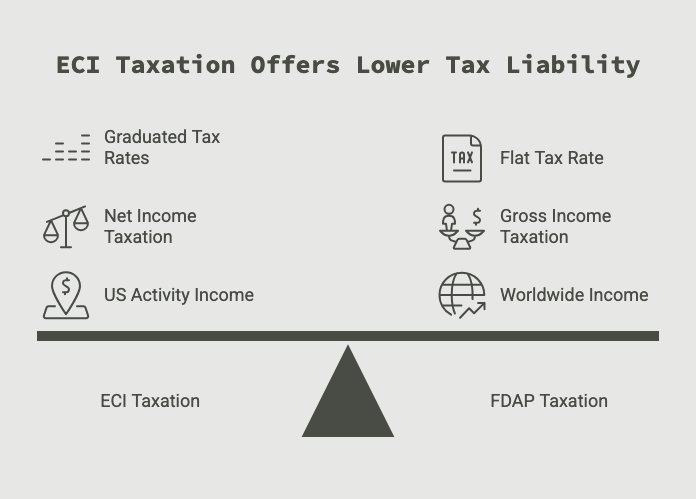
Knowing whether income qualifies as ECI is the practical question. For active business income the answer is usually obvious, but investment income takes a closer look, and the IRS uses two tests to decide whether income is effectively connected. If either test is met, the income is treated as that income.
The first is the asset-use test, which asks whether the income comes from assets used in, or held for use in, the conduct of that trade or business. The second is the business-activities test, which asks whether the activities of the US business were a material factor in the realization of the income. Whether your income qualifies turns on these links: investment income is considered to be effectively connected, and effectively connected with a U.S. business, only when one of these links holds, where income is treated as effectively connected to a trade, and income that is effectively connected with that trade passes because the business truly drives it, so the income must be associated with the actual US business rather than only happening to have a US source. This is what keeps passive holdings from being swept in automatically.
Two more rules can change the bill. First, tax treaties. If the foreign taxpayer's home country has a treaty with the US, income effectively connected with a US business is often only taxable when it is tied to a permanent establishment here, and the tax rate under a tax treaty can be lower than the standard graduated rates. Treaty planning is a major part of cross-border work for this reason.
Second, foreign corporations face an extra layer called the branch profits tax. On top of the 21 percent corporate tax on net ECI, a foreign corporation operating through a US branch can owe a 30 percent branch profits tax on its dividend equivalent amount, which is roughly the after-tax it that was not reinvested in the US business. A treaty can reduce that rate, but without one, the combined burden on a branch can climb well above the headline corporate rate.
Real estate has its own useful rule. Rental income from US property is normally FDAP, taxed at 30 percent on gross rent with no deductions, which can be brutal. But a foreign owner can elect to treat that rental income as effectively connected, which moves it to net-basis taxation and lets them deduct mortgage interest, property taxes, depreciation, and upkeep. For many owners the election turns a painful gross tax into a modest one on actual profit.
Sales of US real property carry their own treatment, where gain or loss is treated as effectively connected under the FIRPTA rules, so a foreign seller reports gain or loss as effectively connected. There are also timing rules: income from sources within the US that would have been effectively connected in the year it was earned can keep that character even if received later, and the rules treat income received then as still connected to the business. These edges are where careful review pays off.
Reporting runs through the return that fits the taxpayer. A nonresident alien reports the income on Form 1040-NR, while foreign corporations report it on Form 1120-F. On either return, you calculate gross ECI, subtract allowable deductions, and pay tax on the effectively connected taxable income that remains.
One trap is worth flagging. Certain income normally treated as ECI or FDAP for income tax purposes can be handled differently for withholding tax purposes, so what a payer must withhold tax on does not always line up with the final answer on the return. Partnerships add another wrinkle, since a partnership must withhold on that income allocated to its foreign partners. And filing late has teeth: miss the deadline and the IRS can disallow your deductions and hit your gross ECI instead of the net, which erases the whole benefit. That risk alone is a reason to keep filing on schedule.
The gap between net-basis the income and flat gross FDAP is often the single biggest number on a foreign taxpayer's US return, and the tests, treaty positions, and elections behind it are easy to get wrong. Whether a given stream of income is effectively connected, and how to report it, depends on the facts of the business and the treaty in play. Madras Accountancy supports US CPA firms and their clients on exactly this kind of international tax work, from classifying income to preparing the return. You can also review the official IRS guidance on it.
If a foreign client's US income has you weighing this income against FDAP, you can reach out here. This is general information, not tax advice, so confirm the treatment for any specific taxpayer with their preparer.
1. What is effectively connected income? Effectively connected income is income effectively connected with the conduct of a US trade or business, earned by a nonresident alien or foreign corporation engaged in that business during the tax year. It is taxed much like the income of a US business.
2. How is that income taxed? ECI is taxed at graduated rates on a net basis, meaning deductions are allowed against gross ECI. Nonresident aliens pay the 10 to 37 percent individual rates, and foreign corporations pay the flat 21 percent corporate rate on net ECI.
3. What is the difference between ECI and non-ECI income? the US income is active US business income taxed at graduated rates on net profit. Non-ECI income, mostly FDAP such as interest and dividends, is taxed at a flat 30 percent on the gross amount through withholding, unless a treaty lowers the rate.
4. Who has to pay tax on the income? A nonresident alien or foreign corporation engaged in a US trade or business during the tax year pays tax on its it. The income must be connected to that US business under the asset-use or business-activities test.
5. What form do you use to report this income? Nonresident aliens report that income on Form 1040-NR, and foreign corporations report it on Form 1120-F. On both, you report gross ECI, take deductions, and pay tax on the effectively connected taxable income.
6. What is the branch profits tax? The branch profits tax is a 30 percent tax, or a lower treaty rate, on a foreign corporation's dividend equivalent amount, roughly the after-tax the income not reinvested in the US business. It applies on top of the regular corporate charge.
7. Can rental income be effectively connected income? Yes. US rental income is normally FDAP taxed at 30 percent on gross, but a foreign owner can elect to treat it as effectively connected, moving it to net-basis taxation so mortgage interest, property tax, and depreciation become deductible.
8. How do you know if income is effectively connected? The income must be tied to a US trade or business. For investment income, the asset-use test and the business-activities test decide whether the income is effectively connected, based on how the US business relates to the income.
The 2026 1099 reporting threshold changed: 1099-NEC and 1099-MISC now start at $2,000, and 1099-K is back to $20,000. Here is what you must file.

A plain guide to how a 2026 sales tax holiday works, which items are exempt, and the rules on price caps, refunds, and rain checks.
Form 7004 buys a 6-month extension of time to file business returns like 1065, 1120-S and 1120. Deadlines, e-file steps and the payment trap.



