


If you run a business where employees earn tips, you are almost certainly paying payroll tax on money your customers handed to your staff, not to you. The FICA tip credit exists to give that money back. It lets eligible employers claim a dollar-for-dollar federal tax credit for the Social Security and Medicare taxes they pay on employee tips, and it is one of the most reliable tip credits in the tax code.
Here is the frustrating part. This credit has been around since 1993, yet survey after survey finds restaurant owners leaving these tip credits unclaimed, often because they simply do not know the credit exists. You claim it on a one-page form, Form 8846, and for a busy operator that one form can be worth thousands of dollars a year.
There is also fresh news worth knowing. For decades the FICA tip credit was limited to food and beverage businesses, but the One Big Beautiful Bill Act expanded it to beauty service businesses like salons, spas, and barbershops starting in 2025. This guide walks through what the credit is, who now qualifies, the wage threshold that trips people up, how to calculate it, and how to claim it on Form 8846.
The FICA tip credit, found in Section 45B of the tax code, is officially the credit for employer Social Security and Medicare taxes paid on certain employee tips. To understand it, start with the problem it solves. As an employer, you pay FICA on every dollar of tip income your employees report, currently 7.65 percent, which is 6.2 percent for Social Security and 1.45 percent for Medicare. That is tax on income your customers paid your staff directly.
The FICA tip credit hands most of that back. It is a dollar-for-dollar credit for the employer Social Security and Medicare taxes you paid on qualifying tips, so it directly reduces your tax rather than just your taxable income. Because it comes from the Federal Insurance Contributions Act, the same law behind regular payroll tax, people often call it the FICA tip tax credit.
One structural point matters for planning. Like other tip credits, it is a nonrefundable credit and part of the general business credit, the same family as the R&D credit. That means it can reduce your tax bill to zero but will not generate a refund on its own, and any unused amount can be carried back one year or forward for up to 20 years. It also ties directly to your payroll records, since the whole calculation runs off the tips your employees reported.
For most of its life, the FICA tip credit applied only to food and beverage employers where tipping is customary. Restaurants, bars, and cafes have claimed it for years. The tip credit applies to tips earned by servers, bartenders, and other staff who receive tips for providing, delivering, or serving food or beverages.
That changed in 2025. The One Big Beautiful Bill Act, signed in July 2025, permanently expanded the credit to beauty service businesses where tipping is customary, effective for tax years beginning after December 31, 2024. For the first time, salons, barbershops, nail salons, spas, and similar personal care businesses can claim the same credit restaurants have used for decades. This was a major win for an industry that had lobbied for it for years, and it opens the credit to hundreds of thousands of new eligible employers. Beauty businesses do need to meet specific rules to qualify, including a test tied to how much of their revenue comes from tips, so confirming eligibility is a smart first step.
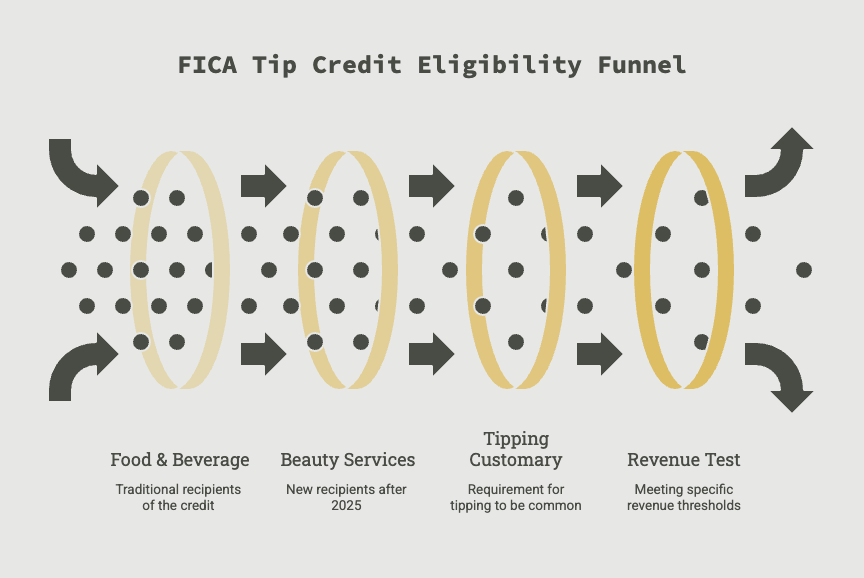
Here is the detail that confuses almost everyone, and getting it wrong changes the number. The credit applies only to a portion of tips, not every dollar. It counts only the tips above the amount used to bring an employee's pay up to a set minimum wage. Tips used to reach that wage floor are excluded, and only the tips that exceed it count toward the credit.
The twist is which wage floor applies. For food and beverage employers, the law freezes the threshold at the federal minimum wage in effect on January 1, 2007, which is $5.15 per hour. That figure has not moved in nearly two decades, even though the current federal minimum wage is $7.25 per hour. Because restaurant staff are almost always paid a base wage plus tips well above that frozen $5.15 mark, a large share of their tips qualify. For the newly added beauty service businesses, the threshold is the current federal minimum wage of $7.25 per hour instead. So a restaurant and a salon calculate the same credit against two different wage floors, which is easy to miss.
The calculation itself is refreshingly simple once the threshold is clear. It comes down to three steps.
First, identify the reported tips, whether cash or credit card tips, on which you actually paid employer FICA tax during the tax year. Second, subtract any tips that were used to meet the applicable minimum wage floor, either the frozen $5.15 for food and beverage or $7.25 for beauty services, since those tips do not qualify. What is left is your creditable tips. Third, multiply the creditable tips by 7.65 percent. That result is your credit for the year.
A quick example makes it concrete. Say a stylist works 100 hours in a month, is paid at least $7.25 per hour in regular wages, and receives $450 in tips. Because the base wage already meets the floor, the full $450 counts, and the credit is 7.65 percent of $450, or about $34 for that employee. Scale that across a full staff and a full year and the numbers get real. One important catch: if you claim the credit, you must reduce your payroll tax deduction by the same amount, so you cannot double dip. And watch out for service charges, like an automatic 18 percent gratuity added for large parties. Those are treated as regular wages, not tips, and do not count toward the credit.
You claim the credit on Internal Revenue Service Form 8846, a short form titled Credit for Employer Social Security and Medicare Taxes Paid on Certain Employee Tips. You complete it, then attach the form to your business tax return for the year.
From there, the credit does not sit on its own. Because it is part of the general business credit, the amount from Form 8846 carries over to Form 3800, the general business credit form, where it combines with any other credits you are claiming. Partnerships file Form 1065 and, along with S corporations, report the credit to their owners through Schedule K, where the owners handle it on their own returns. If you have missed the credit in the past, you generally can amend prior returns within the normal three-year window and claim it retroactively, which is how many operators recover several years of overlooked credits at once. The IRS About Form 8846 page has the current form and instructions.
This is worth clearing up, because the same 2025 law created both and people mix them up constantly. The FICA tip credit is an employer benefit. It reduces the business's tax based on the payroll taxes the business paid on tips, and it is claimed on Form 8846.
The One Big Beautiful Bill Act also created a separate "no tax on tips" deduction, but that one is for employees, not employers. It lets tipped workers deduct up to $25,000 of qualified tips on their own personal income tax returns for tax years 2025 through 2028. The two provisions target completely different taxpayers, so a restaurant or salon owner should think of them as two distinct things: the employer keeps claiming the FICA tip credit, while employees separately benefit from the new deduction on their individual returns.
For tip credits this mechanical, the amount of money sitting on the table is surprising. The most common reason is simple unawareness. Owners are busy running a service business, and asking staff to report tips feels like a compliance chore rather than an opportunity, so no one tells them a credit is waiting at the end of it.
The lesson is that accurate tip reporting is not just a payroll obligation, it is what unlocks the credit. Every dollar of tips your employees properly report is a dollar that can feed the FICA tip credit calculation. With the OBBBA expansion pulling in a whole new set of beauty businesses that have never claimed it, a lot of eligible employers are about to discover tip credits that have quietly existed for over 30 years. Checking whether you qualify, and whether you left credits unclaimed in recent years, is well worth an afternoon.
Worth saying plainly. The FICA tip credit is only as good as the tip reporting and payroll records behind it, and pulling clean numbers together across a full staff and year is the part that stops busy owners from claiming it.
That is the kind of work we handle at Madras Accountancy. As an offshore payroll and tax preparation partner to U.S. CPA firms, we help track reported tips, calculate the credit correctly against the right wage threshold, complete Form 8846, and roll it into the general business credit so nothing gets missed. Since 2015 we have handled detailed, high-volume tax and payroll work like this. If your firm has restaurant or salon clients who could be claiming this credit, talk to our team and we will take it from there.
What is the FICA tip credit? The FICA tip credit is a federal tax credit under Section 45B that lets eligible employers recover the employer share of Social Security and Medicare taxes they pay on employee tips. Employers owe 7.65 percent in FICA tax on reported tips, even though the tips come from customers rather than the business. The credit refunds most of that dollar for dollar. It is a nonrefundable credit and part of the general business credit, claimed on Form 8846 and carried to Form 3800.
Who qualifies for the FICA tip credit? Traditionally, only food and beverage employers where tipping is customary, such as restaurants, bars, and cafes, could claim these tip credits. As of 2025, the One Big Beautiful Bill Act permanently expanded it to beauty service businesses where tipping is customary, including salons, barbershops, nail salons, and spas, for tax years beginning after December 31, 2024. To qualify, employees must receive tips for their services and the employer must have paid FICA taxes on those tips. Beauty businesses face some additional eligibility rules.
How is the FICA tip credit calculated? Start with the reported tips on which you paid employer FICA tax. Subtract the tips used to bring the employee's pay up to the applicable minimum wage floor, which is a frozen $5.15 per hour for food and beverage employers and $7.25 per hour for beauty service businesses. The remaining creditable tips are multiplied by 7.65 percent to get the credit. For example, $450 in qualifying tips produces a credit of about $34. Remember to reduce your payroll tax deduction by the credit amount.
What is Form 8846? Form 8846 is the IRS form used to claim the FICA tip credit. Its full name is Credit for Employer Social Security and Medicare Taxes Paid on Certain Employee Tips. Food and beverage and, now, beauty service employers complete this short form and attach it to their business tax return. The credit calculated on Form 8846 then flows to Form 3800, the general business credit, where it is combined with any other business credits. Partnerships and S corporations pass the credit to owners through Schedule K.
Did the One Big Beautiful Bill Act change the FICA tip credit? Yes. The One Big Beautiful Bill Act, signed in July 2025, permanently expanded the credit beyond restaurants to beauty service businesses where tipping is customary, such as salons, spas, and barbershops, effective for tax years beginning after December 31, 2024. For those beauty businesses, the credit uses the current $7.25 federal minimum wage as the threshold, while food and beverage employers continue using the frozen $5.15 rate. The core mechanics of the credit did not change for restaurants.
Is the FICA tip credit the same as "no tax on tips"? No, they are different and often confused. The FICA tip credit is a credit for employers, claimed on Form 8846, based on the payroll taxes the business paid on tips. The "no tax on tips" deduction, also created by the One Big Beautiful Bill Act, is for employees, letting tipped workers deduct up to $25,000 of qualified tips on their personal returns for 2025 through 2028. One benefits the business, the other benefits the worker, and they are claimed separately.
Do service charges qualify for the FICA tip credit? No. Service charges, such as an automatic gratuity added to the bill for large parties, are not treated as tips. Because the employer sets the amount rather than the customer choosing to leave it voluntarily, the IRS classifies distributed service charges as regular wages, not tips. That means they are excluded from the FICA tip credit calculation. Only voluntary tips left by customers, and properly reported, count toward the credit, so separating true tips from service charges matters for an accurate claim.
How does Madras Accountancy help with the FICA tip credit? Madras Accountancy handles the payroll and tax work behind the FICA tip credit. As an offshore partner to U.S. CPA firms, we help track reported employee tips, calculate the credit against the correct wage threshold for restaurants or beauty businesses, complete Form 8846, and carry it into the general business credit on the return. Many employers never claim this credit, so we also help review prior years for missed amounts. Since 2015 we have handled detailed payroll and tax work like this. You can reach our team through the contact link above.
Section 4960's 21% excise tax now reaches far more nonprofit employees. See who is a covered employee in 2026 and what changed.

The Section 45S paid family leave credit is permanent for 2026 with new options. See who qualifies, the amounts, and how to claim it.
Opportunity zones become permanent in 2027 under the One Big Beautiful Bill. See the new deferral, rural bonus, and the 2026 handoff.