


The foreign earned income exclusion 2026 limit is $132,900 per qualifying person, up from $130,000 for 2025. US citizens and qualifying resident aliens with a foreign tax home who pass the bona fide residence test or the 330-day physical presence test can leave up to that amount of foreign wages or self-employment earnings out of federal taxable income by filing Form 2555 with Form 1040.
The exclusion is elective and can be paired with a separate housing exclusion or deduction, while a stacking rule keeps the remaining income in the higher brackets. This guide covers the foreign earned income exclusion 2026 figures, who qualifies, how the election and revocation rules work, how the exclusion interacts with the foreign tax credit, and a worked example of the tax calculation for a 2026 return filed in 2027.
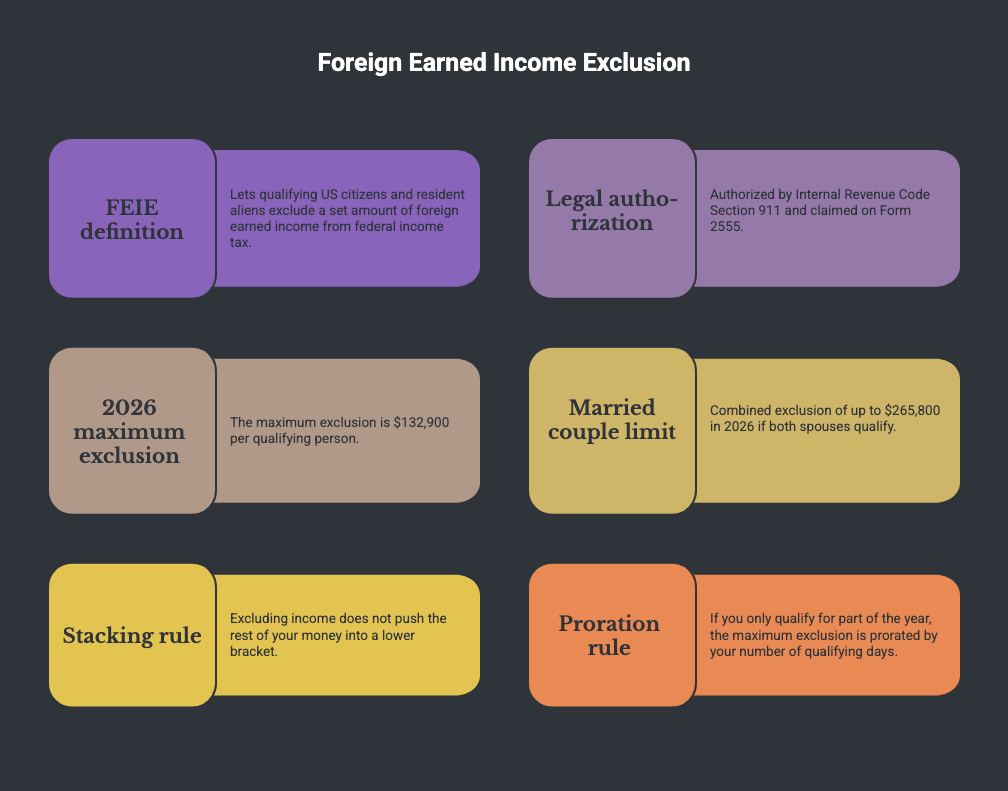
The IRS announced the new amount with its other tax year 2026 inflation adjustments: "For tax year 2026, the foreign earned income exclusion is $132,900 up from $130,000 for tax year 2025," according to the IRS release on tax year 2026 inflation adjustments, which points to Revenue Procedure 2025-32 for the details.
| 2026 item | How it is set | Full-year amount | Daily amount |
|---|---|---|---|
| Maximum foreign earned income exclusion | Inflation-adjusted annual figure | $132,900 | $364.11 |
| Married couple, both spouses qualify | Each spouse claims separately | $265,800 combined | n/a |
| Base housing amount (floor) | 16% of the maximum exclusion | $21,264 | $58.26 |
| Standard limit on housing expenses (cap) | 30% of the maximum exclusion | $39,870 | $109.23 |
| Largest housing amount at the standard cap | Cap minus base | $18,606 | n/a |
Daily amounts use 365 days. Many high-cost cities have a higher housing cap than the standard 30% figure. The IRS lists those locations and their limits in an annual notice (Notice 2025-16 covered 2025; check the IRS for the notice covering 2026, as figures here are as of October 2026), and the Form 2555 instructions tell filers to use the notice table when their city appears in it.
If you qualify for only part of 2026, the exclusion shrinks. Under 26 U.S.C. § 911, the excludable amount is "computed on a daily basis at an annual rate equal to the exclusion amount" for the year, so a person whose qualifying period covers 200 days of 2026 can exclude at most about $72,822 ($132,900 x 200 / 365).
Two conditions must hold at the same time. First, your tax home must be in a foreign country. The IRS foreign earned income exclusion page explains that you may have a foreign tax home "if your work is in a foreign country and you expect to be employed in the foreign country for an indefinite, rather than temporary, period of time," and that you do not have one if your abode stays in the United States. Second, you must pass one of two residency tests.
You must be "a bona fide resident of a foreign country or countries for an uninterrupted period that includes an entire tax year." US citizens can use it. Resident aliens can use it only if they are citizens or nationals of a country that has an income tax treaty in effect with the United States. If you rely on a treaty position elsewhere on the return, the rules for Form 8833 treaty-based return disclosures may also apply.
You must be physically present in a foreign country or countries "for at least 330 full days during any period of 12 months in a row," according to the Instructions for Form 2555. A full day "means the 24-hour period that starts at midnight." The 330 days do not have to be consecutive, and the 12-month window can straddle two calendar years. The instructions add that the 330 days "can be interrupted by periods when you are traveling over international waters or are otherwise not in a foreign country," which means those periods do not add to the count. This test applies to both citizens and resident aliens and depends only on the day count.
Foreign earned income means "wages, salaries, professional fees, and other compensation received for personal services you performed in a foreign country" during your qualifying period, including noncash pay and allowances.
The Form 2555 instructions list income that does not qualify, including:
Self-employed people get a partial benefit. The exclusion removes qualifying business profit from income tax, but IRS Publication 54 gives the example of a consultant with $68,000 of net profit who "must pay self-employment tax on your net profit of $68,000, even though you are qualified for the foreign earned income exclusion." Publication 54 notes that the United States has totalization agreements with some countries under which "dual coverage and dual contributions (taxes) for the same work are eliminated," so where one applies, social security tax is generally paid to only one country. Self-employed expats who owe tax on the remaining income should also plan quarterly estimated tax payments.
On top of the earned income exclusion, you can claim a housing benefit for reasonable foreign housing costs above the base amount. Publication 54 explains that the base "is 16% of the maximum annual exclusion amount allowed for the specific tax year," and the standard limit on housing expenses "is generally 30% of the maximum foreign earned income exclusion (computed on a daily basis)." For 2026 that means expenses between $21,264 and $39,870 in a standard-cost location, which yields up to $18,606 of housing benefit for a full year.
Employees take this as the housing exclusion, which "applies only to amounts considered paid for with employer-provided amounts." Self-employed people take it as the housing deduction, which applies "only to amounts paid for with self-employment earnings." If you claim the housing exclusion, you figure it first and then figure the earned income exclusion on what remains.
Excluded income does not reset your brackets. Section 911(f) says the tax on your remaining income equals the tax on taxable income increased by the excluded amount, minus the tax on the excluded amount alone. The Form 2555 instructions put it this way: "you must figure the tax on your nonexcluded income using the tax rates that would have applied had you not claimed the exclusions." On the return, this is done with the Foreign Earned Income Tax Worksheet in the Form 1040 instructions.
Example. A single US citizen meets the physical presence test for all of 2026 and earns $180,000 in foreign wages with no other income. She takes the 2026 standard deduction of $16,100 and claims the full $132,900 exclusion. The calculation uses the 2026 single brackets from the IRS release (10% up to $12,400, 12% to $50,400, 22% to $105,700, 24% to $201,775).
| Step | Amount |
|---|---|
| Foreign wages | $180,000 |
| Less foreign earned income exclusion | ($132,900) |
| Less standard deduction | ($16,100) |
| Taxable income (Form 1040, line 15) | $31,000 |
| Worksheet: taxable income plus the excluded amount | $163,900 |
| Tax on $163,900 | $31,934 |
| Less tax on $132,900 (the excluded amount) | ($24,494) |
| US income tax with the exclusion, under stacking | $7,440 |
The comparison:
| Scenario | Taxable income | US income tax |
|---|---|---|
| No exclusion claimed | $163,900 | $31,934 |
| Exclusion claimed, stacking rule applied (the actual result) | $31,000 | $7,440 |
| Saving from the exclusion | n/a | $24,494 |
Stacking explains why the $7,440 is higher than the tax a person with only $31,000 of taxable income would pay. Taxed on its own, $31,000 would start in the 10% bracket and come to $3,472 under the rate schedule. Stacking places her remaining $31,000 on top of the $132,900 she excluded, between $132,900 and $163,900, which sits entirely in the 24% bracket. That is why her tax equals $31,000 x 24%, or $7,440, which is $3,968 more than the same income would bear on its own. If she paid foreign income tax on the $47,100 of wages that was not excluded, she may be able to claim a credit for that share, as described below.
The exclusion is an election that carries forward from year to year. The Form 2555 instructions say "Your initial choice to claim the exclusion must usually be made on a timely filed return (including extensions) or on a return amending a timely filed return," with limited exceptions explained in Publication 54. Once made, the choice "remains in effect for that year and all future years unless it is revoked."
To revoke, you attach a statement to the return for the first year you do not want the exclusion, and the earned income and housing choices are revoked separately. Revocation has a long tail: "If you revoke your choice, you can't claim the exclusion(s) for your next 5 tax years without the approval of the IRS." Publication 54 adds that claiming the foreign tax credit, the additional child tax credit or the earned income credit in a later year counts as a revocation, so a one-year switch to the credit can lock you out of the exclusion until the sixth year unless the IRS grants a ruling.
You cannot use both benefits on the same dollar. Publication 54 states: "Once you've made a foreign earned income exclusion election or foreign housing exclusion election, you can't take a foreign tax credit or deduction for foreign taxes on income you choose to exclude." It also confirms that a high earner can exclude up to the limit and then "take a foreign tax credit for any foreign taxes paid on the portion of the wage that wasn't excluded."
As a practitioner rule of thumb, the exclusion tends to help most in low-tax countries, while residents of high-tax countries often compare it against the credit. Because of the five-year revocation rule, run both versions before the first election. Our guide to the foreign tax credit in 2026 covers the credit side, and the walkthrough of Form 1116 and how the credit prevents double taxation explains the form used to claim it.
For the 2026 tax year, the regular due date is April 15, 2027. Publication 54 grants "an automatic 2-month extension to file your income tax return and pay federal income tax" to US citizens and resident aliens who are living outside the United States and Puerto Rico with their main place of business or post of duty outside both on the regular due date. That moves the date to June 15, 2027, and you attach a statement explaining which situation qualifies you. Interest still runs: "if you pay the tax due after the regular due date, interest will be charged from the regular due date until the date the tax is paid." Form 4868, filed by June 15, adds another 4 months to file, to October 15, 2027, but it does not extend the time to pay.
If you moved abroad recently and will not meet either test by the due date, Form 2350 is the tool. Publication 54 explains that you can apply on Form 2350 "for an extension of time to file to a date 30 days beyond the date you expect to qualify under either the bona fide residence test or the physical presence test." It must be filed by the due date of the return, and a return filed after the approved date may face a failure-to-file penalty.
The exclusion does not change your information reporting. Foreign accounts above the threshold still require FBAR filing on FinCEN Form 114, expats who own foreign companies may have Form 5471 filing requirements, and large gifts or inheritances from abroad can trigger Form 3520 reporting.
What is the foreign earned income exclusion for 2026? The maximum exclusion for tax year 2026 is $132,900 per qualifying person, up from $130,000 for 2025. It applies to foreign wages and self-employment earnings for services performed abroad and is claimed on Form 2555.
What are the 2026 foreign housing base and cap amounts? The base housing amount is 16% of the maximum exclusion, or $21,264 for a full year. The standard cap on housing expenses is 30%, or $39,870, and the IRS sets higher caps for listed high-cost locations.
Can a married couple both claim the exclusion? Yes. If both spouses have a foreign tax home and each meets one of the tests, each can exclude up to $132,900 of their own foreign earned income, for up to $265,800 combined. The spouses do not have to meet the same test.
What happens if I stop claiming the exclusion? Leaving it off a later return while the election is in place, or claiming the foreign tax credit, additional child tax credit or earned income credit in a later year, counts as a revocation. After a revocation you cannot claim the exclusion again for the next 5 tax years without IRS approval.
Does the exclusion reduce self-employment tax? No. Self-employed people still owe self-employment tax on their net profit, although a totalization agreement between the United States and the country where they work can mean social security tax is paid to only one country.
Madras Accountancy supports US CPA firms and their clients with individual tax return preparation, including returns for clients living and working abroad, along with bookkeeping and review support that fits into a firm's 1040, 1065 and 1120 tax prep workflow. To talk through your expat return volume, contact our team.
The section 4960 excise tax is 21% of nonprofit pay over $1M. From 2026 it covers all employees. See the medical carve-outs, Form 4720 and a worked example.

The paid family and medical leave tax credit is permanent from 2026. See the 12.5% to 25% rates, the premium option, the 6-month rule and how Form 8994 works.

Opportunity zones become permanent in 2027 under the One Big Beautiful Bill. See the new deferral, rural bonus, and the 2026 handoff.



