



Form W-8BEN-E is the certificate a foreign entity hands to a US payer to prove it is foreign, state its Chapter 3 and Chapter 4 (FATCA) status, and claim any treaty rate it qualifies for. The entity gives the form to the payer or withholding agent, never to the IRS, and a payer without a valid one on file generally withholds 30% from US-source income such as interest, dividends, rents and royalties.
The full name of Form W-8BEN-E is the Certificate of Status of Beneficial Owner for United States Tax Withholding and Reporting (Entities). As of October 2026 the IRS still uses the October 2021 revision of the form and its instructions, and the IRS page for the form lists no recent developments. This is general information, so check the specific facts with a tax adviser.
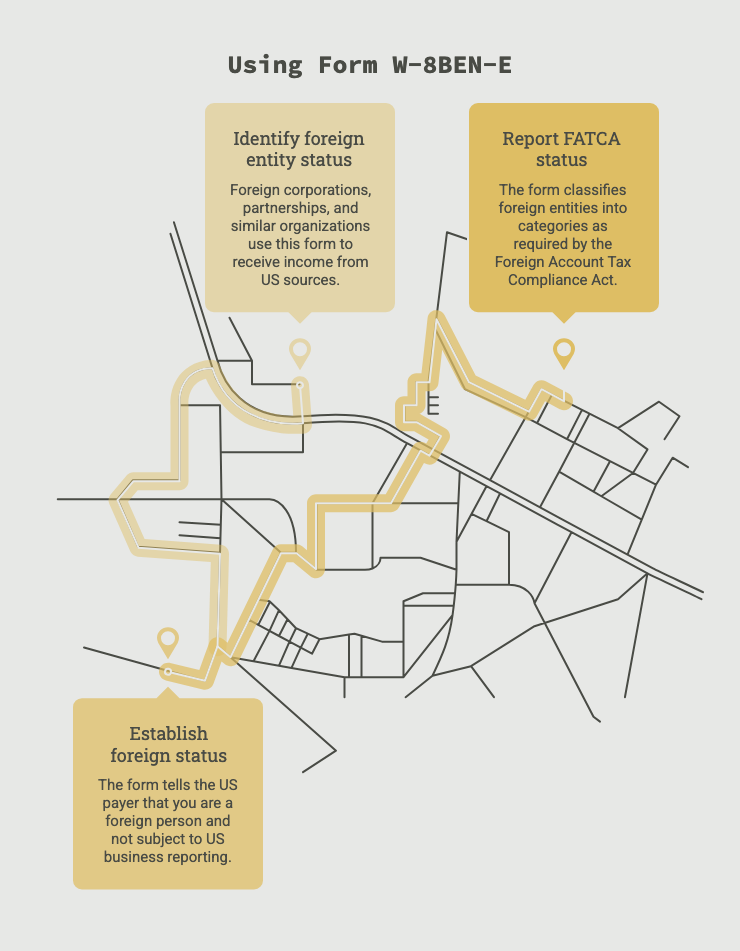
The form travels from the foreign entity to the person paying it. The IRS instructions for Form W-8BEN-E say plainly: "Do not send Form W-8BEN-E to the IRS. Instead, give it to the person who is requesting it from you." That is usually the US customer paying an invoice, the bank or broker crediting an account, or a partnership allocating income. A foreign financial institution can also ask for the form to document the status of an account the entity holds with it.
The instructions say a foreign entity must provide the form if it receives a withholdable payment from a withholding agent, receives a payment subject to Chapter 3 withholding, or holds an account with a foreign financial institution that requests it. The entity should hand it over before the income is paid or credited, because the payer decides how much to withhold at the moment of payment.
Any person that controls or pays US-source income subject to Chapter 3 or 4 withholding is a withholding agent, which includes ordinary US companies paying foreign vendors. Companies that pay overseas suppliers through an outsourced accounts payable team usually build W-8 collection into vendor onboarding for this reason.
Picking the wrong certificate is one of the most common reasons a payer rejects paperwork. The instructions list several cases where an entity uses a different form.
| Situation | Correct form |
|---|---|
| US person, including a corporation organized under the law of a US state | Form W-9 |
| Foreign individual | Form W-8BEN |
| Income effectively connected with a US trade or business | Form W-8ECI |
| Intermediary, or a flow-through entity such as a foreign partnership receiving income for its partners | Form W-8IMY |
| Foreign government, international organization, foreign central bank or foreign tax-exempt organization claiming specific exemptions | Form W-8EXP |
| Foreign corporation or other foreign entity that beneficially owns the income | Form W-8BEN-E |
A disregarded entity generally does not submit its own Form W-8BEN-E. If the single owner is foreign, the owner provides its own W-8BEN or W-8BEN-E, and the owner completes Part II only in specific cases, such as a disregarded entity that has its own GIIN or is an FFI outside the owner's country of organization. A US LLC taxed as a corporation is a US person and gives payers Form W-9, while a disregarded single-member US LLC is documented through its foreign owner's W-8. Either way, the LLC has its own filing duties, covered in the guide to Form 5472 for foreign-owned US businesses. A US payee that fails to supply a correct W-9 faces a different regime, explained in the guide to backup withholding and how to stop it.
The reason payers insist on the form is the default rate. According to the instructions, foreign persons are subject to US tax "at a 30% rate on income they receive from U.S. sources" that consists of interest, dividends, rents, royalties, premiums, annuities, compensation for services and other fixed or determinable annual or periodical income. The tax applies to the gross amount and is generally collected by withholding under sections 1441 or 1442.
IRS Publication 515 explains that pay for personal services is sourced where the services are performed, "regardless of where the contract was made, the place of payment, or the residence of the payer." Royalties for patents and copyrights are sourced where the property is used. A foreign consulting firm that does all of its work outside the United States therefore earns foreign-source income, which falls outside Chapter 3 withholding, even though the payer is American. The payer still collects the form to document foreign status.
The table below compares three outcomes for the same $50,000 payment. The 10% treaty rate is illustrative only; actual rates depend on the treaty and the type of income.
| Scenario | Withholding rate | Tax withheld | Net received |
|---|---|---|---|
| Royalties for use of a copyright in the US, no valid form on file | 30% | $15,000 | $35,000 |
| Same royalties, valid form with a treaty claim at a 10% rate | 10% | $5,000 | $45,000 |
| Fee for consulting performed entirely outside the US, valid form on file | Generally none (foreign-source income) | $0 | $50,000 |
The difference between the first two rows is $10,000 on a single payment. When too much is withheld, the foreign company usually has to file a US return, such as Form 1120-F for foreign corporations, to claim the excess back.
Part I of Form W-8BEN-E identifies the beneficial owner and asks for two separate classifications.
Chapter 3 status (line 4). Chapter 3 covers sections 1441 through 1464, excluding sections 1445 and 1446, and governs the regular withholding on foreign persons. On line 4 the entity checks one box, such as corporation, partnership, disregarded entity, simple trust, grantor trust, central bank of issue or private foundation. The instructions require the box that matches the entity's classification "under U.S. tax principles (not under the law of a treaty country)."
Chapter 4 status (line 5). Chapter 4 is FATCA, sections 1471 through 1474. It asks payers to sort foreign entities into categories such as participating foreign financial institution (FFI), deemed-compliant FFI, exempt beneficial owner, active non-financial foreign entity (NFFE) and passive NFFE. The instructions say an entity only needs to give a Chapter 4 status if it is the payee of a withholdable payment or is documenting an account held with an FFI that requested the form.
Most Chapter 4 statuses come with a matching certification part. Parts IV through XXVIII each cover one status, and the entity completes only the part that matches the box it checked on line 5. A typical trading or services company is an active NFFE and completes Part XXV, which certifies that it meets all the requirements for that status, including the assets and passive income test. A holding company that earns mainly dividends and interest is more likely a passive NFFE, which completes Part XXVI and either certifies that it has no substantial US owners or lists them in Part XXIX.
A GIIN is a global intermediary identification number, which the instructions define as "the identification number assigned to an entity that has registered with the IRS for chapter 4 purposes." Line 9a requires a GIIN from participating FFIs, registered deemed-compliant FFIs, reporting Model 1 and Model 2 FFIs, direct reporting NFFEs, sponsored direct reporting NFFEs and certain trustees of trustee-documented trusts. An ordinary active NFFE does not register with the IRS and leaves line 9a blank.
Two other numbers often come up:
Part III is where Form W-8BEN-E can reduce the 30% rate. An entity claiming a reduced rate or exemption completes the following lines.
The LOB article is an anti-treaty-shopping rule. The IRS tax treaty tables describe it as a provision "intended to prevent residents of third countries from obtaining benefits under a treaty that were not intended for them." The instructions say an entity "may only check a box if the LOB article in that treaty includes a provision that corresponds to the checkbox on which you are relying," and each treaty may set its own requirements for the same test. The derivative benefits test, for example, is generally limited to treaties with EU, EEA and USMCA countries.
Table 1 of the treaty tables lists withholding rates by country and income type, and Table 4 summarizes the LOB tests. The full treaty text controls, so check the article itself before relying on a table. A foreign company that later files a US return and takes a position that a treaty overrides the Code may also need to disclose it, which the guide to Form 8833 treaty-based return positions covers.
Part XXX is the certification. An authorized representative or officer signs and dates the form under penalties of perjury and checks the box confirming legal capacity to sign for the entity on line 1. An agent signing under a power of attorney must attach it, and Form 2848 can serve that purpose.
The validity rule in the instructions reads: a Form W-8BEN-E "will remain valid for purposes of both chapters 3 and 4 for a period starting on the date the form is signed and ending on the last day of the third succeeding calendar year, unless a change in circumstances makes any information on the form incorrect." A form signed on any date in 2026 is therefore valid through 31 December 2029.
When something on the form becomes wrong, such as a move to a different country of residence, a change in Chapter 4 status or income that becomes effectively connected with a US business, the entity must notify the withholding agent or financial institution within 30 days and provide new documentation. Payers that track expiry dates in the vendor master file avoid a lapsed form triggering 30% withholding.
On the payer's side, the W-8BEN-E supports how each payment is reported. A withholding agent reports US-source amounts paid to foreign persons on Form 1042-S and summarizes them on Form 1042. The Form 1042-S instructions state that the forms "must be filed with the IRS and be furnished to the recipient of the income by March 15 of the following calendar year," with Copies B, C and D going to the recipient. For 2026 payments, that deadline is 15 March 2027.
The filing system has also changed. The instructions say IRIS "must be used to e-file 2026 Forms 1042-S (due March 15, 2027)," while either IRIS or FIRE could be used for 2025 forms. The fields a payer needs, including Chapter 3 and Chapter 4 status codes and the treaty country, come straight from the W-8BEN-E on file, so an incomplete certificate leads to an incorrect 1042-S. The guide to Form 1042-S for withholding agents and payees walks through the boxes and codes.
Partnerships with foreign partners face a separate withholding regime under section 1446, explained in the guide to Forms 8804 and 8805. Foreign-owned US companies juggling W-8 collection, Form 5472 and state filings at the same time often look for accounting services for foreign-owned US companies that handle the whole cycle.
Do I send Form W-8BEN-E to the IRS? No. The completed form goes to the withholding agent or payer that requested it, which keeps it on file to support its withholding and reporting. The IRS instructions state directly that it should not be sent to the IRS.
What is the difference between Form W-8BEN and Form W-8BEN-E? Form W-8BEN is for foreign individuals, and Form W-8BEN-E is for foreign entities such as corporations and partnerships. The entity version is longer because it collects Chapter 4 (FATCA) classification and LOB details that do not apply to individuals. A payer will treat a W-8BEN from a foreign company as the wrong form.
Does an active NFFE need a GIIN? Generally no. Line 9a requires a GIIN from registered entities such as participating FFIs, registered deemed-compliant FFIs, reporting Model 1 and Model 2 FFIs and direct reporting NFFEs. An active NFFE certifies its status in Part XXV and leaves line 9a blank.
How long is Form W-8BEN-E valid? It is generally valid from the date it is signed through the last day of the third following calendar year, so a form signed in 2026 lasts through 31 December 2029. A change in circumstances that makes any information incorrect ends that validity, and the entity must provide new documentation within 30 days.
What happens if a foreign company does not provide Form W-8BEN-E? A payer without a valid form generally withholds 30% on US-source income such as interest, dividends, rents and royalties, and may apply backup withholding to certain payments. Recovering over-withheld tax usually means filing a US tax return to claim a refund.
Madras Accountancy works with US CPA firms and businesses on cross-border compliance, including reviewing W-8 forms from foreign vendors and clients, checking Chapter 4 status and treaty claims, and preparing Form 1042 and 1042-S reporting alongside regular bookkeeping and tax preparation. To discuss your foreign payments and withholding workflow, contact our team.
The section 4960 excise tax is 21% of nonprofit pay over $1M. From 2026 it covers all employees. See the medical carve-outs, Form 4720 and a worked example.

The paid family and medical leave tax credit is permanent from 2026. See the 12.5% to 25% rates, the premium option, the 6-month rule and how Form 8994 works.

Opportunity zones become permanent in 2027 under the One Big Beautiful Bill. See the new deferral, rural bonus, and the 2026 handoff.



