


A revenue officer left a card, or a notice showed up asking for a completed Form 433. Now there are seven sections in front of you asking for every account, every asset, and every dollar moving in and out.
It feels invasive because it is. That is the point of it.
Quick overview: Form 433-A is the Collection Information Statement for Wage Earners and Self-Employed Individuals, to give it the full name. It is the financial disclosure the Internal Revenue Service uses to work out your ability to pay before it will approve a payment plan, a settlement or a hardship status. The numbers you write on it decide your monthly payment for years, so it deserves more care than most people give it.
One thing almost every article on this still gets wrong: the IRS released a new revision in June 2026. If you are working from a 7-2022 template, you are missing questions.
The current version is Form 433-A (Rev. 6-2026), eight pages, seven sections. Download the PDF fresh rather than reusing last year's file.
Four additions matter:
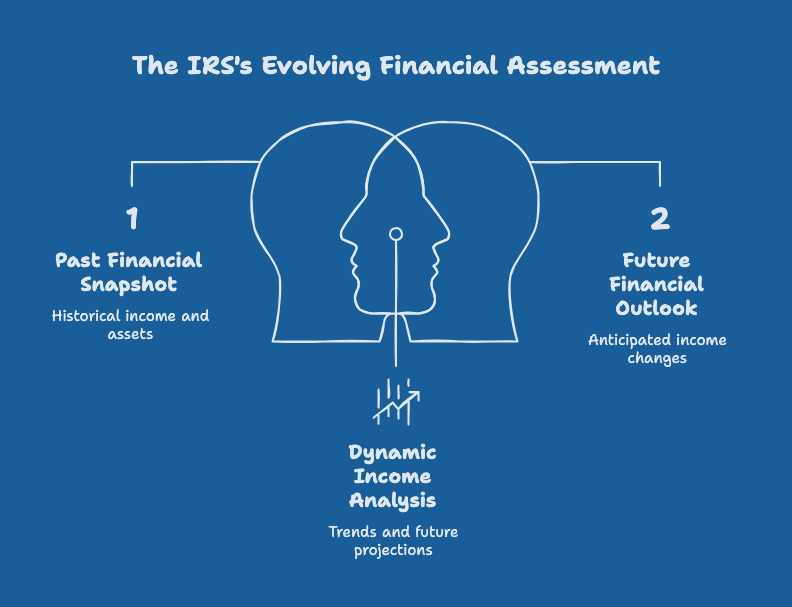
Practitioners reading the change see a pattern: the IRS wants a fuller financial condition picture, including offshore ties and future collection potential, not just a snapshot of today.
Not every balance triggers it, which is the first thing worth checking.
If you owe $50,000 or less and have filed everything, a streamlined agreement is usually available online with no disclosure of your finances at all. The IRS just divides the amount into payments. No 433 of any kind.
This form comes out when the case gets harder. That generally means a balance above the streamlined installment ceiling, a self-employed taxpayer, an assigned revenue officer, a settlement request, or a move to delay the collection process through Currently Not Collectible status.
Pick the right version before you start, because the IRS forms in this family look alike. The 433-F is the shorter one used by the phone unit. The 433-A is the full statement for a revenue officer. The 433-A (OIC) goes with Form 656 for a compromise. Businesses use 433-B. Sending the wrong one restarts the clock.
Section 1 covers personal information, household members, and any outside business interests, including an LLC or partnership stake.
Section 2 is employment for wage earners: employer, pay period, occupation, how long you have been there.
Section 3 is other financial information, and it is where the new questions live alongside older ones about lawsuits, bankruptcy, safe deposit boxes, trusts you benefit from or serve as trustee for, and any asset transferred for less than its value in the past ten years above $10,000.
Section 4 is personal assets. Bank accounts, investments, available credit, life insurance with cash value, retirement accounts, real property, vehicles, and a dedicated digital assets block covering cryptocurrency, NFTs and smart contracts, down to who else holds the private keys.
Section 5 is monthly income and expenses, including wages, Social Security and any other household money coming in. This is the section that produces the number.
Sections 6 and 7 apply only to self-employed filers: business assets, then a business income and expense statement whose net figure feeds back into line 24 of Section 5.
Answer every question or write N/A. A blank looks like an oversight, and the case comes back.
Attach proof as you go rather than waiting to be asked. The standard package:
Publication 1854 is the IRS comprehensive guide to preparing the statement, and it explains what detailed financial information each line wants.
Here is the part that decides your outcome.
The IRS does not use your actual budget. It compares what you report against its collection financial standards, the caps on allowable expenses for food, housing, transportation and out-of-pocket health care. The current set took effect June 29, 2026, so check the date on whatever table you are using against your own financial situation.
For most categories the IRS allows the lower of what you spend or what the standard permits. Anything you spend above the cap is treated as money available for your tax debt, whether or not it is actually sitting in the bank.
Gross monthly income minus those permitted amounts equals the payment the IRS expects. Run that calculation before you sign, because it tells you which resolution options are realistically open and what your financial picture looks like from their side of the desk. If the number lands near zero, you may be looking at hardship rather than an installment plan. If it lands high, an offer in compromise probably will not fly.
Leaving blanks. Covered above, and it is still the most frequent reason a package bounces.
Reporting what you actually spend without checking the standards. Claim $5,200 of housing where the local cap is $4,419 and the difference becomes disposable income unless you document why the higher figure is necessary.
Forgetting the assets that are easy to forget. Retirement accounts, the surrender value in a life insurance policy, digital assets and a safe deposit box all belong on the form. What you fail to disclose reads as concealment, and it can carry a penalty on top of the tax.
Valuing assets at retail. The IRS works from quick sale value, generally around 80% of fair market value, not what an item is worth to you.
Guessing at self-employment income. Average it over six to twelve months so one strong month does not set your obligation for the next five years.
Letting compliance slip mid-review. Missing an estimated payment while the submission is open can end the whole thing.
Follow the instruction on your notice, because it varies. Some IRS notices, including the CP522 series about an installment agreement under review, tell you to call rather than mail, and warn that mail will not arrive in time. Others route to a specific revenue officer.
Where a mailing address applies, the Document Upload Tool often takes the package instead and gives you a timestamped submission. Keep a complete copy either way.
If the answer is a levy release or an installment agreement, our walkthrough of Form 9465 covers the request itself. If you are heading toward settlement, start with how an offer in compromise works, including the $205 application fee and the low-income waiver.
You do not have to complete IRS Form 433-A on your own. A representative can talk to the IRS for you, which changes the tone of a collection case quickly. That requires authorization, and our guide to Form 2848 explains the difference between the two options.
For CPA firms, collection work does not follow the April calendar. It arrives year round and spikes when notices land. Madras Accountancy builds the 433-A workpaper, chases the documentation and drafts the expense analysis so your consultation time goes to strategy instead of data entry.
1. What is Form 433-A used for? It is the financial statement the IRS reviews to decide what you can afford to pay on a tax liability, and it supports installment agreements, offers and hardship requests.
2. Do I have to complete Form 433-A for every installment plan? No. At $50,000 or less with all returns filed, you usually qualify for a streamlined agreement without it.
3. What is the difference between 433-A and 433-F? The 433-F is shorter and used by IRS collection call centers. The 433-A is the detailed statement used by revenue officers and in offer cases.
4. How far back do the bank statements go? Three months is the usual request, though a revenue officer can ask for more if the account activity raises questions.
5. Will the IRS accept my actual monthly expenses? Only up to the published caps. Above them you need proof the higher figure is necessary, or the IRS may treat the excess as available to pay.
6. Can filing this form stop a levy? It can. A complete package plus an accepted resolution generally stops enforced collection actions, including wage garnishment. A lien already filed is a separate matter with its own appeal path.
7. What happens if I make a mistake? Correct it in writing quickly. Errors caught late look worse than errors caught early, and understated assets can jeopardize an agreement.
8. How long does the review take? A revenue officer may respond within weeks. An offer can run six months to two years, and the IRS has up to 24 months to decide.
This article is general information about IRS tax problems, not advice on your situation. Collection deadlines move fast, so talk to a professional before you sign anything.
The 2026 1099 reporting threshold changed: 1099-NEC and 1099-MISC now start at $2,000, and 1099-K is back to $20,000. Here is what you must file.
A plain guide to how a 2026 sales tax holiday works, which items are exempt, and the rules on price caps, refunds, and rain checks.
Form 7004 buys a 6-month extension of time to file business returns like 1065, 1120-S and 1120. Deadlines, e-file steps and the payment trap.



