


If you have been hit with a penalty and believe it should be removed, or if you overpaid and need your money back, Form 843 is likely what you need. Its full name is "Claim for Refund and Request for Abatement," and it covers situations where you need to ask the IRS for relief.
Taxpayers use this form to request an abatement of certain taxes, penalties, interest, and additions to tax. It is also used to recover penalties that were assessed or collected in error. Whether you are dealing with a failure to file penalty, a late deposit issue, or a covid-era penalty refund situation, Form 843 is usually how you start that conversation with the Internal Revenue Service.
Here are the most common reasons to file form 843:
Penalty abatement. If you received an IRS notice assessing a penalty or addition to tax and you had reasonable cause for the issue, you can use this form to ask the IRS for relief.
Refund of a penalty already paid. If a penalty was assessed and you already paid it, you can recover that amount through this form.
IRS error or delay. If the IRS made a mistake or caused a delay that led to a penalty, you can request an abatement or refund.
Refund of Social Security or Medicare tax. In some situations (like excess withholding from multiple employers), this form can handle the recovery, though other paths exist through your annual return.
Abatement of certain taxes. Beyond penalties, the form can handle abatement of certain taxes in narrow cases, such as taxes assessed due to an IRS employee error.
What this form is not for: amending your return. For that, use form 1040-X. If you need a refund because of a mistake on your annual filing, that is the wrong form. Form 843 deals with penalties, certain fees, and specific situations. You can check the IRS website for more information about form 843 and which situations it covers.
For a deeper look at penalty abatement strategies, our guide covers the options available.
The form itself is one page, but it needs specific information. Here is a walkthrough:
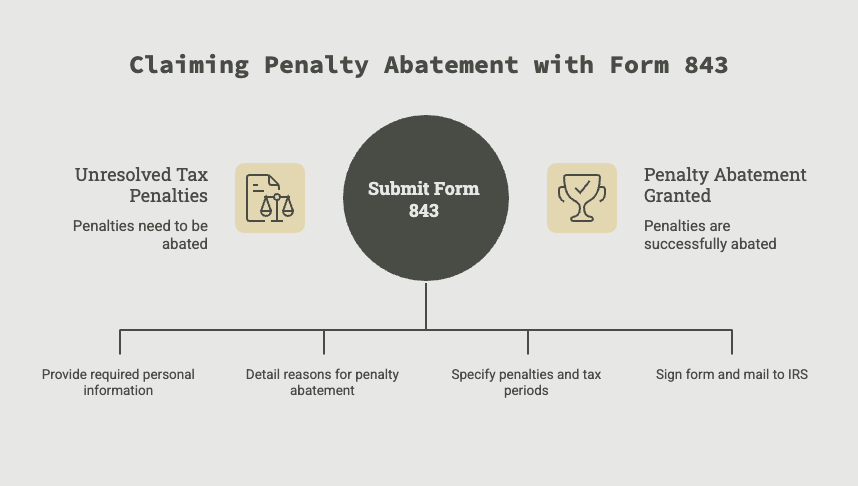
Across the top of the form, enter your name, address, Social Security number (or EIN), and your spouse's SSN if applicable.
Line 1: The tax period your claim relates to. This is the tax year or quarter the penalty covers.
Line 2: The amount you are seeking.
Line 3: The type of tax involved. Check the box that matches (income tax, employment tax, estate, gift, excise, or penalty). This tells the IRS which department handles it.
Line 4: Enter the Internal Revenue Code section related to your claim. For example, a failure to file penalty falls under IRC section 6651. The form 843 instructions and the notice you received should help identify the right code. If you are unsure, according to IRS guidance, you can call the IRS to ask.
Line 5a: Explain why the IRS should grant your claim. Be specific. If the basis is reasonable cause, describe what happened and why it prevented compliance. If you are pointing to an IRS error or delay, explain what went wrong. If this is a straightforward first-time abatement request, state that you qualify and that your compliance history supports it.
Line 5b: List the penalties or additions to tax and the tax period each one covers.
Signature: Sign and date. If a tax professional is filing on your behalf, they sign in the preparer section.
One key detail: Form 843 cannot be e-filed. You must print it, sign the completed form, and mail it to the IRS.
Where you mail your form depends on the type of tax and your location. The IRS instructions list the correct address.
For most penalty and refund situations, mail form 843 to the IRS service center where you filed the original return. If you have an IRS notice about the penalty, use the address on the notice.
Send it by certified mail with a return receipt. This gives you proof that the IRS received it. Keep a copy of everything. You can track status through your IRS online account or by calling the IRS directly.
If the IRS approves your claim, they will send a letter confirming the abatement or issue a refund check. If they deny it, they will explain why, and you can appeal or submit additional documentation.
First-time penalty abatement (FTA). If you have a clean compliance history for the prior three years, the IRS may grant relief. This is one of the most common uses of the form. For a straightforward first-time abatement request, you note on Line 5a that you qualify for an abatement under FTA and request fta relief. These are typically processed faster.
Reasonable cause. If you missed a deadline due to reasonable cause (medical emergency, natural disaster, reliance on incorrect advice from the IRS), explain and document it on Line 5a.
Statutory exceptions. Certain penalties can be removed if you fall under an exception listed in the form or Internal Revenue Code.
COVID-era penalty refund. The IRS announced automatic relief for certain years. If your situation was not automatically covered, submitting form 843 may be necessary to get that relief.
A protective claim is a form 843 claim you file to preserve your right to a refund while a related legal or administrative issue is still pending. For example, if a court case could affect whether you are owed money, you can submit a protective claim so you do not miss the deadline.
Protective claims do not need a specific dollar amount. You describe the issue, and the IRS holds the claim until the matter resolves. This is an advanced use of the form, and getting tax advice before filing one is a good idea. This article is general information about form 843, not legal or tax advice for specific situations.
1. What is IRS Form 843? It is the Claim for Refund and Request for Abatement. Taxpayers use it to seek relief from penalties, recover overpaid amounts, or address an IRS error.
2. When should I use Form 843? Use it when you need to address a penalty, recover an amount you already paid, or handle an IRS error or delay. Do not use this form to amend your return. For that, use Form 1040-X.
3. Can Form 843 be e-filed? No. Form 843 must be printed, signed, and mailed. You cannot submit it electronically.
4. Where do I mail Form 843? Mail your form to the IRS service center listed in the instructions for your type of tax. If you have an IRS notice, use the address on it. Send via certified mail with a return receipt.
5. What is first-time penalty abatement? It is an IRS policy allowing relief for taxpayers with a clean three-year filing and payment history. If you qualify, the process is typically faster.
6. What is reasonable cause? It means you had a legitimate reason for not meeting an obligation, such as a serious illness or natural disaster. You need to explain it on the form and provide documentation.
7. How long does the IRS take to process Form 843? It varies. Simple claims may take a few weeks. More complex ones can take months. You can check progress through your IRS online account or by contacting them. Access your IRS account to monitor status.
8. Can I use Form 843 for a tax refund on my return? Generally no. For refund claims related to errors on your annual return, use the amended return process (1040-X). Form 843 handles penalties, abatement of penalties, and specific situations involving an IRS error or delay.
Need help with penalty relief, IRS penalty abatement, or submitting Form 843? Madras Accountancy works with CPA firms across the U.S. on IRS resolution. Reach out to discuss your situation.

The section 4960 excise tax is 21% of nonprofit pay over $1M. From 2026 it covers all employees. See the medical carve-outs, Form 4720 and a worked example.

The paid family and medical leave tax credit is permanent from 2026. See the 12.5% to 25% rates, the premium option, the 6-month rule and how Form 8994 works.

Opportunity zones become permanent in 2027 under the One Big Beautiful Bill. See the new deferral, rural bonus, and the 2026 handoff.