



You have probably heard that overtime is tax-free now. That is the headline, and it is only half true, in a very literal sense. The no tax on overtime deduction is real, but it applies to a specific slice of your overtime and comes with limits worth understanding before you count on it. This guide explains what the tax on overtime deduction actually covers, who qualifies, how much you can deduct, and how to claim it.
The One Big Beautiful Bill Act, signed in July 2025, created a temporary federal income tax deduction for qualified overtime. People call it the no tax on overtime rule, though it is a break rather than a full exemption. This new tax break runs for tax years 2025 through 2028, part of a wave of new tax laws aimed at working families, so it covers overtime earned in 2025 and the three years after.
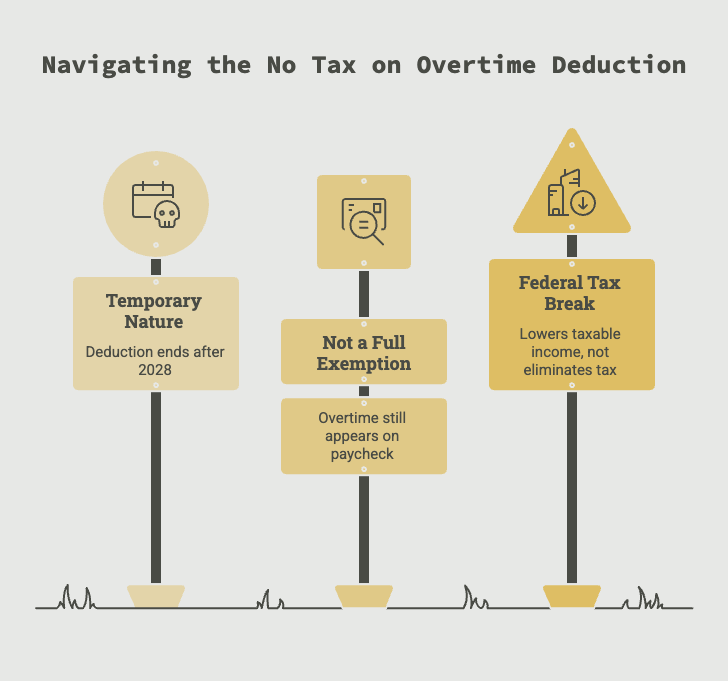
Here is the important framing. It is a federal tax break, which lowers the income you pay tax on, not a rule that makes overtime disappear from your paycheck. The law wrote this in as a temporary break, so unless Congress extends it, the deduction for qualified overtime compensation ends after 2028. Understanding it as a break, not a magic tax-free zone, saves a lot of confusion when you file your tax return.
This is the part almost everyone gets wrong. The break only covers the overtime premium, meaning the extra half of your time-and-a-half overtime, not the whole overtime paycheck. The qualifying premium is the amount you earn above your regular rate of pay under the Fair Labor Standards Act, which is the half that makes time-and-a-half more than straight time when you take on overtime work.
An example makes the amount of qualified overtime compensation clear. Say you normally earn 20 dollars an hour, and for overtime you get 30 dollars an hour, which is time-and-a-half. Only 10 dollars of that 30, the premium above your regular rate for overtime, is what counts, and workers who receive qualified overtime compensation may deduct only that piece. The other 20 dollars, your normal wage, does not. So the deductible overtime amount is much smaller than your total overtime compensation, and the overtime earnings that qualify are only the premium the FLSA requires.
Eligibility follows federal overtime law. To claim it, you generally have to be someone the FLSA requires overtime pay for, meaning a non-exempt worker who receives overtime pay at time-and-a-half for hours over 40 in a week. Employees who receive overtime pay under those federal rules are the target group, so working overtime for a covered employer is what matters, though some overtime might still fall outside the federal definition.
That leaves some people out. Salaried workers who are exempt from FLSA overtime are not eligible for overtime under the law, so their extra-hours pay does not qualify even if their employer pays something for it. Overtime required only by a state law or a contract, but not by the FLSA, also does not count as qualifying overtime. Because this tracks whether you are eligible for overtime pay federally, it mostly reaches hourly W-2 employees rather than salaried staff or contractors.
There is a cap, and it is not small. Eligible workers can deduct up to 12,500 dollars of qualified overtime pay on a single return, or up to 25,000 dollars for a married couple filing jointly. That is the ceiling on the premium you can write off in a year.
Higher earners get less. The deduction phases out once your modified adjusted gross income passes 150,000 dollars for single filers or 300,000 dollars for joint filers, so the deduction is reduced as income climbs above those points and disappears entirely for high earners. For most hourly workers earning overtime, the full amount is available, but it is worth checking where your income lands before you assume you get the whole tax deduction.
Here is some good news that surprises people. This is an above-the-line write-off, which means you can claim the tax break whether you itemize or take the standard deduction. You do not have to give up the itemizing to get it.
That makes the income tax deduction for certain overtime unusually accessible. Most deductions worth having require itemizing, which many hourly workers do not do. Because the deduction for qualified overtime compensation sits above the line, it stacks on top of the the standard option rather than competing with it, so a worker taking the itemized deductions still gets the full benefit of this break.
Do not expect your paycheck to grow. The no tax on overtime label only touches federal tax, so your overtime pay is still subject to Social Security and Medicare payroll tax exactly as before. There is no special overtime tax rate, and the money still has payroll tax taken out when you are paid.
State tax is a separate question too. This is a federal break, so whether your state follows it depends on state tax law, and many states do not conform automatically. Your regular tax withholding during the year also does not change much, since the benefit shows up as a write-off when you file rather than as a bigger paycheck. In short, the write-off lowers your federal income tax bill at filing time, not your take-home pay each period.
For tax year 2025, claiming it takes a little legwork. The Internal Revenue Service (IRS) treated the 2025 tax year as a transition year, so for tax purposes employers were not required to separately report qualified overtime compensation on your 2025 Form W-2, keeping it off your federal tax return records. That means you may need to calculate your total qualified overtime premium yourself from your pay stubs to claim the deduction when you file.
Starting with the 2026 tax year, this gets easier. Employers must report the qualifying premium on the W-2 using a dedicated code, so the number will be there for you. Either way, the deduction is claimed on your federal income tax return for the current tax year, and this new deduction for qualified overtime is handled through the payroll compliance side of separately reporting these amounts is where employers now have real work to do. If your pay stubs are hard to read, this is a fair question to bring to a tax professional.
The no tax on overtime deduction is a genuine break, but the details, the premium-only rule, the income phase-out, and the 2025 reporting gap, are exactly where mistakes happen. Whether a given worker qualifies, and for how much, depends on their FLSA status, their income, and clean pay records. Madras Accountancy supports US CPA firms and their clients on exactly this, from separating the qualifying overtime premium in payroll to reporting it correctly and claiming the break at filing. You can also read the official IRS guidance on the new rules.
If overtime reporting has you unsure, you can reach out here. This is general information, not tax advice, so speak with a tax preparer about any specific tax situation before you file. A quick tax preparation review can catch tax questions early, and unlike a tax credit, this break lowers taxable income rather than the bill directly.
1. What is the no tax on overtime deduction? It is a temporary federal tax break created by the One Big Beautiful Bill Act for qualified overtime compensation earned in tax years 2025 through 2028. It lowers taxable income rather than making overtime fully tax-free.
2. Is overtime really tax-free now? Not fully. The write-off covers only the overtime premium and only income tax. Your overtime pay is still subject to Social Security and Medicare payroll tax, so it is not truly tax-free.
3. How much overtime can you deduct? Eligible workers can deduct up to 12,500 dollars of qualified overtime pay on a single return, or 25,000 dollars for joint filers, before the income phase-out. The deduction is reduced above 150,000 dollars of income for single filers.
4. What is qualified overtime compensation? It is the overtime premium required by the Fair Labor Standards Act, meaning the extra half of your time-and-a-half above your regular rate of pay. The regular wage portion of overtime does not qualify.
5. Who is eligible for the overtime break? Non-exempt workers who receive overtime pay required under the FLSA at time-and-a-half for hours over 40 in a week. Salaried employees exempt from federal overtime, and overtime required only by state law or contract, do not qualify.
6. Does the break apply if you take the itemizing? Yes. It is an above-the-line tax break, so you can claim it whether you itemize or take the the standard option. You do not have to itemize to benefit.
7. Is overtime still subject to payroll tax? Yes. The write-off affects income tax only. Overtime wages remain subject to Social Security and Medicare payroll tax, and state treatment depends on your state's own tax law.
8. How do you claim the overtime write-off for 2025? Because 2025 is a transition year, employers were not required to separately report qualified overtime on the W-2, so you may need to total your overtime premium from pay stubs and claim the break on your 2025 return.

Section 4960's 21% excise tax now reaches far more nonprofit employees. See who is a covered employee in 2026 and what changed.

The Section 45S paid family leave credit is permanent for 2026 with new options. See who qualifies, the amounts, and how to claim it.

Opportunity zones become permanent in 2027 under the One Big Beautiful Bill. See the new deferral, rural bonus, and the 2026 handoff.