



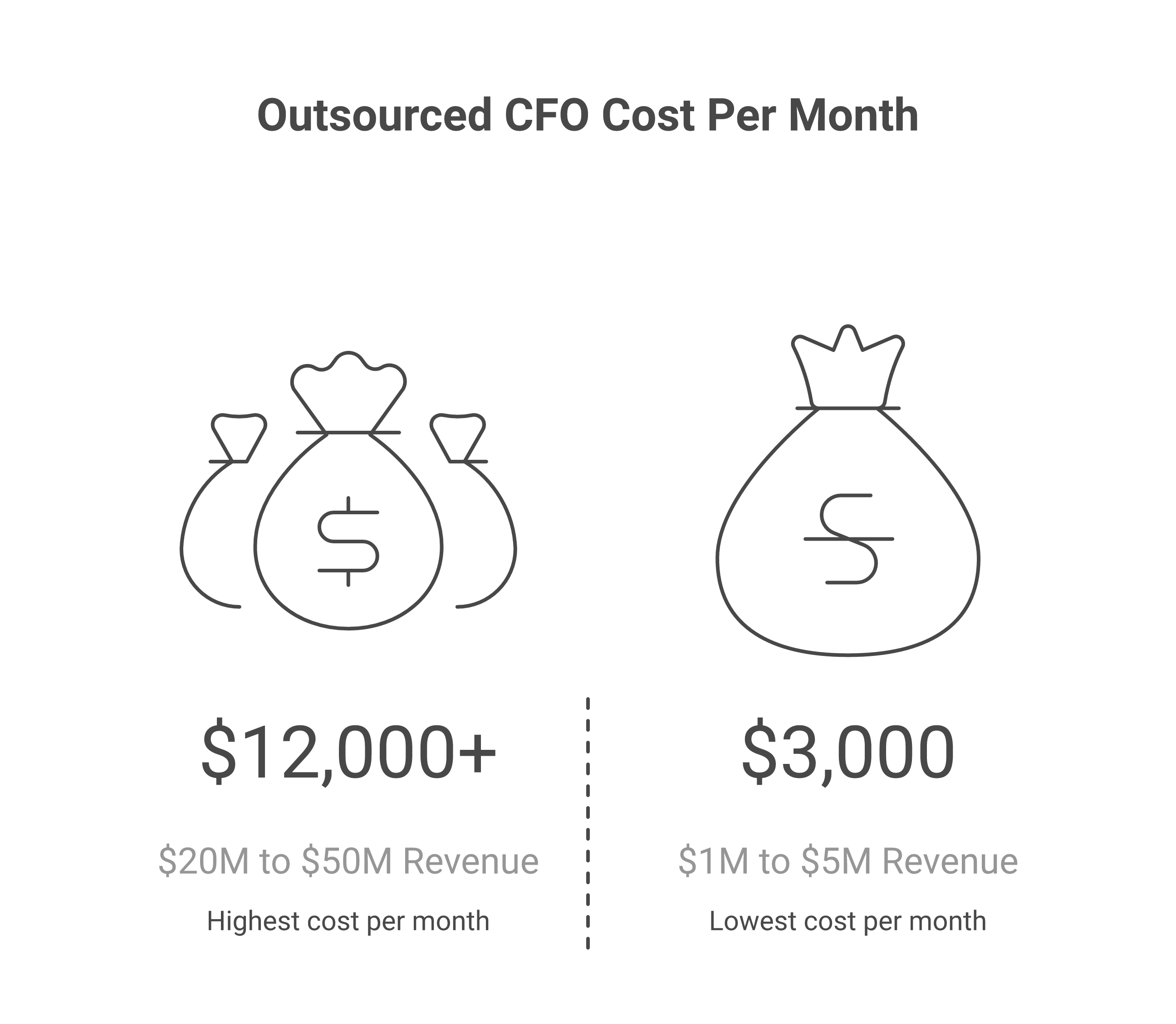
We get this question every week at Madras Accountancy: "How much does an outsourced CFO cost?" The answer is annoyingly simple once you know the pattern. Company revenue is the primary driver. A $2M company needs fewer CFO hours and less complex analysis than a $15M company. The pricing reflects that.
Here is the honest breakdown based on what we charge and what we know the market charges. For a deeper look at different pricing structures (hourly vs retainer vs project-based), our fractional CFO pricing guide covers the models in detail.
Before diving into the tiers, it is worth noting that the outsourced CFO market has matured significantly over the past five years. In 2020, most outsourced CFO providers were solo practitioners charging hourly rates. Today, the market includes solo practitioners, boutique firms with small teams, and hybrid models like ours at Madras that pair a senior CFO with an offshore production team. The pricing varies across these models, and the value delivered per dollar varies even more. A solo practitioner charging $5,000 per month delivers their personal time (typically 10 to 15 hours). A hybrid model at the same price point delivers senior CFO time plus 30 to 50 hours of analytical support from the production team. The output is substantially different.
At this stage, you are probably running on a bookkeeper and a CPA. The financials are there but nobody is doing anything with them. No cash flow forecasting. No profitability analysis by service line. No financial modeling for growth decisions.
What you get at this tier: monthly financial review and reporting, cash flow forecasting (13-week rolling), basic KPI tracking and dashboards, annual budget development and monthly variance analysis, banking relationship support, and on-demand financial guidance (typically 8 to 12 hours of senior CFO time per month backed by production team support).
What you do not get: weekly CFO engagement, complex financial modeling, fundraising support, M&A advisory, or multi-entity consolidation. If you need those, you are in the next tier.
At Madras, this tier pairs a senior fractional CFO with our Chennai production team. The CFO handles the monthly review meeting and strategic guidance. The production team maintains the dashboards, prepares the reports, and runs the forecasts. That hybrid structure is how we deliver CFO-quality output at $3,000 to $5,000 per month instead of $8,000 to $10,000. For the full picture of how the hybrid model works, see our complete fractional CFO guide.
In our experience, companies at this revenue stage often underestimate how much value a fractional CFO delivers because they have never had one. They are accustomed to making financial decisions based on a checking account balance and a quarterly conversation with their CPA. When they start receiving monthly financial packages with variance analysis, cash flow forecasts, and KPI dashboards, the quality of their decision-making improves immediately. The CFO does not need to make revolutionary changes. They need to provide the financial visibility that enables better decisions on the questions the business is already facing.
The most common engagements we see at this tier involve cash flow management (building a forecast that prevents surprises), banking support (preparing the financial packages that lenders require), and pricing analysis (determining whether current pricing covers costs and generates adequate margin). These are not exotic CFO activities. They are the fundamentals that every business needs and most businesses at this stage lack.
This is where financial complexity scales. You might have multiple revenue streams, multiple locations, or a growing headcount that requires workforce planning. You are probably thinking about (or already dealing with) a line of credit, equipment financing, or SBA loan. Maybe you are considering your first acquisition or preparing for a fundraise.
What you get at this tier: everything in the foundational tier, plus weekly or biweekly CFO meetings, detailed financial modeling (scenario analysis, what-if planning), profitability analysis by department/location/service line, banking and lender management (covenant compliance, loan negotiations), board or investor reporting packages, and strategic project support (15 to 25 hours of senior CFO time per month plus production team).
The jump from $3K to $5K or more is driven by frequency and depth. Weekly engagement means the CFO is embedded in your decision-making process, not just reviewing last month's numbers. The financial modeling at this tier goes beyond "what happened" into "what should we do about it."
In our experience, the growth tier is where the fractional CFO engagement starts to feel less like a service and more like having a CFO on the team. The weekly meeting cadence means the CFO is aware of emerging issues in real time, not discovering them in last month's financials. The depth of analysis means the CFO is modeling scenarios before decisions are made, not just reporting on the outcomes after the fact.
Companies at this tier are also dealing with increasing stakeholder complexity. The bank wants quarterly financial packages. The board or investors want reporting. Key employees want to understand the company's financial trajectory. The fractional CFO manages these stakeholder communications, ensuring that each audience receives the appropriate information in the appropriate format. This stakeholder management role is often undervalued when companies evaluate whether to engage a fractional CFO, but in practice it consumes 15 to 20 percent of the CFO's time and delivers significant value.
The strategic project support at this tier deserves specific mention. Companies between $5M and $20M frequently face one-time financial decisions that have long-term implications: an acquisition opportunity, a major capital investment, a new market entry, or a change in pricing strategy. These projects require intensive financial analysis over a period of weeks, and the fractional CFO leads that analysis. The production team at Madras builds the models and runs the scenarios. The CFO interprets the results and presents recommendations to the CEO or board. This project-based work often generates more value than the ongoing monthly engagement because the decisions at stake involve hundreds of thousands or millions of dollars.
At this size, you probably need a full-time CFO eventually. But the gap between "we need one" and "we can afford one and find the right person" can be 12 to 24 months. A fractional CFO bridges that gap, and some companies at this size discover that the fractional model delivers everything they need without the $350,000 to $500,000 annual cost of a full-time hire.
What you get at this tier: weekly CFO engagement as a core team member, multi-entity financial consolidation, complex M&A advisory (target identification, valuation, due diligence, integration planning), fundraising support (financial model, data room, investor meetings), treasury management and cash optimization, executive team financial coaching, and strategic planning facilitation (25 to 40 hours of senior CFO time per month plus dedicated production team).
Some firms at this tier eventually hire a full-time CFO and transition the fractional engagement to a controller-level or advisory-only relationship. Others keep the fractional model permanently because the hybrid structure (senior CFO + offshore production) delivers more analytical horsepower per dollar than a single full-time hire.
In our experience, the decision between keeping the fractional model and hiring full-time comes down to how much the CEO values having a CFO physically present in the office versus the analytical depth that the hybrid model provides. A full-time CFO is available for hallway conversations and can attend every meeting. A fractional CFO is available during scheduled hours and for urgent matters but is not on-site daily. For companies where the CEO values accessibility above all else, a full-time hire eventually makes sense. For companies where the CEO values analytical depth and is comfortable with a structured meeting cadence, the fractional model often remains the better choice even above $50M.
A full-time CFO in a major US metro costs $200,000 to $350,000 in base salary, plus benefits, bonuses, and often equity. Fully loaded annual cost: $275,000 to $475,000. For companies under $20M in revenue, that is 1.5 to 5 percent of revenue spent on a single hire.
A fractional engagement at $6,000 per month costs $72,000 per year. At $10,000 per month, it is $120,000 per year. That is 25 to 40 percent of the full-time cost with comparable strategic output. The tradeoff is availability. A full-time CFO is in the office 40 to 50 hours per week. A fractional CFO is engaged 10 to 25 hours per week. For most companies under $30M, the fractional hours are sufficient because the production team handles the analytical work that a full-time CFO would otherwise spend time on.
For a detailed comparison, our article on full-time vs outsourced CFO covers the roles and responsibilities at each level.
The comparison also needs to account for the hiring risk. Finding a qualified CFO takes 3 to 6 months. There is no guarantee the hire works out. If it does not, you are back to square one 9 months later, having spent $200,000 or more in compensation and opportunity cost. A fractional engagement can be started in 1 to 2 weeks, and if the fit is not right, the transition to a different provider is straightforward. This flexibility is particularly valuable for companies that are not entirely sure what they need from a CFO and want to define the role through experience before committing to a full-time hire.
Several factors push pricing toward the top of each range. Multi-entity structures with intercompany transactions require more consolidation work. International operations add currency, compliance, and transfer pricing complexity. Active M&A processes (buy-side or sell-side) require intense engagement for 3 to 6 months. Board or investor reporting obligations add recurring deliverables. And industry-specific complexity (construction bonding, healthcare revenue cycle, SaaS metrics) requires specialized expertise that commands a premium.
The complexity factor is worth exploring further. A $10M company with a single entity, one location, and straightforward operations might need $5,000 per month. A $10M company with 4 entities, operations in 3 states, a line of credit with covenants, and an active acquisition pipeline might need $8,000 to $10,000 per month. The revenue is the same. The complexity is not.
The Madras model specifically drives cost down because our offshore production team handles tasks that other fractional CFO firms assign to the CFO or to expensive onshore analysts. Dashboard maintenance, report preparation, financial model updates, data reconciliation, and variance analysis all happen at offshore rates. The senior CFO's time is reserved for the strategic work that actually requires their experience and judgment.
This means a Madras engagement at $6,000 per month delivers the analytical depth of what other providers charge $10,000 to $12,000 for. Same strategic leadership at the top, lower-cost production underneath.
The production team advantage is most visible in the deliverables. A solo fractional CFO charging $6,000 per month at 15 hours of engagement has time for meetings and basic analysis but is unlikely to also maintain detailed dashboards, build complex financial models, and produce polished board reports. Our model at the same price point includes all of those deliverables because the production team handles them.
If you want to talk about what a fractional CFO engagement would cost for your specific company, reach out at madrasaccountancy.com. We will give you a straight answer based on your revenue, complexity, and what you actually need.
Yes, and we recommend this for most companies. Start at the foundational tier ($3,000 to $5,000 per month), get the basic reporting and forecasting infrastructure built, and upgrade to the growth tier when you need weekly engagement or strategic project support. The production team and reporting infrastructure carry forward, so upgrading does not require starting over.
At Madras, we recommend a 6-month initial engagement to allow time for setup and stabilization, then month-to-month thereafter. Some providers require 12-month contracts. Ask about termination provisions before signing. Our article on signs you need a fractional CFO can help you determine if the timing is right.
If your primary need is accurate monthly financials, clean close processes, and basic reporting, you need a controller ($3,000 to $6,000 per month). If you need cash flow forecasting, strategic analysis, banking relationships, fundraising support, or M&A advisory, you need a CFO. Some companies need both, and at Madras, we offer combined engagements where the controller handles production and the CFO handles strategy.
When a company reaches $30M to $50M in revenue or has consistently complex financial needs (multiple acquisitions per year, public company aspirations, international operations), a full-time CFO usually makes sense. We help with the search and hiring process, then transition to an advisory role supporting the new full-time CFO during their first 6 months.
The value should be measurable within 6 months. Specific indicators include better financial visibility (you receive reports you never had before), improved cash flow management (fewer surprises, better forecasting accuracy), stronger banking relationships (better terms, faster approvals), and more confident decision-making (because decisions are backed by financial analysis rather than intuition). If none of these improvements are evident after 6 months, either the engagement is not structured correctly or the CFO is not the right fit.

Section 4960's 21% excise tax now reaches far more nonprofit employees. See who is a covered employee in 2026 and what changed.

The Section 45S paid family leave credit is permanent for 2026 with new options. See who qualifies, the amounts, and how to claim it.

Opportunity zones become permanent in 2027 under the One Big Beautiful Bill. See the new deferral, rural bonus, and the 2026 handoff.