


A full-time controller in the US costs $90,000 to $140,000 in salary alone. Add benefits, payroll taxes, office space, and management time, and you are looking at $120,000 to $185,000 per year. For a growing business doing $2M to $20M in revenue, that is a significant line item, especially when you may not need 40 hours a week of controller-level work.
This is why outsourced controller services have grown so rapidly over the past five years. You get the expertise without the full-time commitment. But "outsourced controller" is a broad category, and the pricing varies dramatically depending on what is actually included.
We provide outsourced controller services through our partnerships with US CPA firms, supporting their clients with month-end close, financial reporting, cash flow management, and the other functions that sit between bookkeeping and CFO-level strategy. Here is what the pricing landscape looks like in 2026 and what you should expect at each tier.
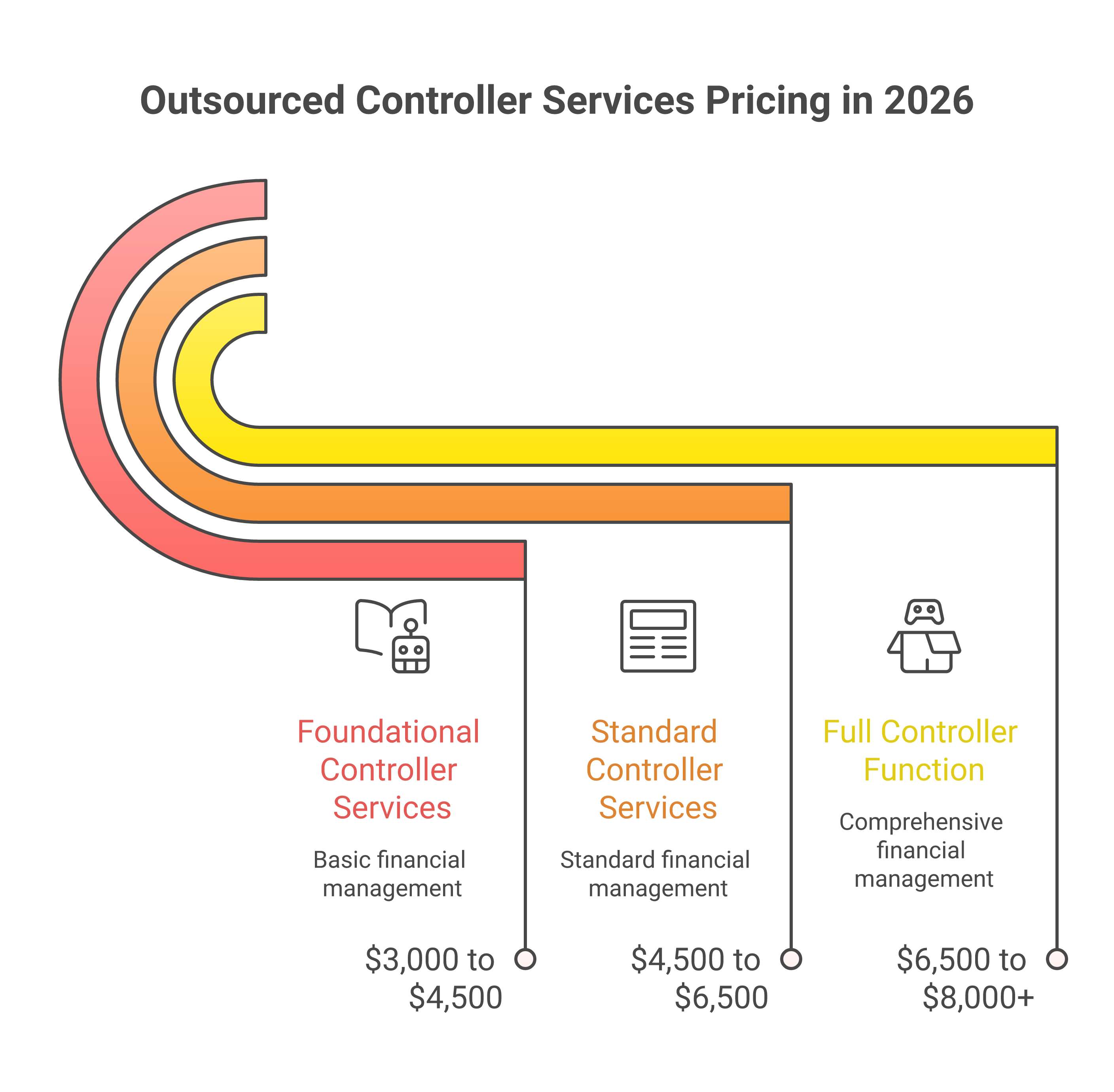
That is the range for most businesses doing $2M to $30M in annual revenue. Some providers go lower. Some go higher. But 80% of the market falls within this band.
Why such a wide range? Because "controller services" can mean very different things:
At the low end ($3,000 to $4,000/month), you are getting month-end close, basic financial statement preparation, and some oversight of the bookkeeping function. This is what a 10-hour-per-month engagement looks like. Good for businesses that have solid bookkeeping in place and just need someone experienced to close the books, produce reports, and make sure nothing falls through the cracks.
At the high end ($6,500 to $8,000/month), you are getting a full controller function: month-end and year-end close, detailed financial reporting with variance analysis, budgeting and forecasting, cash flow management, internal controls, audit preparation, and direct interaction with the company's CPA firm and bankers. This is 25 to 35 hours per month and replaces what a full-time controller would do.
Let us break each tier down.
Hours per month: 8 to 15
Best for: Businesses with $1M to $5M in revenue that have bookkeepers handling day-to-day transactions but no one managing the close process or producing reliable financial statements.
What is included:
What is not included at this tier:
This tier works well when the business has clean books but needs an experienced set of eyes on the close process. Think of it as a quality control layer with financial statement output. The controller reviews the bookkeeper's work, ensures proper accruals and deferrals, reconciles the balance sheet, and produces financials that the business owner and their CPA can rely on.
At Madras, we deliver Tier 1 services in partnership with CPA firms who want to offer controller services to their clients without hiring controller-level staff internally. Our offshore team handles the reconciliation work and financial statement preparation, while the CPA firm provides the client-facing relationship and high-level review.
Hours per month: 15 to 25
Best for: Businesses with $5M to $15M in revenue that need active financial management, not just month-end reporting.
What is included (everything in Tier 1, plus):
This is the sweet spot for most growing businesses. They have outgrown the basic bookkeeper-plus-CPA model but are not large enough to justify a full-time controller at $120,000+ per year. At $5,000 to $6,500 per month ($60,000 to $78,000 per year), they get 60% to 70% of what a full-time controller provides at 40% to 50% of the cost.
The key differentiator between Tier 1 and Tier 2 is the forward-looking work. Tier 1 is backward-looking: what happened last month. Tier 2 adds the forward-looking lens: what is our cash position in 90 days, are we on budget, where are we over- or under-spending. This is the information that drives better business decisions.
For firms considering how controller services fit alongside CFO-level support, our guide to controller vs fractional CFO roles clarifies where one ends and the other begins.
Hours per month: 25 to 40
Best for: Businesses with $10M to $30M in revenue that need a true controller function without the full-time hire.
What is included (everything in Tier 2, plus):
At this tier, you are effectively replacing a full-time controller. The outsourced team handles everything from daily transaction oversight to board-level reporting. The primary difference from an in-house controller is physical presence. Your outsourced controller is not walking the halls, not sitting in on every meeting, not available for every impromptu question. But they are accessible by phone, email, and video call during agreed-upon hours, and the work product is identical to what an in-house controller would produce.
Some businesses at this tier eventually hire a full-time controller and transition the outsourced team to a supporting role. Others stay with the outsourced model indefinitely because the cost savings are too significant to give up.
Two businesses at the same revenue level can pay very different prices for controller services. Here is why.
Transaction volume. A $5M professional services firm with 200 transactions per month is simpler than a $5M retail business with 5,000 transactions per month. More transactions mean more reconciliation work, more categorization review, and more time spent on the close process.
Entity complexity. A single-entity LLC is straightforward. A holding company with three operating subsidiaries, intercompany transactions, and consolidated reporting? That is 2 to 3 times the work.
Industry-specific requirements. Construction companies need job costing and percentage-of-completion revenue recognition. Real estate firms need property-level reporting and complex depreciation schedules. Nonprofits need fund accounting and grant compliance reporting. Industry specialization adds time and requires expertise that commands higher rates.
Reporting sophistication. Some business owners want a P&L and a balance sheet. Others want departmental P&Ls, KPI dashboards, rolling forecasts, and board presentation packages. The more detailed the reporting, the more hours required.
State of the books. If the bookkeeping is clean and current, the controller can focus on higher-level work. If the books are a mess, the controller spends time on cleanup before they can do anything else. We have seen engagements where the first three months were spent entirely on fixing historical errors. Those months are billable, and they push the effective monthly cost higher during the cleanup period.
Software environment. QuickBooks Online is simple. NetSuite, Sage Intacct, or a custom ERP requires more expertise and more configuration time. Expect a 10% to 20% premium for engagements involving mid-market ERP systems.
Monthly retainer. The most common model. You pay a fixed monthly fee for an agreed-upon scope and hour range. This is predictable for budgeting and aligns incentives well. Most of the pricing in this article assumes a retainer model.
Hourly billing. Some providers bill by the hour, typically $75 to $150 per hour for controller-level work from a US-based provider, $40 to $75 per hour from an offshore provider. Hourly billing gives you flexibility but makes budgeting harder. It also creates a perverse incentive: the provider earns more when work takes longer.
Project-based. For specific engagements like cleaning up messy books, setting up a new accounting system, or preparing for an audit. Project fees range from $3,000 to $25,000 depending on scope. These are one-time costs, not ongoing.
At Madras, we work primarily on a monthly retainer model because it provides budget certainty for the CPA firm and their clients. Our retainers include a defined scope and hour band, with clear provisions for what happens if work exceeds the agreed range.
Let us run the numbers for a business that needs approximately 20 hours per month of controller-level work.
Outsourced controller (Tier 2): $5,000 to $6,500 per month = $60,000 to $78,000 per year. No benefits, no payroll taxes, no recruiting costs, no office space. If you are using an offshore-supported model like Madras provides, the cost drops further because the production work (reconciliations, report preparation) is done offshore while the US-based CPA provides the client relationship and high-level review.
Full-time controller: $90,000 to $140,000 salary + 30% benefits and overhead = $117,000 to $182,000 per year. But you are paying for 40 hours per week when you only need 20. Your controller will fill the extra hours with work that does not require their skill level, which is an expensive way to do bookkeeper-level tasks.
Part-time controller hire: Possible in theory, difficult in practice. Experienced controllers rarely accept part-time roles at proportional pay. They want full-time salary, benefits, and career growth. The few who accept part-time work tend to be semi-retired or juggling multiple clients, which creates availability and responsiveness issues.
For a broader analysis of when outsourcing makes financial sense, our in-house vs outsourced cost-benefit analysis models the decision across different firm sizes and service types.
We deliver outsourced controller services in a model designed specifically for CPA firms.
Here is how it works: the CPA firm maintains the client relationship. We provide the production horsepower. Our team in Chennai handles the monthly close, reconciliations, financial statement preparation, budget-to-actual reporting, and other hands-on controller tasks. The CPA firm's staff handles client communication, high-level review, and advisory conversations.
This model lets CPA firms offer controller services to their clients without hiring controller-level staff. The economics are compelling:
It is a win for everyone. The CPA firm adds a service line without adding headcount. The end client gets controller-level support at a competitive price. And the work gets done by experienced professionals who do this full-time.
For CPA firms interested in expanding their service offerings, our fractional CFO services guide explains how controller services can serve as the foundation for a broader advisory practice.
This is a common point of confusion, so let us clarify.
A controller manages the accounting function. They ensure the books are accurate, the close happens on time, the financial statements are reliable, and internal controls are followed. They look backward (what happened) and sideways (are we doing this correctly).
A CFO manages the financial strategy. They handle capital structure, financing, M&A, investor relations, board communication, and long-term planning. They look forward (where are we going) and upward (how do we get there).
Most businesses under $10M in revenue need a controller but not a CFO. Businesses between $10M and $50M often need both, but not full-time. Businesses above $50M typically need a full-time CFO and a full-time controller.
If you are not sure which you need, start with controller services. Ninety percent of the financial function gaps we see in growing businesses are controller-level gaps: late closes, unreliable financials, no cash flow visibility, weak internal controls. Fix those first. The CFO-level work can come later.
Our article on CFO services for small businesses covers when and how to add CFO-level support on top of controller services.
A few practical tips:
Start with scope, not price. Define exactly what you need before asking for quotes. A vague "we need a controller" will get you vague pricing. A specific "we need monthly close for two entities, quarterly budgeting, weekly cash flow updates, and audit prep support" gets you an accurate quote.
Ask about annual contracts vs month-to-month. Annual commitments typically come with 5% to 15% discounts. But make sure the contract includes a performance-based exit clause. You do not want to be locked into a year-long contract with a provider who is not performing.
Clarify what triggers scope creep charges. Does a new entity trigger repricing? Does adding payroll oversight change the fee? Does audit year cost more than non-audit year? Get these answers before you sign.
Ask about the team composition. Who is actually doing the work? A US CPA reviewing offshore production work is a different value proposition than an entirely US-based team. Both can work well, but you should know what you are buying and the pricing should reflect it.
If you are a CPA firm looking to offer controller services to your clients, or a business owner looking for controller support through your CPA firm, reach out to us at madrasaccountancy.com. We will scope the engagement based on your specific needs and provide a fixed monthly quote within one week.
No long-term commitment required to start. We offer a 90-day trial period at standard pricing so you can evaluate the quality before committing to an annual agreement.
Can an outsourced controller handle industry-specific requirements like construction job costing or nonprofit fund accounting? Yes, but not every provider has that expertise. At Madras, we have team members experienced in construction (percentage-of-completion, job costing, AIA billing), real estate (property-level reporting, CAM reconciliations), nonprofit (fund accounting, grant compliance), and several other verticals. Ask any provider for references in your specific industry before engaging.
How does an outsourced controller communicate with my team? Typically through a combination of email, messaging platforms (Teams or Slack), and scheduled video calls. Most engagements include a weekly or bi-weekly check-in call and ad-hoc communication as needed. Response times during business hours are usually within 2 to 4 hours for non-urgent matters and within 1 hour for urgent items.
What happens during audit season if I am on the lower tier? Audit preparation is typically scoped as an add-on at Tier 1 and included at Tiers 2 and 3. If you are on Tier 1 and your client faces an audit, we can temporarily increase scope (and cost) to handle audit prep, then step back down afterward. Most providers are flexible about seasonal scope adjustments.
Do I need to change my accounting software to use outsourced controller services? No. We work with whatever you are using: QuickBooks Online, QuickBooks Desktop, Xero, Sage Intacct, NetSuite, or others. If your current software is limiting the quality of reporting you can produce, we may recommend a migration, but that is a business decision, not a requirement of working with us.
How quickly can an outsourced controller get up to speed on my business? For Tier 1 engagements with clean books, 2 to 4 weeks. For Tier 2 and Tier 3 engagements with more complex operations, 4 to 8 weeks. The ramp period depends heavily on the state of existing documentation and the complexity of the business. We usually deliver a "first pass" close within 30 days, with quality and speed improving over the next 60 days.

Section 4960's 21% excise tax now reaches far more nonprofit employees. See who is a covered employee in 2026 and what changed.

The Section 45S paid family leave credit is permanent for 2026 with new options. See who qualifies, the amounts, and how to claim it.

Opportunity zones become permanent in 2027 under the One Big Beautiful Bill. See the new deferral, rural bonus, and the 2026 handoff.