


If your business profit lands on your personal return, there is a line on that return that can take up to 20% of it off the income you get taxed on. It costs you nothing to claim. You do not have to itemize to get it. Plenty of owners still skip it, either because they assume they earn too much or because the rules looked complicated the one time they checked.
This is the qualified business income deduction, also called the QBI deduction or the Section 199A deduction. Three things about it changed for 2026, and where you land comes down almost entirely to one number on your return.
Section 199A lets owners of pass-through businesses deduct up to 20 percent of qualified business income, plus 20 percent of qualified REIT dividends and qualified publicly traded partnership income.
It covers income that flows through to your 1040: sole proprietorships, partnerships, S corporations, and certain trusts and estates. It does not cover income earned by a C corporation, and it does not cover wages you earn as somebody's employee.
Two points that get missed a lot. You can claim this whether you itemize or take the standard deduction, because it sits below adjusted gross income and never touches Schedule A. And it only reduces income tax. Self-employment tax is calculated before this deduction and does not move.
QBI is the net amount of qualified items of income, gain, deduction, and loss from your qualified trade or business operated inside the United States.
Left out of QBI: capital gains and losses, dividends, interest income that is not allocable to the business, wage income, reasonable compensation you pay yourself out of an S corporation, and guaranteed payments from a partnership.
QBI also sits after several deductions owners forget are business deductions. The deductible half of self-employment tax, self-employed health insurance premiums, and contributions to a SEP, SIMPLE, or solo 401(k) all come out before you apply the 20 percent. That is why the number on your Schedule C and the number the 20 percent runs against are rarely the same.
The QBI component is the one everyone talks about: 20 percent of income from your qualified trade or business, subject to the limits below. The second piece is 20 percent of qualified REIT dividends and qualified PTP income, and it works differently. It is never limited by wages or property, so a taxpayer with REIT dividends in a brokerage account and no business at all can still land a small write-off here. The two get added together, then capped at 20 percent of taxable income minus net capital gain.
Under the Tax Cuts and Jobs Act, the deduction was scheduled to end after 2025. The One Big Beautiful Bill Act, signed on July 4, 2025, rewrote that. Section 70105 of the Act struck the termination language in § 199A(i), so the deduction is now permanent with no sunset date to plan around.
Two other changes took effect for tax years beginning after December 31, 2025:
The rate itself stayed at 20 percent.
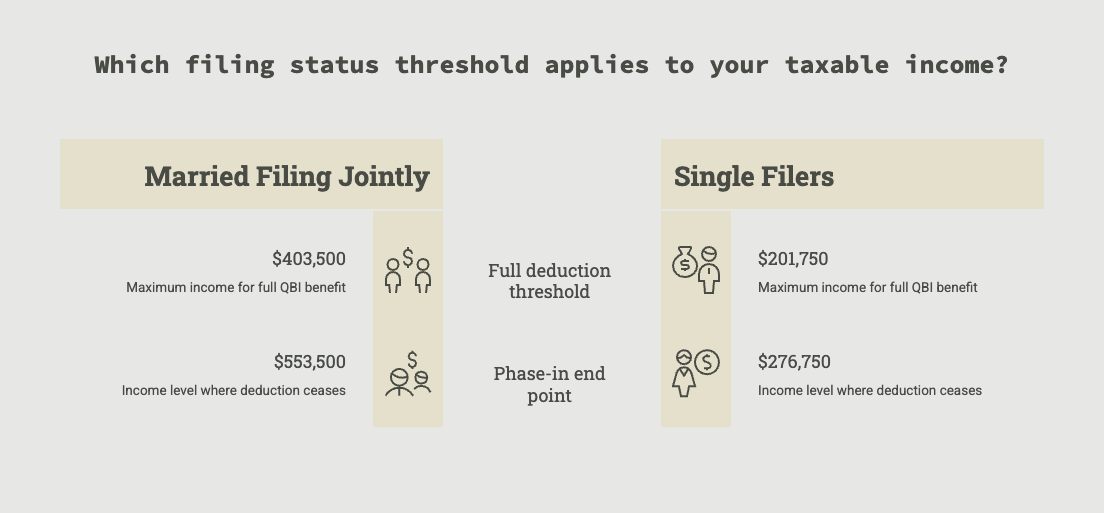
Below it. You take 20 percent of QBI, capped at 20 percent of taxable income minus net capital gain. No wage test, no property test, no question about what industry you are in. A consultant and a machine shop get treated the same way here.
Inside the phase-in band. The limits apply proportionally to how far into the band you sit. A joint filer $46,500 into the $150,000 band gets roughly 31 percent of the restriction. Form 8995-A carries the worksheets that run this.
Above the band. Two very different outcomes. Specified service businesses lose the deduction entirely. Everyone else is capped at the greater of 50 percent of the W-2 wages the business paid, or 25 percent of those wages plus 2.5 percent of the unadjusted basis of qualified property. A profitable business with no payroll and no equipment can land at zero.
The specified service trade or business list covers health, law, accounting, actuarial science, performing arts, consulting, athletics, financial services, brokerage, investing and investment management, trading, and dealing in securities. It also picks up any business whose principal asset is the reputation or skill of its owners or employees, which in practice means endorsement income, licensing your name or likeness, and appearance fees rather than "you are good at your job."
Engineering and architecture are not on the list. That was deliberate when the statute was written.
If your taxable income is under the threshold above, none of this applies to you.
A freelance graphic designer, filing single, with $90,000 of Schedule C profit and no other income:
Line
Amount
Schedule C net profit
$90,000
Deductible half of self-employment tax
($6,358)
QBI
$83,642
Standard deduction
($16,100)
Taxable income before QBI deduction
$67,542
Twenty percent of QBI is $16,728. Twenty percent of taxable income is $13,508. She takes the lower figure, $13,508. She is nowhere near $201,750, so no wage test and no SSTB question ever comes up. At a 22 percent marginal rate that is close to $2,970 in tax she does not pay.
Notice which cap bit here. It was not the wage limit everyone worries about. It was the taxable income cap, and it shows up constantly for owners whose business is most of their household income.
Most of the friction here is bookkeeping, not tax law. Before anyone can calculate this properly, someone needs five things: your net business income by entity, your K-1s with the Section 199A detail filled in (Box 20 code Z on a partnership K-1, Box 17 code V on an S corporation K-1), total W-2 wages the business paid for the year, a fixed asset schedule showing original cost and placed-in-service dates for the property test, and any qualified business loss carried in from last year.
Firms that chase these in March get worse answers than firms that have them in October. The property schedule is usually the one that has gone missing, and it is the one that decides the outcome for capital-heavy businesses above the threshold.
Start with one figure, your taxable income before the QBI deduction, and the rest becomes a short decision tree. Most owners never get past that first number, which is why the deduction gets underclaimed by people who qualified for the full 20 percent the whole time. If you want yours checked against an actual return rather than an estimate, that conversation belongs in the fall, while there is still time to change the inputs.
1. Do I qualify for the QBI deduction? If you own a pass-through business (sole proprietorship, partnership, S corporation, or certain trusts and estates) with income from a qualified trade or business in the US, you generally qualify. Below the 2026 taxable income thresholds of $201,750 single and $403,500 joint, you get the full 20 percent regardless of your industry, wages paid, or property owned.
2. Is the QBI deduction going away after 2025? No. The deduction was set to expire after 2025 under the Tax Cuts and Jobs Act, but the One Big Beautiful Bill Act made Section 199A permanent effective for tax years beginning after December 31, 2025.
3. Can I claim the QBI deduction if I take the standard deduction? Yes. The QBI deduction is available whether you itemize or take the standard deduction. It is applied after AGI and is separate from Schedule A.
4. What is the income threshold for the QBI deduction in 2026? $201,750 for single and head of household filers, $201,775 for married filing separately, and $403,500 for married filing jointly, per Rev. Proc. 2025-32. Above those figures the limits phase in over $75,000 single or $150,000 joint.
5. What is the new $400 minimum QBI deduction? Starting in 2026, a taxpayer with at least $1,000 of QBI from active qualified trades or businesses they materially participate in receives a minimum deduction of $400, even if the standard calculation would produce less. Both figures adjust for inflation after 2026.
6. What is a specified service trade or business? An SSTB is a business in health, law, accounting, actuarial science, performing arts, consulting, athletics, financial services, brokerage, investing, trading, or dealing in securities, plus businesses built on the reputation or skill of their owners. SSTB status only matters if your taxable income exceeds the threshold, at which point the deduction phases out and disappears entirely at the top of the range.
7. Does rental income qualify for the QBI deduction? It can, if the rental activity rises to the level of a Section 162 trade or business. The Notice 2019-07 safe harbor treats a rental real estate enterprise as a trade or business when you log 250 hours of rental services, keep separate books, and maintain contemporaneous records.
8. Does the QBI deduction reduce self-employment tax? No. Self-employment tax is calculated on your net earnings before the QBI deduction is applied. The deduction reduces federal income tax only.
The 2026 1099 reporting threshold changed: 1099-NEC and 1099-MISC now start at $2,000, and 1099-K is back to $20,000. Here is what you must file.
A plain guide to how a 2026 sales tax holiday works, which items are exempt, and the rules on price caps, refunds, and rain checks.
Form 7004 buys a 6-month extension of time to file business returns like 1065, 1120-S and 1120. Deadlines, e-file steps and the payment trap.