


If you are age 70½ or older and want to support a charity while keeping your tax bill low, a qualified charitable distribution might be one of the best tools available. It lets you move money directly from your IRA to a qualified charitable organization without counting that amount toward your income.
For people already taking required minimum distributions, QCDs can be a smart giving strategy. They lower what you owe, can count toward your RMD, and work even if you do not itemize deductions.
Let us walk through how this works, who qualifies, the limits, and how to get one done.
A QCD is a nontaxable distribution made directly from your IRA to a qualified charity. Instead of pulling money out of your account, paying tax on it, and then writing a check, you skip the taxable step. The custodian sends the funds straight to the organization, and that amount of it is excluded from your gross income.
This distribution option is available for traditional IRA owners, and it also applies to inherited IRA accounts and certain other IRAs. Employer plans like 401(k)s are not eligible. A SIMPLE IRA may qualify after a two-year holding period. The key is that the distribution must be made directly from the IRA to the nonprofit. If the check comes to you first and you forward it, it does not qualify as a QCD.
The eligibility rules are clear:
Age requirement. You must have reached 70½ on the date of the transfer. This used to align with the RMD starting age, but since the SECURE Act moved RMDs to age 73, there is now a gap. You can start at that age even though your required minimum distribution may not begin until 73.
Account type. These can come from a traditional, Roth, or inactive SEP or SIMPLE account. The most common use is with traditional accounts since those withdrawals would otherwise be fully included in income.
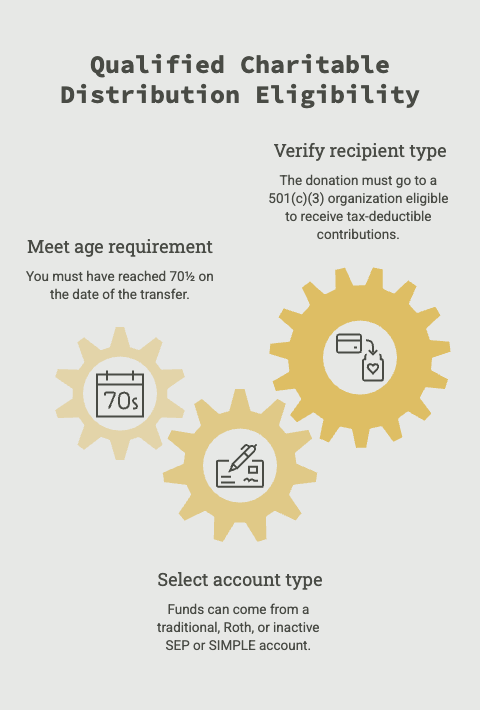
Recipient type. The donation must go to a 501(c)(3) organization eligible to receive tax-deductible contributions. Most public nonprofits are eligible. Private foundations, donor-advised funds, and supporting organizations are not eligible. A charitable remainder trust, charitable remainder unitrust, or charitable gift annuity also does not work for this purpose.
If you are not sure about a specific organization, the IRS has a searchable database on its website.
For the 2025 and 2026 calendar year, the QCD amount is capped at $108,000 per person per year. This limit is indexed for inflation. If you are married and both spouses have IRAs, each of you can give up to the cap from your own account.
There is also a one-time provision that lets you direct up to $54,000 to a charitable remainder trust or a charitable gift annuity arrangement. This was introduced by the SECURE 2.0 Act.
A few things to note about QCD limits:
You cannot carry over unused capacity. If you give $50,000 this year, you do not get extra room next year.
The exclusion only applies to amounts that would otherwise be included in income. If you made nondeductible contributions, the transfer comes first from the portion that would have been included in income.
If you made after-70½ deductible contributions to your account, your eligible amount may be reduced. This wrinkle is worth discussing with a tax advisor.
There are a few reasons this approach beats taking a normal IRA distribution and making a separate charitable donation.
Lowers income directly. A QCD is not subject to federal income tax. It is excluded from gross income entirely, not structured as a write-off. This matters because a tax deduction only helps if you itemize, and many retirees take the standard deduction. With this approach, you get the tax benefit either way.
Can satisfy your RMD. If you are at an age where RMDs are required, this approach can cover all or part of that obligation. The money goes to the nonprofit, counts toward your RMD, and does not appear on your return. This is one of the cleanest ways to reduce required minimum distributions.
May push you into a lower tax bracket. By keeping that income off your return, you can minimize your tax liability, lower Medicare premium surcharges, and avoid higher tax thresholds like the IRMAA brackets.
Simplifies giving. Instead of tracking donation receipts for write-off purposes, this handles it in one direct transfer of funds from your IRA directly to the organization.
For more on how nonprofits handle their own reporting obligations, our Form 990 guide covers what they need to file.
The process is not complicated, but details matter.
Contact your IRA custodian. Let them know you want to make a charitable gift through this route. Most custodians have a specific form. The transfer of funds must go directly from your IRA to the nonprofit. It cannot pass through your personal account.
Confirm the recipient. Make sure the organization is a qualified charitable organization. Those two categories, along with supporting organizations, are excluded.
Complete the transfer. The custodian issues a check or initiates an electronic payment to the organization. For the QCD to count for a given year, the donation to a charity must be completed by December 31 of the tax year. If you are using this to satisfy your RMD, make sure it clears before year-end.
Keep records. Get written acknowledgment from the organization confirming the contribution is made and the date. You will need this for your files.
If you have questions about noncash contributions, our Form 8283 guide covers property donations.
Here is the part that trips people up: your contribution will be reported as a normal distribution on IRS Form 1099-R. The form does not have a special code for QCDs. Your custodian shows the full withdrawal on the 1099-R for any non-inherited IRAs, and it is up to you to report the QCD correctly on your return. (In inherited account situations, it may instead be reported as a death distribution on the 1099-R.)
On your 1040, show the full amount on Line 4a and the includable portion on Line 4b. If the entire withdrawal went to a nonprofit, Line 4b would be zero, and you write "QCD" next to it.
If you do not properly note it, the IRS may treat it as an ordinary withdrawal. Consult a tax advisor who knows these tax rules if you are unsure.
State tax rules may vary. Some states follow the federal treatment. Others do not. Ask about state tax rules in your area, as this article is general information only, not legal or tax advice.
1. What is a qualified charitable distribution? It is a direct transfer from a retirement account to an eligible nonprofit. It is excluded from income and can count toward your required minimum distribution.
2. Who qualifies for a QCD? Anyone at least 70½ with an eligible retirement account. The account can be a traditional, Roth, or inactive SEP/SIMPLE. The recipient must be a 501(c)(3) eligible to receive tax-deductible contributions.
3. How much can I give through a QCD? Up to $108,000 per person per year for 2025 and 2026. There is also a one-time $54,000 allowance for certain charitable remainder arrangements. The cap is indexed for inflation.
4. Can a QCD satisfy my RMD? Yes. If RMDs are required, this approach can cover all or part of that obligation for the year.
5. Do I need to itemize to benefit? No. That is one of the biggest benefits of a QCD. The amount is excluded from income, so you get the advantage even without itemizing.
6. Can I send a QCD to a donor-advised fund? No. They cannot go to DAFs, private foundations, or supporting organizations.
7. How do I report the QCD on my tax return? The full amount appears on Form 1099-R as a normal distribution. On your 1040, show it on Line 4a and enter the taxable portion on Line 4b. Write "QCD" next to Line 4b.
8. Can I make a QCD from a 401(k)? No. This option only applies to individual retirement accounts. Employer plans like 401(k)s and 403(b)s are not eligible. You would need to roll the funds into an IRA first, then make the charitable transfer.
Need help with QCD planning, tax preparation, or charitable tax strategy? Madras Accountancy works with CPA firms across the U.S. on individual and business tax support. Get in touch to talk through your situation.
The 2026 1099 reporting threshold changed: 1099-NEC and 1099-MISC now start at $2,000, and 1099-K is back to $20,000. Here is what you must file.

A plain guide to how a 2026 sales tax holiday works, which items are exempt, and the rules on price caps, refunds, and rain checks.
Form 7004 buys a 6-month extension of time to file business returns like 1065, 1120-S and 1120. Deadlines, e-file steps and the payment trap.