


Working for yourself means nobody hands you a workplace retirement plan, but it also means you can build one of the best retirement plans for small business owners, more powerful than most employees ever get.
The Roth solo 401k is that plan. It is a retirement account for anyone who works for themselves, with no employees other than a spouse, and it lets you save after-tax money that grows and comes out completely tax-free in retirement. Because you act as both the employee and the employer, the high contribution limits run well above an IRA, which makes it a serious way to save for retirement. This guide covers what the plan is, the current contribution limits, and the rules that decide how much you can actually put in.
The numbers stepped up this year, so timing matters.
Once you see how the two buckets work, you can figure out your own maximum in a few minutes.
A Roth solo 401k is simply the Roth side of a one-participant plan.
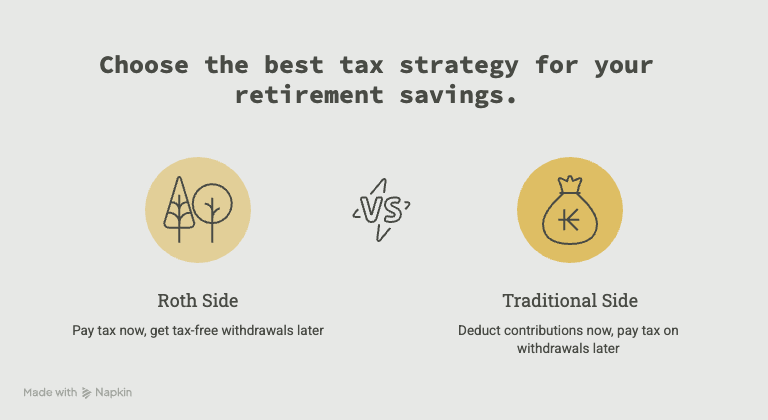
The plan itself is a solo 401k, a small business retirement plan sometimes called a self-employed 401k or individual 401k, designed for self-employed owners with no full-time employees. The Roth part is a designated Roth account, a subaccount where money goes in after tax. That Roth subaccount is the whole point. You pay tax on the money now, it grows for decades, and qualified withdrawals later are tax-free. That is the opposite of the traditional side, where you deduct contributions now and pay tax on distributions in retirement.
Think of it as an IRA with the training wheels off.
Roth IRAs cap you at a few thousand dollars a year and phase out at higher incomes, and they do not let you split between traditional and Roth inside one account. The plan version has no income phase-out and far higher limits, which is exactly why high earners reach for it.
Here is where the account pulls ahead, because you contribute in two roles, and each has its own limit.
The first bucket is your salary deferral, the elective deferrals you make as the employee. For 2025 you can defer up to $23,500, and for 2026 it rises to $24,500. This same employee contribution limit applies whether you choose pre-tax or Roth, and it is shared across every 401k you participate in, so a day-job 401k eats into it. You fund the plan for a tax year up to your tax filing deadline, including extensions.
The second bucket is what you add as the business, the profit sharing piece.
As the employer you can add up to 25% of your compensation, which works out to roughly 20% of net self-employment income for a sole proprietor after the SE tax adjustment, or 25% of W-2 wages for an S corp owner. Stack the two buckets together and the total climbs fast.
One catch worth remembering: your total plan contribution cannot exceed your income, and only compensation up to the annual cap, $350,000 for 2025, counts toward the employer math. That maximum total contribution is the ceiling across both buckets. So you need real income to reach these ceilings.
The choice between pre-tax and Roth is the heart of this account.
Your employee salary deferral contribution can be pre-tax, Roth, or a mix of both. That route lowers your taxable income today, while these after-tax dollars cost you tax now for tax-free growth later. Many owners split the difference, sending some of each retirement plan contribution to both. The Internal Revenue Service treats the two the same for the limit, and the Internal Revenue Code sets that ceiling. The employer profit-sharing contribution is traditionally pre-tax, but the SECURE 2.0 Act changed that.
Since 2023, a plan can allow the employer side to be Roth too.
That means your whole plan contribution, both the employee and employer pieces, can potentially be after-tax if your plan document permits it, though an employer Roth contribution is taxable to you in the year you make it. Whether one or the other makes more sense depends on your current bracket versus your expected bracket in retirement, which is worth modeling with a tax planning professional before you commit.
Catch-up contributions get an important twist, and it catches high earners off guard.
If you are 50 or older, you already qualify for the additional catch-up contribution on top of your regular employee deferral contribution. This can matter even on your initial Roth contribution in a plan's first year. From that year, SECURE 2.0 requires that catch-up to be made as a Roth contribution if your prior-year income was $150,000 or more, a figure the IRS adjusts over time. For a self-employed individual, that ties the coming year's catch-up to prior-year earnings.
There is a trap hiding in that rule.
If your plan does not offer a Roth feature and you fall under the high-earner rule, you simply cannot make catch-up contributions at all. That is one more reason to confirm your plan supports designated Roth contributions well before year end.
Where you open the account decides which Roth features you actually get.
Both Fidelity and Charles Schwab offer this account with no fees, and both let you make Roth employee deferrals inside their standard plans. That covers most self-employed savers who just want to choose Roth or pre-tax on their own salary deferral and pick investments like mutual funds or ETFs across simple 401k plans. What these off-the-shelf plans generally do not support is an employer Roth contribution, an in-plan Roth conversion, or the mega backdoor route, since their basic plan documents leave those features out.
To unlock the full set, you go self-directed.
A self-directed solo 401k built on a third-party plan adoption agreement can add Roth employer contributions, in-plan Roth conversions, and more investment freedom, while you still custody the money at a broker like Fidelity or Schwab. It is more paperwork, so it suits owners who specifically want those advanced features rather than a simple designated Roth account.
The payoff of this account shows up when you take the money out.
Qualified Roth distributions are completely tax-free, meaning you owe nothing on decades of growth, as long as you are at least 59 and a half and the account has met the five-year aging rule. Pull money out early, before a qualifying event, and you can face taxes and penalties on the earnings, so this is not a place to park cash you might need soon.
One SECURE 2.0 change makes it even better.
Roth 401k accounts no longer carry required minimum distributions during your lifetime, so your money can keep compounding tax-free for as long as you like rather than being forced out at a set age.
The plan is light on admin, right up until it is not.
For most of its life the plan needs no annual report to the government. Once your plan assets cross $250,000, though, you must file Form 5500-EZ each year. It is not complicated, but missing it carries penalties, so it belongs on your calendar the moment your balance approaches that line. Keeping clean records of contributions and balances makes that filing routine.
Good records also protect your contribution math.
Because your limit depends on business income or W-2 wages, tying every contribution back to documented earnings is what keeps you from over-contributing and having to unwind it later.
For a CPA firm, this plan is a high-value conversation with clients who work for themselves, and the math is where it gets tricky.
The employer piece depends on entity type, on net self-employment income for a sole proprietor or reasonable W-2 wages for an S corporation owner, and getting that calculation wrong leads to over-contributions and corrections. Running those numbers accurately, across many clients, during a busy season, is exactly the kind of work an offshore team supports well. At Madras Accountancy, we help U.S. CPA firms handle the contribution calculations, coordinate the Roth versus traditional decision with each client's tax return, and keep that annual filing on track.
The goal is simple.
Help each client maximize retirement savings without tripping a limit, so the plan does what it is supposed to do: build wealth that comes out tax-free.
What is a Roth solo 401k? A Roth solo 401k is the Roth portion of a one-participant plan for people who work for themselves, with no employees besides a spouse. Contributions go in after tax, grow tax-free, and qualified withdrawals in retirement are tax-free. It offers much higher limits than a Roth IRA.
What are the contribution limits for 2025 and 2026? The employee salary deferral limit is $23,500 for 2025 and $24,500 for 2026. Combined with the employer piece, the total contribution limit is $70,000 and $72,000 respectively under age 50, before catch-up contributions.
Can I make employer contributions to a Roth solo 401k? Your employee deferral can be Roth. Employer profit sharing contributions are traditionally made before tax, but since the SECURE 2.0 Act a plan may allow Roth employer contributions if the plan document permits it. A Roth employer contribution is taxable to you in the year you make it.
Who is eligible to open one? Any self-employed individual or business owner with no full-time employees other than a spouse can open one. You need earned income from the business to contribute, and your contributions cannot exceed it for the year.
How much can I contribute if I am 50 or older? At 50-plus you can add an $8,000 catch-up, and those ages 60 to 63 can add $11,250 instead. Starting in 2026, if your prior-year income was $150,000 or more, that amount must be made as a Roth contribution.
Does Fidelity or Charles Schwab offer a Roth solo 401k? Both offer a solo 401k that allows Roth employee deferrals with no account fees. Their standard plans generally do not support Roth employer contributions or in-plan Roth conversions. For those features you need a self-directed solo 401k built on a third-party plan adoption agreement.
Are the withdrawals tax-free? Qualified Roth distributions are tax-free once you are at least 59 and a half and the account has met the five-year rule. These accounts also no longer require minimum distributions during your lifetime, so the balance can keep growing.
Do I have to file anything with the IRS? For most years, no. Once plan assets exceed $250,000, you must file that form as an annual report each year. Missing it carries penalties, so track your balance as it approaches that threshold.
Section 4960's 21% excise tax now reaches far more nonprofit employees. See who is a covered employee in 2026 and what changed.

The Section 45S paid family leave credit is permanent for 2026 with new options. See who qualifies, the amounts, and how to claim it.
Opportunity zones become permanent in 2027 under the One Big Beautiful Bill. See the new deferral, rural bonus, and the 2026 handoff.



