



How a partnership assigns its debts among partners matters more than most people think. Under this section of the Internal Revenue Code of 1986, a partner's share of partnership liabilities directly affects their basis in its partnership interest. And basis drives everything: how much loss a partner can deduct, whether distributions are taxable, and what happens on exit.
On December 2, 2024, the IRS issued final regulations that clarify how recourse liabilities are handled when multiple partners bear the economic risk of loss, how tiered partnership structures work, and how constructive ownership rules apply among related parties. These final rules had been in proposed form since 2013, and the updated guidance provides welcome certainty.
Under US law, an increase in a partner's share of partnership liabilities is treated as a contribution of money by the partner to the partnership (considered as a contribution). A decrease in a partner's share is treated as a distribution of money to the partner by the partnership.
So shifts in how debts are assigned directly change basis. If a partner's share goes up, basis goes up. If it goes down, basis drops, and any deemed distribution of money that exceeds basis triggers gain.
Getting this right determines how much loss each partner can claim and whether a cash payment is tax-free or reportable.
For related context on how capital account rules work alongside these provisions, our Section 704(b) guide covers the mechanics.
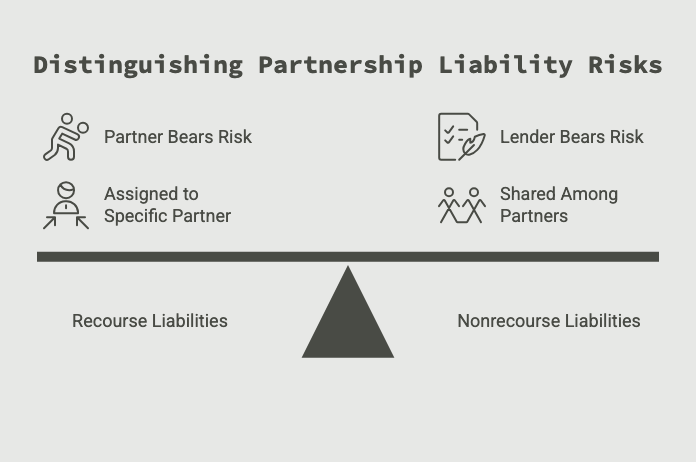
The provision splits partnership liabilities into two categories:
Recourse liabilities. A debt is recourse to the extent that a partner or related person bears the economic risk of loss. If the partnership defaulted and the obligation came due, who would actually be on the hook? That person gets the share. A general partner who personally guarantees a loan has exposure under local law, so the amount is assigned to them.
Nonrecourse liabilities. If no partner or related person bears the risk (meaning the lender's only remedy is against the partnership's assets), the debt is nonrecourse. These are shared among all partners using a three-tier formula: minimum gain, Section 704(c) minimum gain, and a remaining share based on profit ratios.
The December 2 final regulations primarily address the recourse side, specifically what happens when the picture gets complicated.
The updated guidance largely adopts the proposed regulations from 2013, with important clarifications. Three areas matter most:
Before the new rules, it was unclear how to allocate liabilities when situations in which multiple partners bear the economic risk arise. If two people each guarantee 100% of the same loan, who gets the basis?
The final regulations include a proportionality rule. Applying the proportionality rule, the amount of the partnership liability is split based on relative exposure. If Partner A guarantees $600,000 and Partner B guarantees $400,000, the share follows that ratio. When a direct partner and a related person both have exposure, the rules look at who is considered to bear the loss in a constructive liquidation scenario.
The final regulations also address a recourse liability when multiple partners have overlapping guarantees, so that the total assigned does not exceed the actual obligation.
In the case of a tiered partnership (where one partnership, the upper-tier partnership or UTP, holds an interest in a partnership that is a lower-tier partnership or LTP), debt assignment gets layered.
The final regulations provide that when an LTP has a guaranteed obligation and a UTP partner bears the risk, the debt flows up. The LTP allocates to the UTP based on the UTP's exposure, and the UTP then assigns among its own partners. The final regulations also clarify how persons owning interests directly or indirectly through multiple tiers interact, and how the UTP handles debts allocated to UTP from below.
The updated rules refine the constructive ownership rules for determining when a partner or related person bears the risk. Guarantees or indemnities among related parties can create overlap, and the final regulations include guidance on avoiding double-counting and properly measuring each person's exposure.
The final regulations apply to all partnership liabilities incurred or assumed on or after December 2, 2024. However, they do not apply to debts incurred or assumed by a partnership pursuant to a written binding contract in effect prior to December 2, 2024. That binding contract in effect prior to the effective date grandfathers those obligations.
Partnerships can also elect to apply the new rules to all existing debts (including those assumed on or after December 2 and older ones) for any return filed on or after December 2, 2024. The election requires consistent application to all obligations.
For refinanced debt: if a partnership modifies or refinances a pre-existing obligation, the new rules only apply to any increase. The original portion is treated as pre-existing to the extent of the amount and duration of the pre-modified obligation.
For partnerships filing returns for tax years that include or follow the effective date:
Review your guarantee structure. If multiple partners or related persons have exposure on the same debts, the proportionality rule now governs. Confirm the partner's share of recourse liabilities matches the new framework.
Check tiered structures. If you have a UTP/LTP arrangement, verify that the lower-tier partnership assigns debts correctly through the chain.
Consider the election. Electing to apply the final regulations to all debts may be beneficial, but it is all or nothing. Model the impact across every obligation before deciding.
Document everything. The economic risk of loss analysis depends on facts: who guarantees what, what local law says, and how guarantees overlap. The partner's economic risk of loss should be clearly documented for each obligation.
For context on how partnership contributions interact with basis, that guide covers Section 721.
1. What does this provision do? It governs how partnership liabilities are assigned among partners. A partner's share directly affects basis, which determines loss deductions and whether distributions trigger gain. Determining a partner's share is the central function.
2. What is a recourse liability? One where a partner or related person bears the economic risk of loss borne by that partner. If the partnership defaulted, that person would pay. The partner's share of recourse liabilities depends on who holds the exposure.
3. What is nonrecourse? A nonrecourse liability is one where no partner bears the risk. The lender can only look to partnership assets. These are shared using minimum gain and profit ratios.
4. What did the December 2, 2024 final regulations change? They clarified how to handle debts when multiple partners bear the risk (the proportionality rule), updated tiered partnership rules, and refined constructive ownership rules for related parties. The regulations issued replace the 2013 proposed regulations.
5. What is the proportionality rule? It governs how a single debt is split when more than one partner has exposure. Each is assigned a portion based on relative risk, and the loss borne by all partners combined cannot exceed the obligation itself.
6. When do the new rules take effect? They apply to debts incurred or assumed by the partnership on or after December 2, 2024. Debts under a written binding contract in effect prior to that date are grandfathered.
7. Can a partnership elect to apply to older debts? Yes. A partnership may elect for returns filed on or after the effective date, but must do so for all obligations consistently.
8. How do tiered partnerships work? When the LTP has a guaranteed debt and a UTP partner bears the risk, the debt flows to the UTP. The LTP allocates to the UTP, and the UTP assigns among its own partners based on who has exposure. The partner's share of a partnership's debts at each level depends on the risk analysis.
Need help with Section 752, the section 752 regulations, or partnership recourse debt allocation? Madras Accountancy works with CPA firms across the U.S. on complex partnership tax. Reach out to discuss your situation.

The section 4960 excise tax is 21% of nonprofit pay over $1M. From 2026 it covers all employees. See the medical carve-outs, Form 4720 and a worked example.

The paid family and medical leave tax credit is permanent from 2026. See the 12.5% to 25% rates, the premium option, the 6-month rule and how Form 8994 works.

Opportunity zones become permanent in 2027 under the One Big Beautiful Bill. See the new deferral, rural bonus, and the 2026 handoff.



