



If you are a US person who owns a piece of a foreign corporation, there is a rule that can tax you on that company's earnings before you ever see a dollar of them. That rule is Subpart F income, and it catches a lot of owners off guard because it breaks the usual assumption that foreign profits are not taxed until they come home.
Here is the core idea. Normally, the earnings of a foreign corporation are not subject to US tax until they are paid out to US owners as a dividend. Subpart F is the big exception. It forces US shareholders of a controlled foreign corporation to report certain types of income right away, in the year the foreign company earns it, whether or not any cash is distributed. It was Congress's original tool against parking mobile income in low-tax countries, and it has been on the books since 1962.
This guide walks through what Subpart F income actually is, which companies and owners it applies to, the specific categories of income it captures, how it gets taxed, the exceptions that can reduce it, and how it fits together with GILTI, the newer regime that now catches most of the income Subpart F does not. The rules are dense, so the goal here is to make the tax implications clear.
Subpart F income, named for its place in the Internal Revenue Code, is a set of anti-deferral rules. The whole point is to stop US taxpayers from deferring US tax indefinitely by leaving profits inside a foreign corporation, especially profits that are easy to move to a low-tax jurisdiction.
Think about the kind of income that shifts easily: interest, dividends, royalties, and income from selling goods or services between related companies in different countries. That income is not tied to any real location, so without a rule, a US group could route it through a shell company in a zero-tax country and never bring it home. Subpart F says no. When a controlled foreign corporation earns those specific categories of income, its US shareholders are taxed on their share now, at ordinary rates, as if it had been distributed.
That is the trade-off at the heart of the regime. Active foreign income earned from real business operations abroad can often still be deferred, but the mobile, passive, and related-party income that Subpart F targets cannot. For CPA firms handling clients with overseas operations, this is core territory, and our international taxation guide covers where it sits among the wider set of cross-border rules.
Subpart F only applies if two ownership tests are met, so this is where any analysis starts. First, the foreign company has to be a controlled foreign corporation. A foreign corporation is a CFC if US shareholders together own more than 50 percent of it, measured by vote or by value. Second, only a US shareholder picks up the income, and the code defines a US shareholder as a US person owning 10 percent or more of the foreign corporation, again by vote or value.
Put those together and the rule targets foreign companies that are genuinely US-controlled, not small minority stakes. If US owners collectively control the company and you personally hold at least 10 percent, your share of the income is subject to Subpart F. One wrinkle worth flagging: recent changes to the stock attribution rules can pull more foreign corporations into CFC status than owners expect, so the determination is not always obvious. Because this ownership is reported on Form 5471, our guide on who must file Form 5471 is a useful companion for the filing side.
Subpart F income is not all of a CFC's income, only specific buckets. The largest grouping is foreign base company income, which itself breaks into a few types worth knowing by name.
The first and most common is foreign personal holding company income. This is the passive stuff: dividends, interest, rents, royalties, annuities, and gains from selling investment property. If a CFC is essentially earning investment income, this is the category that captures it. Next is foreign base company sales income, which arises when a CFC buys or sells goods involving a related party, and the goods are both made and sold outside the CFC's own country. Foreign base company services income is the parallel for services, covering income a CFC earns performing services for or on behalf of a related party outside its home country. There is also foreign base company oil-related income for certain oil and gas activities. Separately, insurance income earned by a CFC on risks outside its country is its own category. The common thread across all of them is that each item of income has little real connection to where the CFC is located.
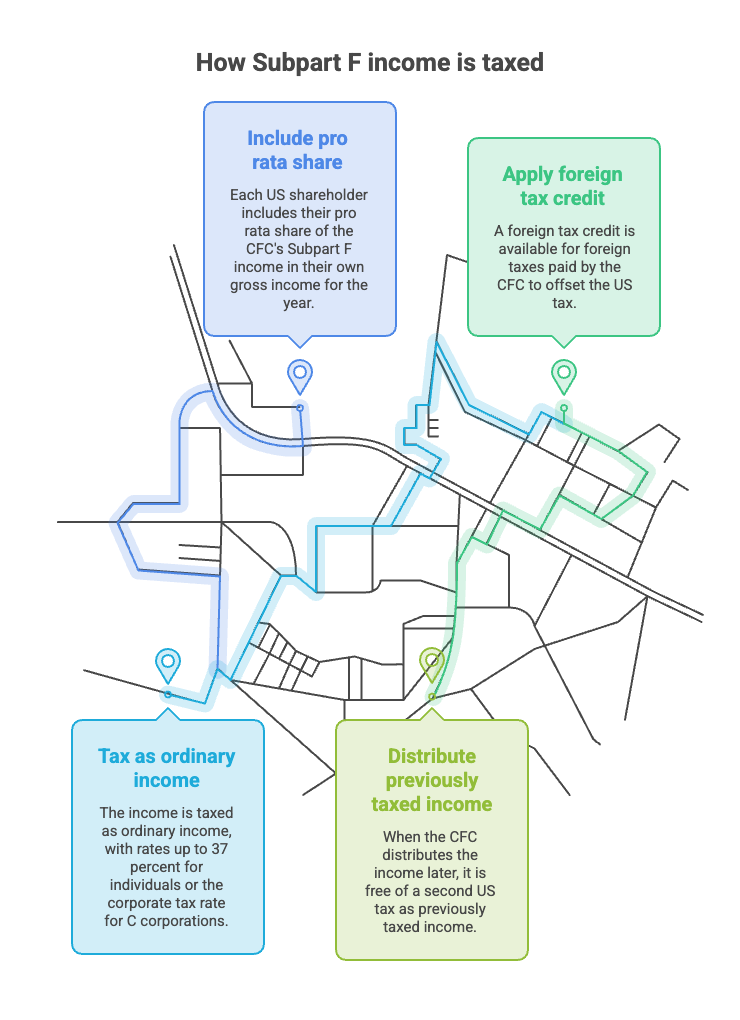
Once income falls into a Subpart F category, the tax treatment is direct. Each US shareholder includes their pro rata share of the CFC's Subpart F income in their own gross income for the year, and it is taxed as ordinary income. For an individual owner, that means rates up to 37 percent. For a US C corporation shareholder, it lands at the corporate tax rate.
The system does try to avoid double taxation. A foreign tax credit is generally available for the foreign taxes the CFC paid on that income, which offsets the US tax, and corporate shareholders can claim a deemed-paid credit for the CFC's foreign taxes. There is also a timing benefit on the back end. Because you already paid US tax on the income when it was earned, the amount becomes previously taxed income, so when the CFC actually distributes it later, that distribution comes out free of a second US tax. In effect, Subpart F accelerates the timing of the tax rather than adding a permanent extra layer, though the cash cost of paying early is real.
Not every dollar in a Subpart F category ends up taxed, because a few important exceptions can shrink or eliminate the inclusion. Knowing them is often where the real tax planning happens.
The de minimis rule comes first. If a CFC's foreign base company income and insurance income together are less than the lesser of 5 percent of its gross income or $1 million, none of it is treated as Subpart F income. At the other extreme is the full inclusion rule: if those same categories exceed 70 percent of the CFC's gross income, then all of its gross income is swept in as Subpart F income. The most valuable exception for many taxpayers is the high-tax exception. If the income was already taxed in the foreign country at a rate above 90 percent of the top US corporate tax rate, it can be excluded by election, on the logic that there was no low-tax deferral to police in the first place. These exceptions turn Subpart F from a blunt rule into something that rewards careful analysis.
For decades, Subpart F was the main anti-deferral rule, and plenty of active foreign business income could still be deferred. The Tax Cuts and Jobs Act, the 2017 tax reform act, changed that by adding GILTI, short for global intangible low-taxed income. GILTI is a second regime that sweeps in most of a CFC's remaining income above a routine return, so between GILTI and Subpart F, very little CFC income escapes current US tax anymore.
The key to keeping them straight is that they do not overlap. Subpart F income takes priority and is calculated first. Whatever is classified as Subpart F is then excluded from the GILTI calculation, so the same dollar is never taxed under both. The GILTI inclusion picks up the leftover tested income. One important update: for tax years beginning after 2025, the 2025 tax law renamed GILTI to net CFC tested income, or NCTI, and tightened it by removing the deduction for a return on tangible assets and reducing the offsetting deduction. The mechanics shifted, but the relationship with Subpart F did not. If you want the full picture on that side, our guide on GILTI and the switch to NCTI goes deep on the calculation and the elections that can soften it.
Worth saying plainly. Subpart F and GILTI sit at the technical end of international tax, they change often, and the calculations feed directly off the Form 5471 data for every controlled foreign corporation. A single figure that does not tie can throw off the whole inclusion.
That is the kind of work we take on at Madras Accountancy. As an offshore tax preparation partner to U.S. CPA firms, we build the calculations that turn a CFC's numbers into a correct Subpart F and tested income inclusion, prepare the supporting Form 5471 workpapers, and keep everything aligned with the current rules while your team keeps review and client strategy. Since 2015 we have handled complex, high-stakes international tax work like this. If your firm has clients with foreign corporations, talk to our team and we will take it from there.
What is Subpart F income? Subpart F income is certain income of a controlled foreign corporation that US shareholders must include in their US taxable income currently, in the year it is earned, even if the foreign company does not distribute it. It is an anti-deferral rule in the Internal Revenue Code aimed at income that is easy to shift to low-tax countries, such as passive investment income and related-party sales and services income. Instead of waiting for a dividend, US shareholders pay US tax on their share of that income right away at ordinary rates.
What is a controlled foreign corporation (CFC)? A controlled foreign corporation is a foreign corporation that is more than 50 percent owned by US shareholders, measured by vote or by value. A US shareholder, for this purpose, is a US person that owns 10 percent or more of the foreign corporation. Only US shareholders of a CFC are subject to the Subpart F rules. The tests matter because Subpart F and GILTI only apply once a foreign company is a CFC, and recent stock attribution changes can make more foreign corporations count as CFCs than owners expect.
What types of income are Subpart F income? The main grouping is foreign base company income, which includes foreign personal holding company income (passive income like dividends, interest, rents, and royalties), foreign base company sales income (related-party goods made and sold outside the CFC's country), foreign base company services income (related-party services performed outside the CFC's country), and foreign base company oil-related income. Insurance income earned on risks outside the CFC's country is a separate category. The theme is income with little real connection to where the CFC operates.
How is Subpart F income taxed? Each US shareholder includes their pro rata share of the CFC's Subpart F income in gross income and pays tax on it as ordinary income, at rates up to 37 percent for individuals or the corporate tax rate for C corporations. A foreign tax credit is generally available for foreign taxes the CFC paid, which reduces the US tax. Because the income is taxed when earned, it becomes previously taxed income, so a later actual distribution of those earnings is not taxed again in the US.
What is the difference between Subpart F income and GILTI? Both are anti-deferral rules that tax a US shareholder on CFC income currently, but they cover different income. Subpart F targets specific categories like passive and related-party income and is calculated first. GILTI, added by the Tax Cuts and Jobs Act and renamed net CFC tested income for tax years after 2025, sweeps in most of the remaining income above a routine return. Subpart F income is excluded from the GILTI calculation, so the same income is never taxed under both regimes at once.
Are there exceptions to Subpart F income? Yes. Under the de minimis rule, if a CFC's foreign base company income and insurance income are below the lesser of 5 percent of gross income or $1 million, none is treated as Subpart F income. Under the full inclusion rule, if they exceed 70 percent of gross income, all of the CFC's gross income becomes Subpart F income. The high-tax exception lets a taxpayer elect to exclude income that was already taxed abroad above 90 percent of the top US corporate rate, since there is no low-tax deferral to prevent.
Who has to report Subpart F income? US shareholders of a controlled foreign corporation report this income, meaning US persons owning 10 percent or more of a CFC. This includes US citizens and residents as well as domestic corporations, partnerships, estates, and trusts that meet the ownership threshold. The income is calculated using the CFC's financial data reported on Form 5471, the information return for US owners of foreign corporations. Missing or incorrect Form 5471 filings carry steep penalties even when little or no tax is ultimately due.
How does Madras Accountancy help with Subpart F income? Madras Accountancy provides the technical support behind Subpart F and GILTI compliance. As an offshore partner to U.S. CPA firms, we take a CFC's financial data and build the Subpart F income and tested income calculations, prepare the Form 5471 workpapers that feed them, and keep the analysis aligned with the current international tax rules, including the 2025 changes. This lets your firm keep review and client advice while we handle the detail. You can reach our team through the contact link above.

The 2026 1099 reporting threshold changed: 1099-NEC and 1099-MISC now start at $2,000, and 1099-K is back to $20,000. Here is what you must file.

A plain guide to how a 2026 sales tax holiday works, which items are exempt, and the rules on price caps, refunds, and rain checks.

Form 7004 buys a 6-month extension of time to file business returns like 1065, 1120-S and 1120. Deadlines, e-file steps and the payment trap.



