



Texas is famous for having no personal income tax, but businesses do not get off completely free. The state charges a franchise tax, sometimes called the margin tax, on most entities that operate here. The good news is that the vast majority of businesses end up owing nothing. The catch is that owing nothing does not mean filing nothing.
Here is the quick version. The franchise tax is a privilege tax for the right to do business in Texas, administered by the Texas Comptroller. It applies to corporations, LLCs, partnerships, and similar entities, but only those above a revenue threshold actually pay. For 2026 and 2027 reports that threshold is $2.65 million in annualized total revenue, and the Comptroller estimates roughly nine out of ten Texas entities fall below it and owe zero tax.
The part that trips people up is the paperwork. Even if you owe no franchise tax, you almost certainly still have to file a report every year, and missing it can cost you the right to operate in the state. This guide walks through who must file, the no-tax-due threshold, how the tax is calculated, which report to file, and the deadlines, so you can handle your Texas obligations without a nasty surprise.
The franchise tax is a privilege tax imposed on each taxable entity that is formed or organized in Texas or does business in the state. The name confuses people, since it has nothing to do with franchises like a burger chain. It is simply the price of the privilege of doing business as a registered entity in Texas.
It is also not an income tax. Texas has no corporate income tax, so the franchise tax is the state's main business-level tax, and it is based on a company's revenue and margin rather than its profit. That is a meaningful difference. A business can have a rough year with little or no profit and still owe franchise tax if its revenue is high enough, because the calculation starts from total revenue, not the bottom line.
Do not confuse it with sales tax either, which is a completely separate obligation. If your business sells taxable goods or services in Texas, that is handled through the sales and use tax system, which our Texas sales and use tax guide covers in full. The franchise tax and sales tax are two different filings with two different sets of rules.
Most formal business entities in Texas are taxable entities for franchise tax purposes. That includes corporations, limited liability companies, including single-member LLCs, limited partnerships, professional associations, and business trusts. Even an entity that elected S corporation status federally is subject, because Texas does not recognize the federal S election and taxes the entity itself. Sole proprietorships and certain general partnerships owned only by natural persons are generally not subject.
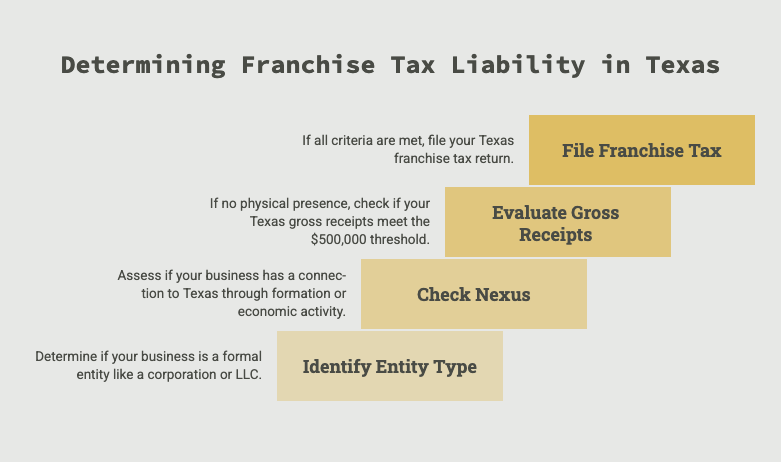
Then there is nexus, which decides whether an out-of-state business gets pulled in. You have franchise tax nexus if your entity is formed or organized in Texas, or if you are doing business in the state. Doing business can mean physical presence, like an office, inventory, or employees, but it can also be purely economic. An out-of-state entity with no physical presence still has nexus in Texas once it has $500,000 or more in Texas gross receipts. So a remote company selling into Texas can owe a franchise tax filing without ever setting foot here, a point our multi-state tax compliance guide explores across states.
Here is the number that determines whether you actually pay anything. If your annualized total revenue is at or below the no-tax-due threshold, you owe no franchise tax at all. For the 2026 and 2027 report years, that threshold is $2.65 million, raised from the $2.47 million that applied to 2024 and 2025 reports. The threshold adjusts for inflation every two years, so it is worth checking the current figure each filing season.
This is why so few businesses actually pay. A company with $2 million in revenue sits comfortably under the line and owes nothing. Only once annualized total revenue climbs above $2.65 million does an entity move into paying territory and need to calculate its tax. If your business has a short accounting period, you annualize the revenue first, dividing it by the number of days in the period and multiplying by 365, before comparing it to the threshold.
This is the part that catches people, so read it twice. Being under the threshold means you owe no tax. It does not mean you can skip filing. Those are two different things, and confusing them is how businesses lose their good standing.
It used to be that under-threshold entities filed a No Tax Due Report to declare they owed nothing. Starting with 2024 reports, the Comptroller eliminated that form. Now, if you are below the threshold, you skip the tax calculation but must still file an information report every year. Corporations, LLCs, limited partnerships, professional associations, and financial institutions file a Public Information Report, Form 05-102. Other taxable entities, such as trusts and certain partnerships, file an Ownership Information Report, Form 05-167 instead. Both list officers, directors or managing members, and the registered agent. Skip this filing and the state can forfeit your right to do business in Texas and even expose officers to personal liability, which is a steep price for a form you did not owe any tax on.
Once you are over the threshold, the franchise tax is based on your taxable margin, not your profit. Your taxable margin is the lowest of four calculations: total revenue minus cost of goods sold, total revenue minus compensation, 70 percent of total revenue, or total revenue minus $1 million. Whichever produces the lowest margin is the one you use, since a lower margin means less tax.
That margin is then apportioned to Texas based on the share of your gross receipts that come from Texas, and the result is multiplied by your tax rate. The franchise tax rates are 0.375 percent for retail and wholesale businesses and 0.75 percent for all other businesses. Because the calculation runs off total revenue and a choice of deductions, clean books matter enormously here, which is where our outsourced tax preparation support helps CPA firms keep the numbers tight.
There is also a shortcut. Entities with annualized total revenue of $20 million or less can choose the EZ Computation. It skips the margin deductions entirely and applies a flat 0.331 percent rate to apportioned total revenue. The EZ Computation report trades a slightly higher rate for far less work, so for many mid-sized businesses it is worth comparing against the long form to see which produces a lower bill.
The form you use depends on your revenue and entity type. If you are above the threshold and not using the shortcut, you file the Long Form report, Form 05-158, where you choose your margin calculation. If you qualify and elect the shortcut, you file the EZ Computation report, Form 05-169. And whether you owe tax or not, you file the matching information report, the Public Information Report or the Ownership Information Report, alongside it or on its own.
In short, every taxable entity files something each year. Under-threshold businesses file just the information report. Above-threshold businesses file a tax report plus the information report. Getting the right combination is half the battle with the Texas franchise tax report.
The annual franchise tax report is due May 15 every year. If May 15 falls on a weekend or holiday, the deadline moves to the next business day. Unlike federal taxes, there are no quarterly estimated payments for the franchise tax, so it is a once-a-year event, which is easy to forget precisely because it comes around so infrequently.
You file and pay through the Comptroller's Webfile system, using your 11-digit Texas taxpayer number. If you need more time, you can request an extension that generally pushes the deadline to mid-November, though any tax owed still needs to be paid by May 15 to avoid penalties and interest. The Texas Comptroller's franchise tax page has the current forms, rates, and filing requirements for each report year.
Worth saying plainly. The franchise tax is not hard in theory, but it is easy to get wrong in practice: the wrong report type, a miscalculated margin, a missed information report, or an overlooked nexus obligation for an out-of-state client. Any one of those can mean penalties or a forfeited entity.
That is the kind of work we handle at Madras Accountancy. As an offshore tax preparation and accounting and bookkeeping partner to U.S. CPA firms, we help pull clean total revenue figures, calculate the margin under each method, pick the right report, and prepare the Public Information Report so nothing slips before May 15. Since 2015 we have handled detailed, multi-state compliance work like this. If your firm has Texas clients and wants the franchise tax filing done cleanly, talk to our team and we will take it from there.
What is the Texas franchise tax? The Texas franchise tax is a privilege tax imposed on taxable entities that are formed or organized in Texas or do business in the state. It is administered by the Texas Comptroller and is the state's main business-level tax, since Texas has no corporate income tax. Often called the margin tax, the franchise tax is based on a company's total revenue and margin rather than its profit. Corporations, LLCs, partnerships, and similar entities are subject, though only those above a revenue threshold actually pay any tax.
Who has to pay the Texas franchise tax? Most formal business entities doing business in Texas are subject to the franchise tax, including corporations, LLCs, single-member LLCs, limited partnerships, professional associations, and business trusts. Entities with a federal S corporation election are also subject, because Texas taxes the entity itself. However, only taxable entities with annualized total revenue above the no-tax-due threshold actually owe tax. Sole proprietorships and certain general partnerships owned only by individuals are generally not subject to the franchise tax at all.
What is the no-tax-due threshold for the Texas franchise tax? For the 2026 and 2027 report years, the no-tax-due threshold is $2.65 million in annualized total revenue, up from $2.47 million for the 2024 and 2025 reports. If your entity's annualized total revenue is at or below that figure, you owe no franchise tax. The threshold is adjusted for inflation every two years, so it changes periodically. The Comptroller estimates that roughly nine out of ten Texas entities fall below the threshold and owe nothing, though they still have a filing obligation.
Do I still have to file if I owe no franchise tax? Yes, and this is the most common mistake. Being under the no-tax-due threshold means you owe no tax, but you must still file an information report every year. Since 2024, there is no separate No Tax Due Report to file. Instead, you file a Public Information Report, Form 05-102, if you are a corporation, LLC, or similar entity, or an Ownership Information Report, Form 05-167, for other entity types. Skipping it can lead to forfeiture of your right to do business in Texas.
How is the Texas franchise tax calculated? If you are above the threshold, the tax is based on your taxable margin. Your margin is the lowest of four figures: total revenue minus cost of goods sold, total revenue minus compensation, 70 percent of total revenue, or total revenue minus $1 million. The remaining margin is apportioned to Texas by your Texas gross receipts, then multiplied by the rate, which is 0.375 percent for retail and wholesale and 0.75 percent for other businesses. Entities with revenue of $20 million or less can instead use the EZ Computation, a flat 0.331 percent on apportioned revenue with no deductions.
When is the Texas franchise tax report due? The franchise tax report is due May 15 each year. If May 15 falls on a weekend or a holiday, the due date shifts to the next business day. There are no quarterly estimated payments, so the franchise tax is filed and paid once annually. You can request an extension that typically moves the filing deadline to mid-November, but any tax you owe is still due by May 15 to avoid penalties and interest. Reports and payments are submitted through the Comptroller's Webfile system.
Do out-of-state businesses owe Texas franchise tax? They can. An out-of-state business has franchise tax nexus in Texas if it is doing business here, which includes economic nexus. Even without any physical presence, an entity with $500,000 or more in Texas gross receipts is considered to have nexus and must file a franchise tax report. So a remote company that sells into Texas can have a filing obligation without an office, warehouse, or employees in the state. Confirming nexus is a key first step for any multi-state business.
How does Madras Accountancy help with the Texas franchise tax? Madras Accountancy handles the preparation work behind the Texas franchise tax. As an offshore partner to U.S. CPA firms, we help gather clean total revenue figures, calculate the taxable margin under each method to find the lowest tax, select the correct report, and prepare the Public Information Report or Ownership Information Report before the May 15 deadline. We also help track nexus for multi-state clients. Since 2015 we have supported detailed state compliance work like this. You can reach our team through the contact link above.

The section 4960 excise tax is 21% of nonprofit pay over $1M. From 2026 it covers all employees. See the medical carve-outs, Form 4720 and a worked example.

The paid family and medical leave tax credit is permanent from 2026. See the 12.5% to 25% rates, the premium option, the 6-month rule and how Form 8994 works.

Opportunity zones become permanent in 2027 under the One Big Beautiful Bill. See the new deferral, rural bonus, and the 2026 handoff.



