



If you run payroll and assume your federal unemployment tax is a flat, tiny number, there is a good chance you are wrong, at least if you have employees in the wrong state. Some businesses quietly owe several times the standard rate.
The reason is the FUTA credit reduction. When a state borrows from the federal government to pay unemployment benefits and does not pay the money back in time, companies in that state lose part of a valuable tax credit, and their federal jobless tax goes up. This guide explains what the FUTA credit reduction is, which states are affected, how much more employers actually pay, and how to report it on Form 940 without getting caught short.
The whole thing starts with a credit most employers take for granted.
Once you understand how that credit works, the credit reductions that chip away at it make a lot more sense.
The Federal Unemployment Tax Act funds the system that pays unemployment benefits, and most businesses barely notice it because the effective rate is so low.
FUTA is one of the payroll taxes every employer handles, and the standard FUTA tax rate, the FUTA rate for employers, is 6.0% on the first $7,000 of wages paid to each employee per calendar year. Employers pay FUTA on wages subject to FUTA up to that base. That sounds steep, but employers who pay their state unemployment taxes in full and on time receive a credit of up to 5.4%, which drops the net FUTA tax rate to just 0.6%. That works out to about $42 per employee per year, which is why FUTA usually flies under the radar. The catch is that the 5.4% credit is not guaranteed. It depends on the state, since the credit rate you actually keep hinges on where your employees work.
That credit is the whole game.
Lose part of it, and your effective FUTA rate climbs well above the comfortable 0.6% most businesses expect to pay.
A FUTA credit reduction happens when a state has borrowed from the federal unemployment trust fund and has not repaid the loan in time.
States may run short on money to pay unemployment insurance, and when that happens a state takes loans from the federal government, borrowing money from the federal government under the Social Security Act. Once a state has outstanding debt, employer FUTA liability there becomes subject to a reduction. If the state still has an outstanding federal advance on January 1 for two consecutive years and has not repaid it by November 10, the Department of Labor designates it a credit reduction state. Businesses in that state then lose part of their 5.4% credit. It works as a reduction in credits otherwise available against the FUTA tax, so the credit reduction due raises the FUTA tax they owe. The reduction is not a penalty on the business. It is the federal government recovering the unpaid loan through higher FUTA costs on the businesses in that state.
The logic is basically a repayment plan.
The state borrowed, did not pay it back, so companies in that state cover the shortfall through a higher effective rate.
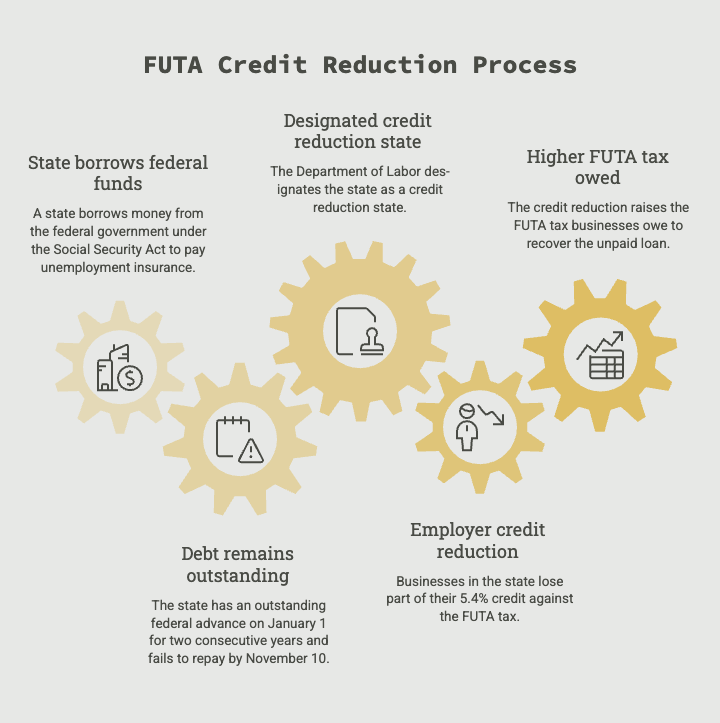
The credit reduction grows the longer a state leaves its loan unpaid, so the cost depends on how long the state has been behind.
The reduction schedule is 0.3% for the first year the state is a credit reduction state, another 0.3% for the second year, and an additional 0.3% for each year thereafter that the state has not repaid its loan. So a credit reduction of 0.3% in a state's first year cuts the credit, meaning you get a 5.1% credit instead of the full amount, moving from the usual rate of 0.6% to an effective FUTA tax rate of 0.9% on the annual FUTA tax. Each additional year the loan sits unpaid, that credit reduction rate climbs, and the higher FUTA tax follows the reduction up. On the $7,000 base, every 0.3% step adds about $21 per employee per year, which adds up fast across a large workforce.
The math is simple but the impact is not.
A long-standing loan can push the credit reduction into the multiple-percent range, turning a $42 per employee bill into several hundred dollars.
For 2024, the FUTA credit reduction states were three jurisdictions, the following states and territories: California, New York, and the U.S. Virgin Islands. Employers in these states, and employers in California especially, saw a bigger bill despite paying their state UI tax.
California and New York had carried outstanding advances since 2021 and did not repay them by the November 10 deadline, so employers in those states faced a 0.9% credit reduction, an effective rate of 1.5%. The U.S. Virgin Islands, with debt dating back to 2010, faced a 4.2% credit reduction and an effective rate of 4.8%. Connecticut had been at risk but repaid its advances in time and avoided the reduction entirely.
The list is not fixed, and that is the part employers miss.
For 2025, California rose to a 1.2% additional credit reduction and the U.S. Virgin Islands to 4.5%, while New York repaid and dropped off the list, so the states and rates from one year simply do not carry over to the next.
The extra amount is reported on your employer's annual federal unemployment tax return, Form 940, along with Schedule A.
The Internal Revenue Service pairs IRS Form 940 with Schedule A, the Multi-State Employer and Credit Reduction Information form, where you list every state or territory you paid wages in and apply the credit reduction rate to the FUTA taxable pay you reported in each affected state. Employers file their Form 940 with these tax obligations included. You multiply those wages by the reduction rate, total it up, and carry the amount to the return. Any increased FUTA liability from a credit reduction is treated as incurred in the fourth quarter and is due by January 31 of the following year, paid through the Electronic Federal Tax Payment System. If you paid wages in more than one state, you complete Schedule A even for states that are not credit reduction states.
Timing is the trap here.
Because the extra liability lands in the fourth quarter and is due January 31, a company that did not budget for it gets a bigger bill than expected right at year end.
Since the affected states change every year, the smart move is to check the list before you close out payroll.
The Department of Labor announces the final credit reduction states and rates by November 10, so there is time to plan before the return is due. If any of your employees work in a state that has taken loans from the federal government, budget for the higher bill rather than letting it surprise you in January. Staying on top of payroll tax compliance keeps this federal employer tax predictable. Solid payroll records that track wages by state make the Schedule A calculation straightforward instead of a scramble.
A few minutes in November saves a headache in January.
Knowing your state's status early turns the credit reduction from a nasty surprise into a line item you already planned for.
For a CPA firm running payroll for clients across multiple states, the credit reduction is an annual moving target that has to be right on every return.
Tracking which states are affected, applying the correct rate on Schedule A, allocating wages by state, and filing on time is detailed, deadline-driven work that changes every year. At Madras Accountancy, we help U.S. CPA firms handle payroll and the tax preparation around Form 940, from tracking the states and rates to calculating the additional tax each client owes.
The goal is no surprises at filing time.
Get the credit reduction right, and a client's return reflects exactly what they owe, filed on time, with the state-by-state wages to back it up.
What is a FUTA credit reduction? A FUTA credit reduction is a cut to the 5.4% federal unemployment tax credit that employers in certain states receive. It applies when a state has borrowed from the federal unemployment trust fund to pay unemployment benefits and has not repaid the loan in time, which raises the FUTA tax employers in that state owe.
Why does a state become a credit reduction state? A state becomes a credit reduction state when it has an outstanding federal loan on January 1 for two consecutive years and has not repaid it by November 10. The Department of Labor makes the determination, and employers in that state then lose part of their FUTA credit.
How much is the FUTA credit reduction? The reduction is 0.3% for the first year a state is a credit reduction state, plus another 0.3% for each additional year the loan stays unpaid. A 0.3% reduction lowers the credit to 5.1% and raises the effective FUTA tax rate to 0.9%, and it climbs from there.
Which states had a FUTA credit reduction for 2024? For 2024, California and New York had a 0.9% credit reduction, giving an effective rate of 1.5%, and the U.S. Virgin Islands had a 4.2% reduction for an effective rate of 4.8%. For 2025, California rose to 1.2% and the U.S. Virgin Islands to 4.5%, while New York dropped off.
What is the standard FUTA tax rate? The standard rate is 6.0% on the first $7,000 of wages paid to each employee per year. With the full credit for paying state unemployment taxes on time, the net FUTA tax rate is 0.6%, or about $42 per employee per year.
How do I report a FUTA credit reduction? You report it on Form 940 and Schedule A. On the schedule you list the states where you paid wages, apply the credit reduction rate to the FUTA taxable wages in each credit reduction state, and carry the total to Form 940. The return is due January 31 of the following year.
When is the additional FUTA tax due? Any increased FUTA tax liability from a credit reduction is treated as incurred in the fourth quarter and is due by January 31 of the following year, filed with Form 940 and paid through the Electronic Federal Tax Payment System.
How can I find out if my state is a credit reduction state? The Department of Labor announces the final credit reduction states and rates by November 10 each year, and the agency lists them in the Instructions for Schedule A (Form 940). Because the list changes annually, companies should check it every year before filing.

The section 4960 excise tax is 21% of nonprofit pay over $1M. From 2026 it covers all employees. See the medical carve-outs, Form 4720 and a worked example.

The paid family and medical leave tax credit is permanent from 2026. See the 12.5% to 25% rates, the premium option, the 6-month rule and how Form 8994 works.

Opportunity zones become permanent in 2027 under the One Big Beautiful Bill. See the new deferral, rural bonus, and the 2026 handoff.



