


If you own a piece of a foreign company, you may have discovered something unpleasant at tax time. Your share of that company's income can get taxed at your individual rate of up to 37%, even if not a dollar ever landed in your bank account.
There is a way to soften that hit, and it has been sitting in the tax code for decades. A Section 962 election lets an individual who is a United States shareholder of a controlled foreign corporation choose to be taxed at corporate rates on certain foreign earnings instead of at high individual rates. For a taxpayer with foreign holdings, that single choice can pull your effective rate down from 37% toward roughly 10.5% on your tax return. This guide explains what the election does, why it saves money, the catch most people miss, and how to actually make it.
The idea sounds almost too good, so it deserves a careful look.
Used in the right situation, 962 elections are among the most powerful tools an individual CFC owner has, and in the wrong one they cost more than they save. This is one of those 962 elections that rewards a close look.
This election allows individual U.S. shareholders of controlled foreign corporations to be taxed as if they were a corporation, but only for their foreign company inclusions. It is one of the few tools available to shareholders of controlled foreign corporations who are individuals rather than companies.
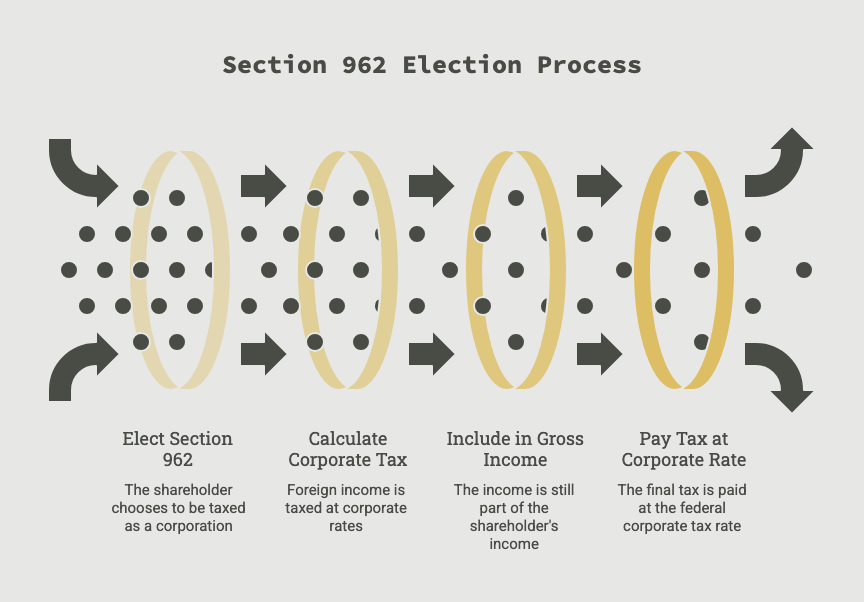
Normally, when you are a US shareholder of a CFC, your pro rata share of that CFC's Subpart F income and GILTI, short for global intangible low-taxed income, gets pulled into your gross income and taxed at your ordinary income tax rates. That pro rata share of Subpart F and GILTI is the shareholder's pro rata share of what the foreign company earned. The election flips that treatment. Under Section 962, you elect to have those same amounts taxed at the corporate tax rate instead, as though a hypothetical domestic corporation earned the income first. The individual's gross income under Section 962 still includes the individual's gross income share of what the CFC earned, but the tax imposed is figured at corporate rates. This is why the provision is described as paying at corporate rates rather than individual ones, with the rate of tax set at the federal corporate tax rate.
The election exists because individuals and corporations were being treated very differently on the same foreign income.
It gives an individual shareholder a way to reach the corporate treatment that a company in the same position would get automatically.
The savings come from three things stacking together, and each one matters on its own.
First, the rate. Your GILTI inclusion is taxed at the 21% corporate rate rather than an individual tax rate that can reach 37%. Second, the Section 250 deduction. Individuals who make the election can also take the Section 250 deduction, which lets you deduct 50% of the GILTI inclusion for the 2025 tax year, cutting the taxable amount in half. That 50% break is scheduled to drop to 37.5% for years after 2025, but it still helps. Third, the foreign tax credit. The election also gives you access to indirect foreign tax credits under Section 960, so foreign income tax the CFC already paid can offset your US tax liability, the same deemed paid credit a C corporation would claim. This pairing of the Section 250 deduction and indirect foreign tax credit is what cuts the overall tax.
Put those together and the math changes fast.
With the corporate rate and that deduction, the effective tax rate on the tax on GILTI can fall to about 10.5%, and that deemed paid credit can push the amount of tax lower still, especially when the foreign tax rate on those earnings was high.
Here is the part that trips people up, and it is the reason a 962 election is never an automatic yes.
The election creates two layers of tax, not one. You pay the corporate-rate tax on the income in the year it happens. Then, when the CFC makes an actual distribution of those previously taxed earnings, that distribution is taxed again to you, this time as a dividend on your individual return. The saving grace is that the second layer applies only to the distribution that exceeds the amount of tax you already paid, so you are taxed again only on the excess over an amount equal to the tax previously paid under the election. If the foreign corporation is a qualified one, that distribution may get the reduced qualified dividend rates, treated much like a dividend received by a domestic corporation and its owners, but if it is not, it falls under ordinary income rates at ordinary rates. Only the amount of tax paid upfront shelters the rest.
So the election is really a bet on timing.
It works best when the upfront savings outweigh that eventual second layer, which is why people expecting a large distribution soon often think twice.
A 962 election is a modeling exercise, not a reflex, because whether the election helps depends entirely on your numbers and your individual tax rate.
It tends to shine when your foreign company operates in a moderate or higher tax jurisdiction, since the credit is only valuable when the company actually paid meaningful foreign income tax. It also helps most when you are in the top individual bracket, where the gap between 37% and the corporate rate is widest. The election makes less sense if you are already in a low bracket, if you expect a large distribution soon that triggers the second layer quickly, or if you live in a state that does not recognize the election and taxes the income anyway. This is exactly the kind of situation where running the numbers both ways is worth the effort.
The right answer is rarely obvious from the outside.
Two shareholders with the same CFC can reach opposite conclusions once their brackets, states, and distribution plans are in the picture.
Making the election is not a form you check so much as a statement you attach, and you decide each year.
The election is made on a return-by-return basis, so you choose whether making this election makes sense every tax year rather than locking in once. The election made in one year does not bind the next. You make a Section 962 election by attaching an election statement to a timely filed Form 1040. That statement identifies the CFCs it applies to, your share of a CFC's income, the foreign taxes deemed paid, and the Section 250 deduction claimed. In effect the Section 962 election provides that the tax is figured as the tax that would be imposed under Section 11, the corporate rate imposed under Section 11 on a company. Alongside it, the underlying inclusions are reported on the related forms, Form 5471 for the CFC itself, Form 8992 for the GILTI calculation, and Form 8993 for the write-off itself. Each amount is reported on Form 5471 and the related GILTI forms so the numbers tie out. The election allows the individual to claim what a corporation would, the election also carries corporate mechanics, and the election must be attached on time. Foreign earnings that were deferred come into focus here. Because the election is annual, you can make it in a year it helps and skip it in a year it does not.
The paperwork rewards precision.
A complete election statement and clean supporting forms are what make the election hold up, so the detail work is not optional.
For a CPA firm, the 962 election is high-value, high-complexity work where the answer genuinely depends on modeling both paths.
Computing the GILTI inclusion, applying the 50% deduction, calculating the indirect foreign tax credit, drafting the election statement, and comparing the two-layer outcome against ordinary treatment is exactly the sort of international work that rewards deep familiarity with the rules. At Madras Accountancy, we help U.S. CPA firms handle the tax preparation behind CFC filings and Section 962 elections, from modeling whether the election saves money to preparing the statement and the supporting Form 5471, backed by clean bookkeeping on the foreign entity's numbers.
The election may help in one year and hurt in the next, so the goal is a decision made on real math, not a guess about what is subject to tax.
Model both ways, document the election properly, and a client pays the lower amount with the workpapers to back it up.
This article is general information, not tax advice, so check the current rules under the Internal Revenue Code or a tax professional for your situation.
What is a Section 962 election? A Section 962 election lets an individual United States shareholder of a CFC pay tax at corporate rates on their Subpart F and GILTI inclusions, as if they were a domestic corporation. It also unlocks the Section 250 deduction and the foreign tax credit that individuals otherwise cannot use.
How does a 962 election lower my tax? It taxes your GILTI inclusion at the 21% corporate rate instead of an individual rate up to 37%, lets you deduct 50% of the inclusion under Section 250 for 2025, and gives you the deemed paid foreign tax credit under Section 960. Together these can bring the effective tax rate on GILTI income to around 10.5%.
What is the downside of a Section 962 election? The main catch is a second layer of tax. When the CFC later distributes the previously taxed earnings, that distribution is taxed again as a dividend on your individual return, though only to the extent it exceeds the tax you already paid under the election.
Who can make a Section 962 election? Any individual who is a US shareholder of a controlled foreign corporation, including one who holds the CFC through a pass-through entity, can make the election. It is aimed at individuals facing Subpart F income or GILTI inclusions at ordinary income tax rates, the group for whom 962 elections were designed.
How do I make a Section 962 election? You make the election by attaching an election statement to a timely filed Form 1040 for the year. The statement identifies the CFCs, your pro rata share of each inclusion, the foreign taxes deemed paid, and the deduction claimed. The election is made on a return-by-return basis each year.
Does the Section 962 election apply to GILTI and Subpart F? Yes. The election covers both your Subpart F income and your GILTI inclusion from a controlled foreign corporation. The GILTI rules created by the Tax Cuts and Jobs Act are the main reason many individual CFC shareholders started making 962 elections.
When does a 962 election not make sense? It often does not help if you are already in a low tax bracket, if the company paid little foreign tax, if you expect a large distribution soon, or if your state does not recognize the election. In those cases the second layer of tax or lost state benefit can outweigh the federal savings.
What forms go with a Section 962 election? Along with the election statement on your Form 1040, you generally file Form 5471 for the controlled foreign corporation, Form 8992 to compute the GILTI inclusion, and Form 8993 for the Section 250 deduction. Together they report the income and support the election.

The 2026 1099 reporting threshold changed: 1099-NEC and 1099-MISC now start at $2,000, and 1099-K is back to $20,000. Here is what you must file.

A plain guide to how a 2026 sales tax holiday works, which items are exempt, and the rules on price caps, refunds, and rain checks.

Form 7004 buys a 6-month extension of time to file business returns like 1065, 1120-S and 1120. Deadlines, e-file steps and the payment trap.