



If you have been hearing about Trump Accounts and wondering what they actually are, here is the short version: they are a new type of individual retirement account designed to give children in America a financial head start through long-term investment.
The One Big Beautiful Bill Act, signed into law on July 4, 2025, created these accounts as part of the Working Families Tax Cuts provisions. The Department of the Treasury launched them on July 4, 2026, and families can now open a Trump Account for any child under age 18 with a valid social security number.
Here is how they work, who qualifies, and what to expect.
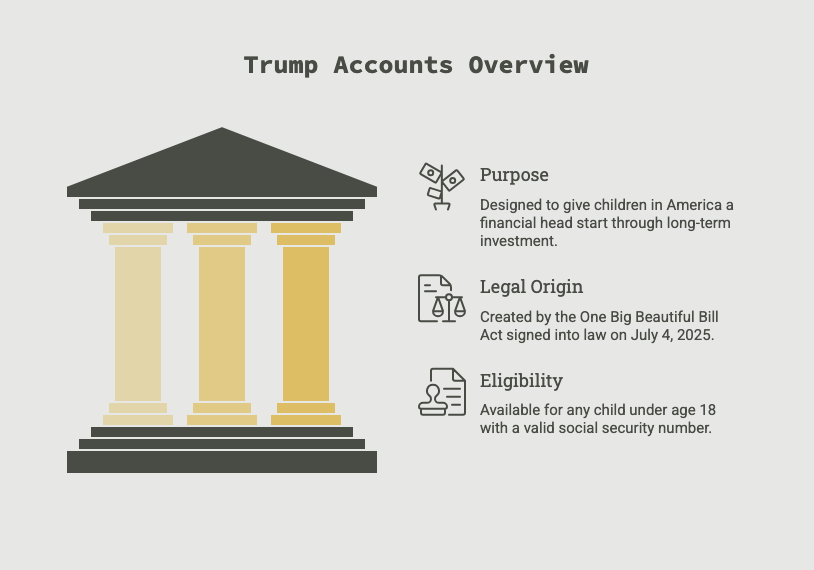
Trump Accounts are designed for children under 18. Any U.S. citizen born between January 1, 2025, and December 31, 2028, who has a valid social security number is eligible for both the account and the $1,000 government deposit.
But eligible children are not limited to that birth range. Children born before 2025 can also have an account opened for them. They just will not receive the $1,000 government deposit. The cutoff for opening an account is the year before the child turns 18.
There is a limit of one account per child. Only a parent, legal guardian, or other authorized adult can establish a Trump Account on the child's behalf. The child is the beneficiary, and the adult serves as custodian.
For babies born within the qualifying window, the federal government provides a one-time $1,000 pilot program contribution. This is essentially free money deposited directly into the child's account, funded through general federal revenues.
On top of that, the Michael and Susan Dell Foundation pledged $6.25 billion to provide a $250 charitable deposit for up to 25 million children age 10 or younger who live in ZIP codes where the median household income is $150,000 or less. These children must have been born before the qualifying window and are therefore not eligible for the $1,000 deposit.
Both deposits are designed to seed the account so that even families who cannot contribute additional money still have something growing over time through compound growth.
Beyond the initial deposits, families can add money to the account each year. The annual limit is $5,000 in after-tax contributions from parents, grandparents, and other individuals. Employer contributions are also allowed, up to $2,500 per year, and those are not counted as part of the employee's taxable income.
Contributions to Trump Accounts are made with after-tax dollars (unlike individual retirement accounts where you may get an upfront deduction). The tax advantages come on the back end: the money in the account grows tax-deferred during the child's growth years.
It is worth noting that contributions are not tax-deductible. This makes the structure different from individual retirement accounts that offer an immediate write-off. Think of it more as a savings and investment vehicle with tax-deferred growth, similar in that respect to a Roth structure but with its own distinct rules.
During the growth phase (from when the account is opened through December 31 of the year the child turns 17), all deposits must be invested in stock mutual funds or exchange-traded funds that mirror the S&P 500 or another American stock index. Account holders do not pick individual stocks.
The accounts are managed by Bank of New York Mellon, and the investment options are limited by design. The idea is to keep costs low and returns tied to broad market performance so the accounts grow steadily over time.
Distributions during the growth phase are generally not allowed. The money generally cannot be withdrawn before the child reaches age 18, with narrow exceptions for rollovers, excess contributions, or the death of the beneficiary. This lock-up is intentional. It keeps the long-term investment thesis intact and prevents the funds from being tapped early.
This is where the account changes shape. Once the child turns 18, the account converts into a traditional IRA and follows standard retirement account rules from that point on.
That means:
The beneficiary can start making their own contributions under normal limits. Withdrawals are allowed but will be taxed as ordinary income and may be subject to the 10% additional tax on early withdrawals if the holder is under 59 and a half. Exceptions to the penalty include qualified education expenses, a first-time home purchase, and a few other situations outlined in the tax code.
The transition is meant to turn a child's account into a lifelong saving and investing tool. If the account is opened at birth and the market averages its historical return, the compound growth over 18 years can turn even a modest initial deposit into a meaningful starting balance for adulthood.
This is also where financial planning conversations come in. When a young person is about to turn 18, they have decisions to make about how to manage those funds going forward.
The process starts at TrumpAccounts.gov. Parents or guardians submit IRS Form 4547 to elect their child into the program. This can be done online or filed with your federal tax return.
After submitting the form, you will receive an activation email from the Treasury with instructions to complete the setup. You can also download the official Trump Accounts app (available on the Apple App Store and Google Play) to manage the account, track the balance, and set up future contributions.
A few things to keep in mind when connecting to the official website: use only the official website or app. The government has warned families to be careful about scams. Your sensitive information should only be shared through the official channels, where it is encrypted and transmitted securely.
If your firm handles tax preparation for families, understanding how Trump Account contributions interact with IRA rules and gift tax reporting is becoming part of the annual workflow. Madras Accountancy supports U.S. CPA firms with this kind of compliance work.
1. What is a Trump Account? It is a new type of individual retirement account created by the One Big Beautiful Bill Act for children under age 18. The accounts provide tax-deferred growth on investments tied to U.S. stock market indexes. They are also known as 530A accounts under the Internal Revenue Code.
2. Who is eligible to establish a Trump Account? Any child under 18 with a valid social security number. The $1,000 government deposit is available to U.S. citizens born between January 1, 2025, and December 31, 2028.
3. How much can you contribute? Up to $5,000 per year from family members and individuals. Employer contributions are allowed up to $2,500 per year and are not included in the employee's taxable income.
4. Can the money be withdrawn before the child reaches 18? Generally, no. During the growth period, distributions are restricted. Exceptions exist for qualified rollovers, excess contributions, and the death of the beneficiary.
5. What happens when the child reaches age 18? The account converts into a traditional IRA. Standard retirement account rules apply, including contribution limits and the 10% early withdrawal penalty with exceptions for education expenses, home purchases, and other qualifying events. This transition is also a good moment for financial education about long-term financial security.
6. Is the $1,000 deposit really free money? Yes. It is a one-time government contribution funded by the US Treasury. There is no repayment obligation. It is deposited directly into the child's Trump Account and invested alongside any other contributions.
7. How do I open an account? Go to TrumpAccounts.gov, sign in or create an IRS account, and submit Form 4547. You can also download the official Trump Accounts app to manage the account after activation.
8. How are Trump Accounts different from 529 plans? 529 plans are designed for education expenses. Children's Trump Accounts are designed as long-term financial security tools that convert to retirement accounts at 18. The money does not have to be used for education, and it is invested in market-tracking funds rather than the range of options a 529 typically offers.

The 2026 1099 reporting threshold changed: 1099-NEC and 1099-MISC now start at $2,000, and 1099-K is back to $20,000. Here is what you must file.
A plain guide to how a 2026 sales tax holiday works, which items are exempt, and the rules on price caps, refunds, and rain checks.
Form 7004 buys a 6-month extension of time to file business returns like 1065, 1120-S and 1120. Deadlines, e-file steps and the payment trap.



