


If you carry buildings, equipment, or other long-lived assets on your balance sheet, ASC 360 is the accounting standard that tells you what to do when those assets lose value. It is the part of US GAAP that governs impairment, and it trips up plenty of experienced accountants because the test has a specific order that is easy to get wrong.
Here is the core idea in one breath. Under ASC 360, you do not test a long-lived asset for impairment every period. You test it only when a triggering event suggests its carrying amount may no longer be recoverable. When that happens, you run a recoverability test, and if the asset fails, you write it down to fair value and book an impairment loss.
That sounds simple, but the details are where the judgment lives. This guide walks through what ASC 360 covers, when a triggering event forces a test, how the two-step impairment test actually works for held-and-used assets, how held-for-sale assets are handled differently, and where ASC 360 stops and ASC 350 begins. The aim is to make the standard clear enough that the next impairment assessment feels routine rather than stressful.
ASC 360, formally FASB Accounting Standards Codification Topic 360, is the guidance for property, plant, and equipment and, within it, the impairment or disposal of long-lived assets. The impairment rules sit in ASC 360-10. When people say a long-lived asset needs to be tested for impairment, this is the standard they mean.
Long-lived assets are the tangible assets you use in operations, things like land, buildings, machinery, equipment, and furniture, along with finite-lived intangible assets that are amortized. What matters is that they are used in the business over time rather than held for quick resale. ASC 360 splits these assets into two buckets that follow different rules: assets classified as held and used, and assets classified as held for sale.
One boundary is worth setting early. ASC 360 does not cover goodwill or indefinite-lived intangibles. Those fall under ASC 350, which uses a different impairment model entirely. Keeping the two standards straight saves a lot of confusion, and our guide on GAAP rules for real estate shows how these tests play out for property specifically.
This is the part people miss. You do not run an impairment test on a schedule. Under ASC 360, you test a held-and-used long-lived asset only when a triggering event happens, meaning events or circumstances indicate the carrying amount may not be recoverable. No trigger, no test.
ASC 360-10-35-21 lists the impairment indicators to watch for. A significant decrease in the market price of the asset is one. So is a significant adverse change in the extent or manner in which the asset is used, or in its physical condition. A significant adverse change in legal factors or in the business climate that could affect the value counts too, including an adverse action or assessment by a regulator. Another is an accumulation of costs significantly in excess of the amount originally expected for the acquisition or construction of the asset.
Two more indicators are easy to overlook. A current-period operating or cash flow loss combined with a history of losses, or a projection or forecast that demonstrates continuing losses associated with the use of the asset, is a trigger. So is an expectation that the asset will more likely than not be sold or otherwise disposed of significantly before the end of its previously estimated useful life. Spot any of these, and it is time to test.
Once a triggering event puts you on notice, ASC 360 uses a two-step recoverability test, and the order is not optional. Getting the steps backward is one of the most common mistakes in long-lived asset impairment testing.
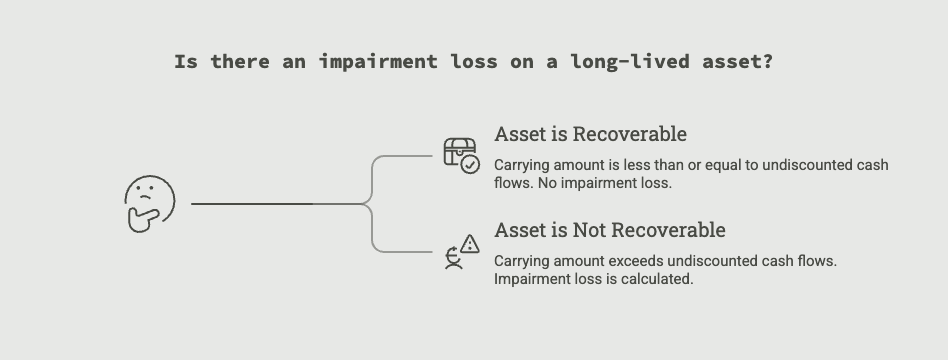
Step one is the recoverability test. You compare the carrying amount of the asset, or the asset group, to the sum of the undiscounted future cash flows expected from using the asset and eventually disposing of it. Note the word undiscounted, since this step uses raw cash flows, not present values. If the carrying amount is less than or equal to those undiscounted cash flows, the asset is recoverable and you stop. There is no impairment, even if fair value has dropped.
Step two only happens if the asset fails step one, meaning the carrying amount exceeds the undiscounted cash flows. Now you measure the impairment loss, and per ASC 360-10-35-17 it equals the amount by which the carrying amount of the long-lived asset exceeds its fair value. You write the asset down to fair value, and that new, lower figure becomes its carrying amount going forward. One hard rule: the impairment loss is permanent. Even if the asset recovers value later, you do not restore it under ASC 360.
A subtle but important point is what you actually test. You rarely test a single machine on its own. The standard requires you to test at the level of an asset group, defined as the lowest level for which identifiable cash flows are largely independent of the cash flows of other assets and liabilities.
Getting that grouping right drives the whole result, because both the undiscounted cash flows in step one and the fair value in step two are measured for the group, not the individual item. The group can include assets and liabilities that are tied to those cash flows. When an impairment loss is recognized for a group, you allocate it across the long-lived assets in the group on a pro rata basis, with one guardrail: the allocation cannot reduce any individual asset below its own fair value when that value is known. Group too broadly and you can mask a real impairment. Group too narrowly and you can create one that is not there.
Everything above applies to assets you intend to keep using. The moment a long-lived asset is classified as held for sale, ASC 360 switches to a completely different measurement, so it is worth treating as its own track.
Once an asset meets the held-for-sale criteria, you stop depreciating it and measure it at the lower of its carrying amount or its fair value less cost to sell. There is no undiscounted cash flow test here, because you are no longer using the asset to generate cash flows, you are selling it. If the asset or group is a component of the entity that qualifies as a discontinued operation, the presentation and disclosure rules in ASC 205-20 come into play on top of the ASC 360 measurement. The two standards work together for disposals, which our overview of audited financial statements touches on from the reporting side.
Because a business often holds long-lived assets, finite-lived intangibles, and goodwill in the same reporting unit, knowing which standard applies to what keeps the analysis clean. ASC 360 covers the long-lived tangible assets and amortizing intangibles. ASC 350 covers goodwill and indefinite-lived intangible assets, using its own impairment approach rather than the two-step recoverability test.
When a reporting unit contains both, the sequence matters. You test the assets under ASC 360 first, resolving any long-lived asset impairment, before you test goodwill for impairment under that standard. Running them out of order distorts both results. Fair value in either case is measured using the framework in ASC 820, which sets out how to determine fair value across US GAAP. For a business tracking a wide range of assets at fair value, our note on accounting for digital assets shows the same fair value discipline applied to a very different asset class.
ASC 360 looks mechanical, but it runs on estimates. The undiscounted cash flow forecasts in step one and the fair value in step two both depend on assumptions that reasonable people can disagree about, which is exactly why auditors probe impairment so hard. Weak support behind those numbers is a fast route to an audit adjustment.
That is why documentation is not an afterthought here. You need to show why a triggering event did or did not occur, how the asset group was defined, what cash flow assumptions you used, and how fair value was determined. ASC 360 also carries its own disclosure requirements, so the amount of the impairment loss and the facts behind it have to make it into the financial statements. Treating impairment as a well-documented process rather than a year-end scramble is what keeps it defensible, and it is the kind of technical work our management reporting support helps keep organized.
Worth saying plainly. ASC 360 impairment work is judgment-heavy, time-consuming, and squarely in the auditor's crosshairs, which is a hard combination for a busy accounting team to absorb during close.
That is the kind of work we take on at Madras Accountancy. As an offshore audit and assurance and accounting support partner to U.S. CPA firms, we help build the asset groups, run the recoverability and fair value calculations, and assemble the documentation that stands up to review. Since 2015 we have handled this level of technical accounting so firms can serve clients without burning out their teams. If you have an impairment analysis coming up and want it done cleanly, talk to our team and we will take it from there.
What is ASC 360? ASC 360 is the FASB Accounting Standards Codification topic that governs property, plant, and equipment, including the impairment and disposal of long-lived assets. The impairment guidance lives in ASC 360-10. It tells companies how to test long-lived assets for impairment when a triggering event occurs, how to measure any impairment loss, and how to handle assets that are held for sale. It applies to tangible long-lived assets and finite-lived intangibles, but not to goodwill or indefinite-lived intangibles, which fall under ASC 350.
What are long-lived assets under ASC 360? Long-lived assets are assets a business uses in its operations over an extended period rather than holding for quick sale. Under ASC 360 they include tangible property such as land, buildings, machinery, equipment, and fixtures, along with finite-lived intangible assets that are amortized. The defining trait is ongoing use in the business. Goodwill and indefinite-lived intangibles are excluded because they are covered by ASC 350, which applies a different impairment model.
When do you test long-lived assets for impairment? Under ASC 360, you test a held-and-used long-lived asset only when a triggering event indicates its carrying amount may not be recoverable, not on a fixed schedule. Triggering events listed in ASC 360-10-35-21 include a significant drop in the asset's market price, an adverse change in how it is used or its physical condition, a significant adverse change in legal factors or business climate, costs far above what was expected, and current losses combined with a history or forecast of continuing losses.
How does the ASC 360 impairment test work? For held-and-used assets, ASC 360 uses a two-step test in a set order. Step one is the recoverability test: compare the carrying amount of the asset group to the sum of its undiscounted future cash flows. If the carrying amount is less than or equal to those cash flows, there is no impairment. If it exceeds them, the asset is not recoverable and you move to step two, where you measure and record an impairment loss equal to the carrying amount minus fair value.
How is an impairment loss measured under ASC 360? Once an asset group fails the recoverability test, ASC 360-10-35-17 measures the impairment loss as the amount by which the carrying amount exceeds fair value. You write the asset group down to fair value, and that becomes the new carrying amount. The loss is allocated across the long-lived assets in the group on a pro rata basis, but no individual asset is written below its own fair value when that value is known. The impairment is permanent and cannot be reversed if value later recovers.
What is the difference between ASC 360 and ASC 350? ASC 360 and ASC 350 both deal with impairment but cover different assets. ASC 360 applies to long-lived tangible assets and finite-lived intangibles, using the two-step recoverability test. ASC 350 applies to goodwill and indefinite-lived intangible assets, using its own approach. When a reporting unit holds both, you test the ASC 360 long-lived assets first and then test goodwill under ASC 350, because the order affects the outcome. Mixing up the two standards is a common source of error.
How are held-for-sale assets measured under ASC 360? When a long-lived asset is classified as held for sale, ASC 360 stops the recoverability test approach. You cease depreciation and measure the asset at the lower of its carrying amount or its fair value less cost to sell. This reflects that the asset will be sold rather than used to generate cash flows. If the asset is a component of the entity that meets the definition of a discontinued operation, the presentation and disclosure rules in ASC 205-20 apply alongside the ASC 360 measurement.
How does Madras Accountancy help with ASC 360 impairment? Madras Accountancy provides the technical accounting support behind ASC 360 impairment work. As an offshore partner to U.S. CPA firms, we help define asset groups, run the recoverability and fair value calculations, measure the impairment loss, and prepare documentation and disclosures that hold up under audit. Impairment testing is judgment-heavy and time-consuming, so firms lean on us to handle the detail accurately during close. Since 2015 we have supported complex, audit-sensitive work like this. You can reach our team through the contact link above.
The 2026 1099 reporting threshold changed: 1099-NEC and 1099-MISC now start at $2,000, and 1099-K is back to $20,000. Here is what you must file.
A plain guide to how a 2026 sales tax holiday works, which items are exempt, and the rules on price caps, refunds, and rain checks.
Form 7004 buys a 6-month extension of time to file business returns like 1065, 1120-S and 1120. Deadlines, e-file steps and the payment trap.



