

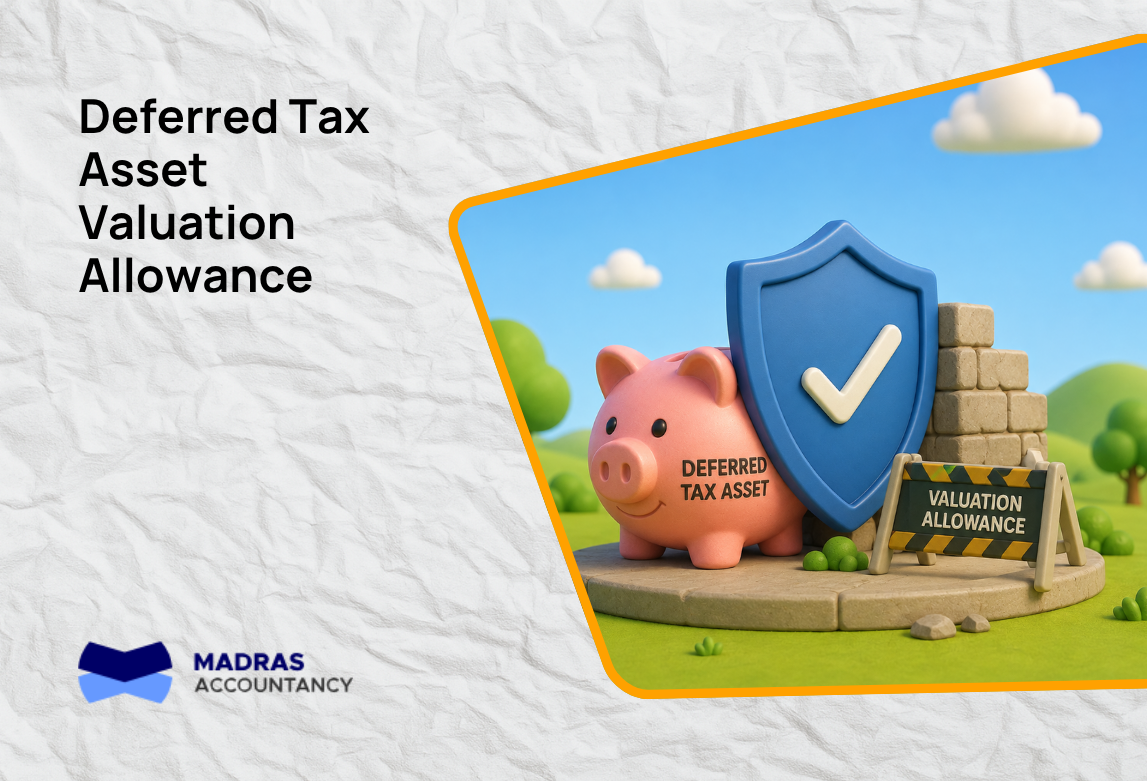

A company can carry a real asset on its balance sheet that it may never actually use. That is what a deferred tax asset is, and the deferred tax asset valuation allowance exists to keep that number honest. Get the judgment wrong and you either overstate earnings or hide a write-down that auditors will find. Get it right and the numbers tell the truth about future tax savings.
Deferred tax assets and liabilities both sit on the balance sheet, and this allowance is what keeps the asset side realistic. This guide walks through what the allowance is, the more-likely-than-not test behind it, how to weigh the evidence, and a worked example so you can see how the amount is set.
A deferred tax asset represents a future tax benefit. It shows up when your book income and your taxable income diverge in a way that will save you tax later. These gaps come from a deductible temporary difference, where an expense hits your financial statements before it appears on the tax return as a deduction and before it becomes deductible for tax purposes, or from a loss or credit carried forward, such as a net operating loss carryforward or unused tax credits.
Say you record a warranty expense this year but cannot deduct it until claims are paid. For book purposes the cost is gone now; for tax purposes the deduction waits. That timing gap creates a deferred tax asset, because the deduction lowers a future tax bill. Deferred tax assets represent future deductions, and those assets represent future cash tax savings, measured at the tax rate expected to apply when they reverse. Each deductible temporary difference has a corresponding tax deduction later, and other carryovers and tax attributes work the same way. The mirror image, where you owe tax later, produces deferred tax liabilities. Companies present deferred tax assets and deferred tax liabilities together on the balance sheet under U.S. GAAP. The Financial Accounting Standards Board sets the rules in the FASB Accounting Standards Codification, Topic 740, and the same standard drives financial reporting for income taxes.
Here is the catch. A deferred tax asset is only worth something if you have future income to deduct it against. A company drowning in losses may never see the taxable income needed to use those deductions, so booking the full asset would overstate its worth. The allowance fixes that.
A valuation allowance reduces a deferred tax asset to the amount you can actually expect to use. It is a contra-asset, so a valuation allowance for deferred tax sits against the gross figure and brings it down to a net deferred tax amount, or where liabilities dominate, a net deferred tax liability. Record an allowance for deferred tax assets and the balance sheet now shows what is realistically recoverable, not a hopeful gross number. The allowance can be full, wiping out the whole balance, or partial, trimming only the portion of the deferred tax that looks unrecoverable.
The trigger is a specific threshold. Under the standard, you record a valuation allowance when it is more likely than not that some or all of the deferred tax asset will not be realized. More likely than not means a greater than 50 percent chance. So if there is more than a coin-flip chance that the asset will not be realized, the allowance is required for that slice.
This is a realizability question, not a quality question. The deduction is real; the doubt is whether you will ever have the future income to claim it against. Assessing the realizability of a deferred tax asset means evaluating future taxable income honestly, and evaluating the need for a valuation allowance is where most of the work sits. It comes down to the weight of available evidence to determine whether a valuation allowance is needed.
The standard asks you to gather all the positive and negative evidence available and weigh it. The weight you give each item is commensurate with the extent to which it can be objectively verified, so hard facts count for more than hopeful forecasts. What already happened outweighs what you project will happen.
Negative evidence is anything suggesting the deduction will go unused. The heaviest single item is cumulative losses. As the guidance puts it, a cumulative loss in recent years is a significant piece of negative evidence that is difficult to overcome, and in practice a three-year cumulative pretax accounting loss is the common starting point. Other red flags include a history of operating loss or tax credit carryforwards expiring unused and expected future losses.
Positive evidence pushes the other way. A firm sales backlog producing enough income, appreciated property worth well above its tax basis, and a strong earnings history where the loss was a one-off aberration all support realization. The rule of thumb is blunt: the more negative the overall picture, the more positive proof you need to conclude a valuation allowance is not needed. Judging the weight of available evidence, and the potential effect of negative items against positive ones, is the core of the assessment, and enough weight on the positive side may reduce the allowance toward zero.
To decide whether the asset can be used, you look for income to absorb it. ASC 740-10-30-18 lists four sources of taxable income available under the tax law, and you need one or more sources to support the asset.
The first is the future reversal of existing taxable temporary differences, which is why those liabilities matter here. The second is more future income beyond those reversals and loss carryforwards, which means projecting future taxable income from operations. The third is taxable income in prior carryback years, though this source is limited in the U.S. because the 2017 tax law largely ended net operating loss carrybacks. The fourth is prudent tax-planning strategies the company would actually use to pull income forward. Projecting future income is the hardest of these to defend, which loops straight back to how heavy the negative picture already is.
Here is a following example to make it concrete. A corporation has 10 million dollars of deferred tax assets, mostly from a net operating loss, a deferred tax asset related to prior-year red ink. It also has 3 million dollars of deferred tax liabilities that will reverse and produce taxable income. The company posted cumulative losses over the last three years, which weighs heavily against the asset.
Start with the sources of income. The 3 million of reversing taxable temporary differences supports 3 million of that balance. Management has signed contracts that credibly support another 2 million of future income. That leaves 5 million of the deferred tax asset with no objectively verifiable income behind it. Given the cumulative losses, projections alone are not enough to carry it. So you record an allowance of 5 million, the amount of the deferred tax asset that is more likely than not to go unrealized. Determining the amount is this matching of the balance against verifiable income, lot by lot, and the amount of a valuation allowance follows directly from it, and the amount of valuation allowance required is simply the unsupported slice. The valuation allowance assessment is redone every period, so a fact that changes next year means a valuation allowance would move up, and fresh positive evidence means a valuation allowance may shrink or reverse.
The valuation allowance does more than sit on the balance sheet. When you record it, the offsetting charge runs through the income tax provision as added tax expense, which reduces the tax benefit you would otherwise report. That is how valuation allowances impact reported earnings: booking one lowers net income, and releasing one later can lift it.
Because the stakes are high, many teams run the numbers in tax provision software rather than spreadsheets, which keeps the deferred tax rollforward, the tax valuation call, and the disclosures consistent. This is squarely a corporate tax reporting exercise, and it repeats every reporting period. You reassess the allowance each period, and when sustained profitability returns, releasing the allowance produces a real tax benefit for that year.
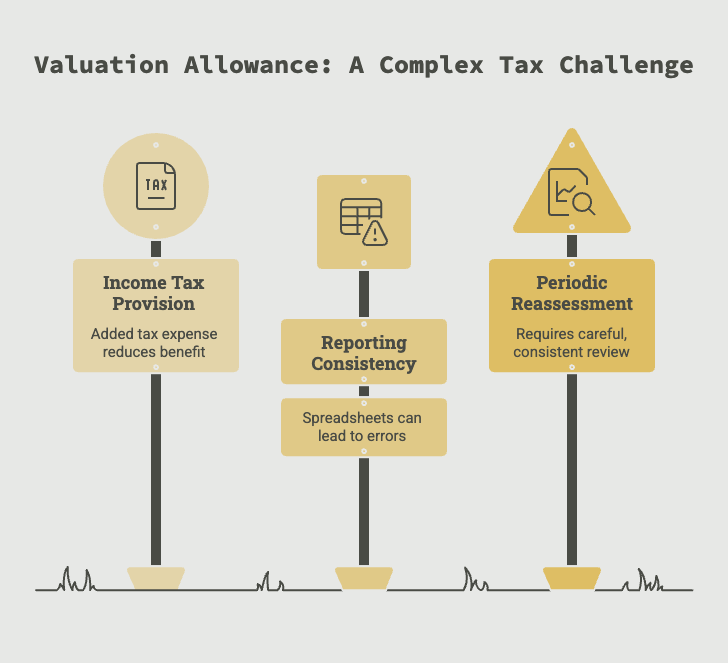
The valuation allowance is one of the most judgmental calls in the whole income tax provision, and it is exactly the kind of work where a second set of trained eyes pays off. Madras Accountancy supports U.S. CPA firms on this, building the deferred tax schedules, documenting the evidence for and against, and sizing the allowance so it holds up in review. If you want help on a provision, you can reach out here.
For the wider framework this sits inside, our ASC 740 guide covers accounting for income taxes end to end, and since so many allowances trace back to losses, the NOL carryforward rules explain how those deductions carry forward. Because the allowance mostly bites for C-corporations that recognize deferred taxes, entity type matters too. This is general information, not tax advice, so confirm the treatment for any client with their preparer, and you can review IRS rules on losses in Publication 536.
1. What is a deferred tax asset valuation allowance? It is a contra-asset that reduces a deferred tax asset to the amount more likely than not to be realized. If a company probably will not have enough future taxable income to use the deduction, the allowance writes the asset down to its recoverable value.
2. When is a valuation allowance required? A valuation allowance is required when it is more likely than not, meaning a greater than 50 percent chance, that some or all of a deferred tax asset will not be realized. You assess this by weighing all the evidence every reporting period.
3. What does more likely than not mean for a deferred tax asset? It means a likelihood greater than 50 percent. If there is a better-than-even chance the asset will not be realized, you record an allowance for that portion. It is a lower bar than many people expect, which is why the evidence review matters.
4. Is a cumulative loss enough to require a valuation allowance? Not automatically, but it is close. A cumulative loss in recent years is significant negative evidence that is difficult to overcome, so you need strong, objective proof to conclude an allowance is not needed despite it.
5. What are the four sources of taxable income for a deferred tax asset? They are future reversals of taxable timing differences, future income from operations, taxable income in prior carryback years where carryback is allowed, and prudent tax-planning strategies. You need at least one source to support realizing the deferred tax asset.
6. How does the allowance affect the tax provision? Recording valuation allowances adds expense to the income tax provision, which reduces the tax benefit and lowers net income. Releasing an allowance later does the reverse and can boost earnings in that period.
7. Can a valuation allowance be reversed? Yes. You reassess it each period, and when positive evidence such as a return to sustained profitability outweighs the negative, you release some or all of the allowance. The reversal flows through the provision as a tax benefit.
8. Do deferred tax liabilities affect the valuation allowance? Yes. Future reversals of deferred tax liabilities are one source of taxable income that can support a deferred tax asset, so a company with strong reversing temporary differences may need a smaller allowance, or none.
The 2026 1099 reporting threshold changed: 1099-NEC and 1099-MISC now start at $2,000, and 1099-K is back to $20,000. Here is what you must file.

A plain guide to how a 2026 sales tax holiday works, which items are exempt, and the rules on price caps, refunds, and rain checks.
Form 7004 buys a 6-month extension of time to file business returns like 1065, 1120-S and 1120. Deadlines, e-file steps and the payment trap.



