

Say you want to give to charity, you want the tax break this year, but you have not decided which charities should get the money or when. That gap is exactly what a donor-advised fund solves. You put money in now, claim your deduction now, and take your time deciding where the grants go later. It is a simple idea, and it has quietly become the fastest-growing charitable giving vehicle in the country. Let us walk through how a DAF works, the tax benefits, and the new 2026 rules that make one more useful than ever.
A donor-advised fund is a charitable giving account you open at a sponsoring organization, which is itself a public charity known as a DAF sponsor. You make an irrevocable contribution of cash or other assets, the sponsor takes legal ownership, and you receive an immediate tax deduction. From there, the money can be invested and grow tax-free, and you recommend grants to the charities you care about over time.
The word "advised" is the key. Once you give, the assets legally belong to the sponsoring organization, so you cannot take them back. What you keep are advisory privileges: the right to recommend how the money is invested and which charities receive grants. Sponsors follow those recommendations in practice as long as the grant goes to a qualified charity. You can even name successor advisors, so a spouse or child can continue the charitable giving after you. The IRS explains the basic structure here, and National Philanthropic Trust has a plain overview too.
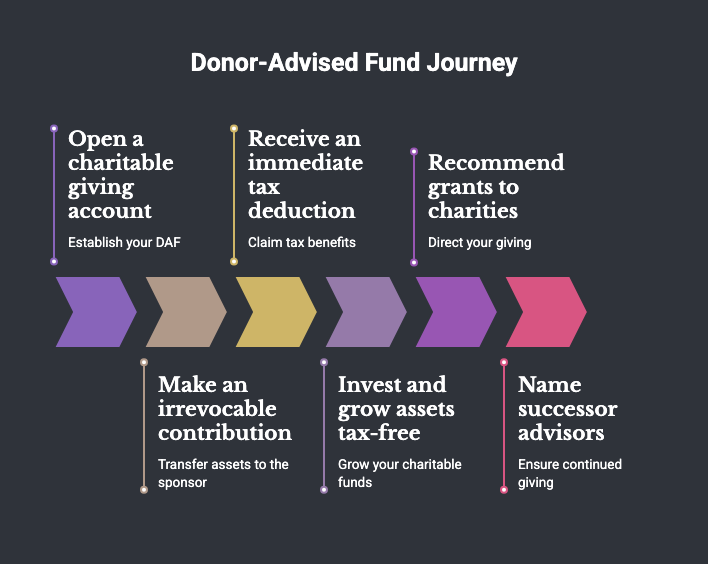
The mechanics are friendlier than most people expect. There are really four moves.
First, you open a donor-advised fund account with a DAF sponsor. Second, you fund it. You can contribute cash, publicly traded securities, or in many cases harder-to-value or illiquid assets, and you take the tax deduction in the year you give. Third, you pick from the sponsor's investment options so the balance can grow before it is granted out. Fourth, when you are ready, you send a grant recommendation and the sponsor sends the money to your chosen charity.
That last part is where the flexibility shines. You are not locked into a schedule. You can support ten charities this year and different ones next year, respond to a disaster the week it happens, or let the fund grow and do more grantmaking down the road. Many donors treat a DAF as their giving hub, running all their charitable gifts through one account so the paperwork lives in one place.
Now the money part, because the tax benefits of donor-advised funds are the reason most people open one.
The headline is the immediate tax deduction. When you contribute, you claim a charitable deduction that year, even if the grants to charities happen much later. Cash gifts to a DAF are deductible up to 60% of your adjusted gross income, and gifts of appreciated assets up to 30%, the same limits that apply to public charities. The IRS lays out these AGI limits in Publication 526.
The smartest move is usually giving appreciated securities rather than cash. If you donate stock you have held more than a year, you generally deduct the full fair market value and skip the capital gains tax you would have owed on a sale. That is real money that ends up with charity instead of the IRS. On top of that, the invested balance enjoys tax-free growth, so a strong market year can leave more available for grants than you originally put in. Contributions also leave your taxable estate, which can help with estate tax planning for larger givers.
People weighing a DAF often look at a private foundation too, so here is the honest comparison. A private foundation gives you the most control, including your own board and staff, but it comes with cost and rules. It must pay out at least 5% of assets a year, it owes an excise tax on net investment income, it files its own return, and its deduction limits are lower, around 30% of AGI for cash and 20% for appreciated property.
A donor-advised fund flips most of that. Deduction limits are higher, there is no separate excise tax on the fund, there is no legal minimum payout, and you can give anonymously if you want. You also get fair market value deductions on many assets that a foundation would only let you deduct at cost basis. The trade-off is control, since a foundation can do things a DAF cannot, like make grants to individuals. For a full side-by-side, NPT compares the two vehicles. Worth noting that "no minimum payout" has not meant hoarding in practice: recent DAF payout rates have run above 20%, far higher than the 5% floor foundations must hit, according to the latest annual DAF report, which pegged DAF grants at about $64.9 billion and total DAF assets near $326 billion.
The One Big Beautiful Bill Act reshaped charitable deductions starting in 2026, and it makes a DAF more valuable, not less. If you itemize, only the giving that clears a new 0.5% of AGI floor is deductible. On a $300,000 income, the first $1,500 of gifts now buys you nothing.
This is where bunching shines. Instead of giving a little each year and possibly never clearing the floor, you can contribute several years' worth into a donor-advised fund in one year, clear the floor in that year, take one large deduction, and still recommend grants to charities gradually. One caution: the new above-the-line deduction for people who take the standard deduction ($1,000 single, $2,000 joint) does not apply to DAF contributions, so that specific perk needs a direct cash gift. If you are over 70 and a half, a qualified charitable distribution from an IRA is another route that sidesteps the floor entirely.
Getting started is easier than opening most investment accounts. Pick a DAF sponsor that fits you: a national sponsor like National Philanthropic Trust or a charity tied to a financial firm, a local community foundation, or a single-issue charity aligned with your values. Minimums vary, and some sponsors let you open a DAF account with as little as $5,000. Fund it, name it whatever you like, name your successor advisors, and you are ready to recommend grants.
One habit worth keeping: confirm a charity is a qualified organization before you recommend a grant. Sponsors check, but knowing that your chosen group is a legitimate public charity in good standing keeps everything smooth. If you want to understand what keeps an organization on the right side of that line, our explainer on the public support test is a helpful read.
What is a donor-advised fund in simple terms?
It is a charitable account. You give money to a sponsoring organization, take a tax deduction right away, and then recommend grants to charities over time while the balance can grow tax-free.
Can I get my money back from a DAF?
No. A contribution to a donor-advised fund is irrevocable. The sponsor takes legal ownership, and you keep advisory privileges to recommend investments and grants, not the right to withdraw the money for yourself.
What is the tax deduction for a donor-advised fund?
You get an immediate tax deduction in the year you contribute. Cash is deductible up to 60% of adjusted gross income and appreciated assets up to 30%, subject to the 2026 rules.
Is a DAF better than a private foundation?
For most donors, yes, on cost and simplicity. A DAF has higher deduction limits, no excise tax, no required minimum payout, and no separate tax return. A private foundation offers more control but more overhead.
What can I donate to a donor-advised fund?
Cash, publicly traded securities, and often appreciated or illiquid assets like private stock or real estate. Donating appreciated securities lets you avoid capital gains tax and deduct fair market value.
Do donor-advised fund grants have a deadline?
There is no legal minimum payout, so no hard deadline. That said, DAFs as a group grant out a large share of assets each year, well above what private foundations are required to distribute.
How did the 2026 tax law change DAF giving?
A new 0.5% AGI floor limits itemized charitable deductions, which makes bunching gifts into a DAF a smart way to clear the floor. The new non-itemizer deduction, though, does not cover DAF contributions.
How much do I need to open a DAF?
It depends on the DAF sponsor. Some national sponsors and community foundations let you open a donor-advised fund with around $5,000, and a few set the bar even lower.
The 2026 1099 reporting threshold changed: 1099-NEC and 1099-MISC now start at $2,000, and 1099-K is back to $20,000. Here is what you must file.

A plain guide to how a 2026 sales tax holiday works, which items are exempt, and the rules on price caps, refunds, and rain checks.

Form 7004 buys a 6-month extension of time to file business returns like 1065, 1120-S and 1120. Deadlines, e-file steps and the payment trap.