


If you traded crypto on an exchange in 2025, a new tax form is about to show up in your account, and it changes how the IRS sees your activity.
That form is Form 1099-DA, Digital Asset Proceeds From Broker Transactions. It is the first tax form built specifically for digital assets, and brokers started using it starting in 2025, with the paperwork reaching you and the IRS in early 2026 for tax year 2025. The idea is simple: bring crypto into the same reporting world that stocks have lived in for years. What the form actually shows, and what it leaves out, is where people get tripped up, so this guide walks through what Form 1099-DA is, who sends it, and what you do with it.
The good part is that it is not as scary as a surprise IRS form sounds.
Once you understand the gap between what the broker reports and what you still owe, the whole thing makes sense.
Form 1099-DA is an information return that brokers use to report your sales of digital assets to the IRS. Brokers use Form 1099-DA to put transactions involving digital assets on record, reported to the IRS and to you.
The introduction of Form 1099-DA came out of the digital asset broker rules under Internal Revenue Code section 6045, the same framework that governs stock reporting. It is the crypto cousin of Form 1099-B, and Form 1099-B reporting is the model it copies from your stock brokerage. Where that older form covers securities, this new form 1099-DA covers sales and exchanges of digital assets like cryptocurrency, stablecoins, and certain tokens. The instructions for Form 1099-DA spell out each box, and the Form 1099-DA instructions define who counts as a broker, but the form itself does not decide whether you owe tax or calculate your gain. Form 1099-DA reporting simply captures the customer's tax details of the sale. It simply reports the transaction so the agency can match what you file against what the exchange says happened.
Think of it as a receipt the agency also gets a copy of.
That matching is the whole point. When the amount on your return does not line up with the digital asset proceeds from broker transactions the IRS already has on file, that mismatch is what draws attention.
The form comes from custodial brokers, the platforms that actually hold your crypto for you.
That mainly means centralized cryptocurrency exchanges and digital asset payment processors. If you buy and sell on a big hosted exchange, that platform is required to issue Form 1099-DA for your cryptocurrency transactions, and you will receive Form 1099-DA covering those sales. These are the brokers for digital assets that have your identity and your transaction records, so they are the ones the rules target.
Not every platform sends one, though, and that surprises people.
Decentralized exchanges and self-custody wallets were exempt from the initial rollout, so trades you make through DeFi or from your own wallet generally will not generate a form. The same goes for many non-U.S. exchanges. That does not make those gains exempt from tax. It just means the agency did not get a tidy report, and the responsibility to track and report those sales sits entirely with you.
Here is the single most important thing to understand about the form, because the rules phase in over two years.
For transactions in 2025, brokers are only required to report gross proceeds, the total dollar amount you received from each sale. They are not required to report what you paid for the asset. Starting with 2026 transactions, they must also report cost basis information for covered digital assets, the ones acquired in custody on or after January 1, 2026. For noncovered securities acquired earlier, brokers are not required to report cost basis, so the picture stays incomplete for a while.
That two-step timeline matters more than it sounds.
In the 2025 tax year you get a form showing big proceeds numbers and no cost, while basis reporting only becomes reliable once the 2026 rules fully kick in. Knowing which current tax year you are in tells you exactly how much work is left on your side, and how much you carry onto your income tax returns.
Because your first form shows proceeds without basis, it can make your taxes look far worse than they are.
Say you sold $50,000 of bitcoin that you had bought for $46,000. Your form reports the $50,000 in proceeds and nothing about the $46,000 you paid. Read literally, that looks like $50,000 of gain instead of the $4,000 you actually made. If you do not supply your own basis, you risk overstating your gain and your tax liability, paying more than you owe or waiting on a tax refund you should not have needed, and the IRS flags a mismatch when you leave it off. The fix is to keep your own records and fill in what you paid, which is why clean digital asset records matter so much in these first years.
Reconciling the form against your own history is the real task.
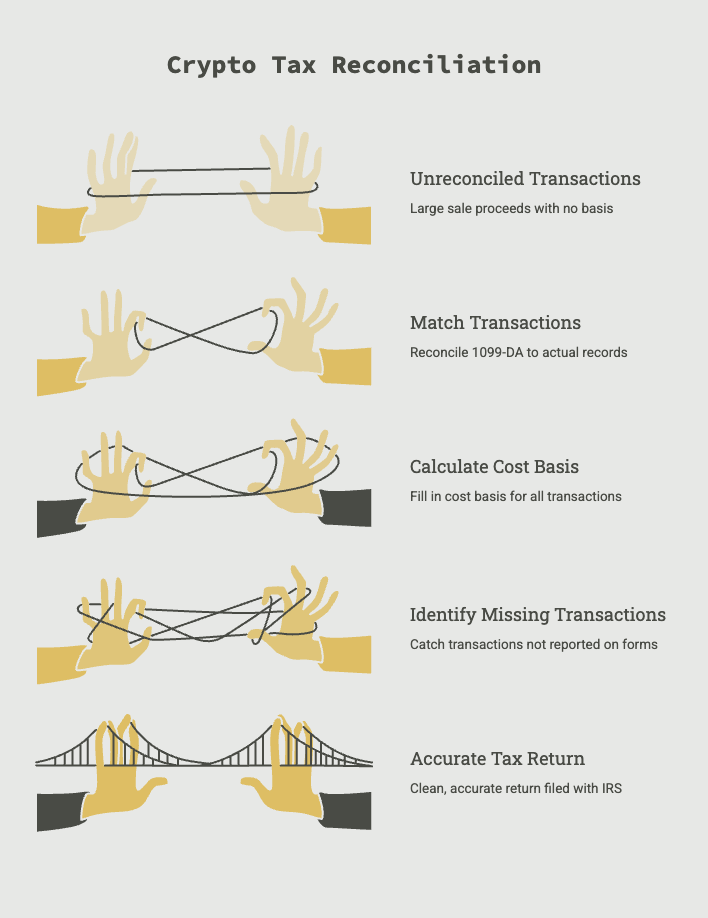
You compare each line on the 1099-DA to your records, add the basis the exchange left blank, and make sure nothing is double-counted or missing before it lands on your return.
The data flows to the same place your stock sales do.
Each sale reported on Form 1099-DA goes on Form 8949, then the totals carry to Schedule D of your Form 1040, which is where your capital gains and losses come together on your federal tax return. Report on Form 8949 the proceeds and basis for each sale, and the amount of tax follows from the gain. For each transaction you show the proceeds, your basis, and the resulting gain or loss, exactly as you would for a stock. Since the IRS treats crypto as property, every disposition counts, including crypto-to-crypto swaps, and cashing out to dollars is only one kind. Trading one token for another is a taxable event, reported at fair market value.
Accuracy here is what keeps you out of trouble.
When you accurately report your crypto transactions and reconcile the amount of crypto you sold to the form, your return matches what the IRS received, and it lets you report capital gains or losses that hold up. Getting the basis right is what turns a scary-looking form into the small gain it usually represents. The broader rules for how crypto is taxed as property are worth a refresher, and we cover them in our guide to crypto tax for businesses.
No form does not mean no tax, and this is where people get into trouble.
If you traded on a decentralized exchange, used a self-custody wallet, or sold on a platform that did not provide custodial reporting, you may never receive a Form 1099-DA. You still have to report those sales or exchanges of digital assets. The IRS requires you to report every taxable sale or exchange of digital assets, whether or not a broker sent a form. You still need to report digital asset sales and any losses from digital asset trades, and many states tax them too, so state tax can apply to certain transactions even when no federal form arrives. Report the transactions, report gains and losses honestly, and keep the records that back them up.
The safest habit is to track everything as you go.
Waiting until tax season to reconstruct a year of trades across several wallets is painful, and it is where errors and missed cost basis creep in.
For a CPA firm, the arrival of this form turned crypto from a side conversation into a real reconciliation project.
Clients now bring in forms showing large sale proceeds with no basis, spread across many exchanges and wallets, and someone has to match all of it to actual records before it hits a return. That work, reconciling the 1099-DA, filling in cost basis, and catching the transactions no form ever reported, is detailed and high-volume, exactly the kind of task an offshore team handles well. At Madras Accountancy, we help U.S. CPA firms reconcile digital asset transactions, complete the tax preparation around them, and help investors avoid mistakes that trigger IRS notices.
A good tax pro also knows the rules for digital assets change fast, and what you need to file this year may differ next year. The goal is a clean, accurate return.
Match the form to the records, report every sale, and make sure the gain that shows up is the real one, not the inflated number a basis-free form implies.
What is Form 1099-DA? Form 1099-DA, Digital Asset Proceeds From Broker Transactions, is an IRS information return that brokers use to report a taxpayer's sales of certain digital assets. It is tax information, not a tax credit or a bill. It started with digital asset sales in that year, and exchanges send it to you and the IRS beginning in early 2026. It works like Form 1099-B does for stocks.
Who has to issue the form? Custodial brokers issue it, mainly centralized cryptocurrency exchanges and digital asset payment processors that hold your crypto and know your identity. Decentralized platforms and self-custody wallets were left out of the initial rollout, so they generally do not send one.
Does Form 1099-DA report cost basis? For 2026 transactions, no. Brokers are only required to report proceeds for the 2026 tax year. Basis reporting begins for covered digital assets acquired on or after January 1, 2026, so until then you supply your own when you report.
How do I report the form on my tax return? You report each sale on Form 8949 and carry the totals to Schedule D of your Form 1040. For every transaction you list the proceeds, your basis, and the gain or loss, then reconcile those figures against your own records before filing.
What if my form does not show cost basis? You add it yourself from your records on your 2026 tax return. Without that figure, the form makes your proceeds look like pure gain, which overstates your tax. Enter the amount you originally paid on Form 8949 so your reported gain reflects what you actually made.
Do I owe tax if I never receive a Form 1099-DA? Yes. You must report every sale or exchange of digital assets whether or not a broker sends you a form. Trades on decentralized exchanges, self-custody wallets, or some non-U.S. platforms often will not generate one, but the gains still count.
Is a crypto-to-crypto trade reported? Yes. The IRS treats a crypto-to-crypto swap as a taxable disposition at fair market value, and a custodial exchange reports it as a sale on Form 1099-DA. You report the gain or loss just as you would for selling crypto for dollars.
How is Form 1099-DA different from Form 1099-B? Form 1099-B reports proceeds from stocks and other securities, while Form 1099-DA reports proceeds from digital asset sales. They serve the same purpose in parallel, and the digital asset version phases in cost basis reporting a year after gross proceeds.
Section 4960's 21% excise tax now reaches far more nonprofit employees. See who is a covered employee in 2026 and what changed.

The Section 45S paid family leave credit is permanent for 2026 with new options. See who qualifies, the amounts, and how to claim it.

Opportunity zones become permanent in 2027 under the One Big Beautiful Bill. See the new deferral, rural bonus, and the 2026 handoff.